


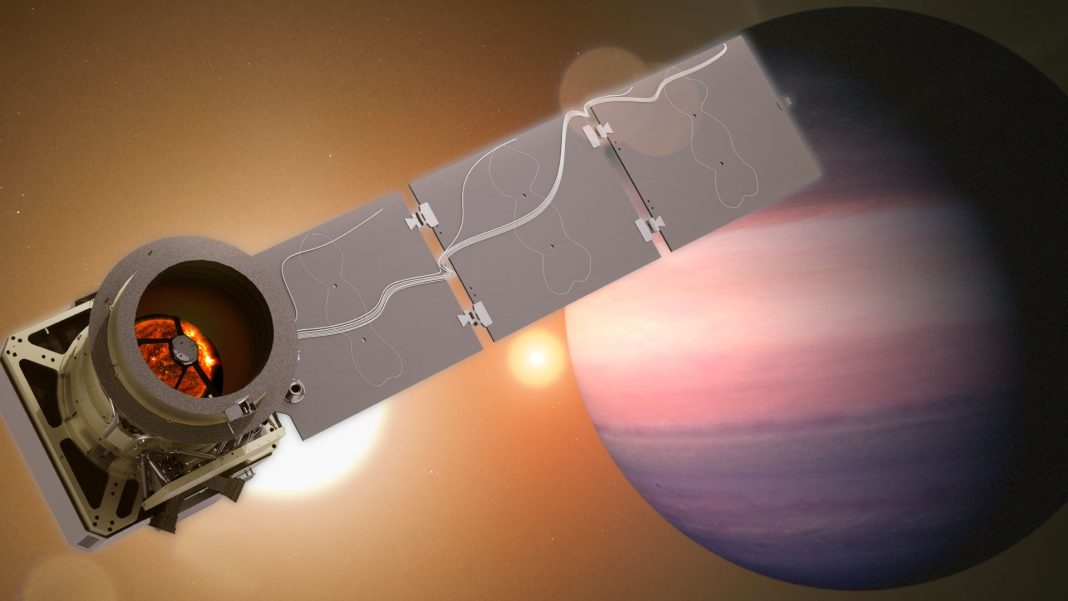
The universe, vast and mysterious, has always called to us. For centuries, we’ve gazed up at the night sky, wondering what other worlds might exist beyond our own. Soon, a monumental step in answering that age-old question will launch from Earth, carrying our hopes and scientific aspirations far into the cosmos. Get ready to witness history in the making as SpaceX prepares to send NASA’s Pandora mission on its crucial quest: to hunt for exoplanets and unravel the secrets of their atmospheres.
Pandora: Peering into Alien Atmospheres
Imagine a world where the sky isn’t blue, but perhaps an iridescent violet, or a swirling crimson. What if alien winds carried not oxygen, but methane, or even exotic compounds we can barely conceive? This isn’t science fiction; it’s the very frontier Pandora is designed to explore. Named not for the mythical box of woes, but for its potential to unlock cosmic wonders, Pandora is an innovative small satellite mission focused on a revolutionary task: characterizing the atmospheres of exoplanets.
While missions like Kepler and TESS have masterfully identified thousands of distant worlds, Pandora steps in to provide a deeper understanding. Its instruments are finely tuned to observe these exoplanets as they transit, or pass in front of, their host stars. During these transits, a tiny sliver of the star’s light filters through the exoplanet’s atmosphere, and Pandora will meticulously analyze this light. By studying the spectral fingerprints left by various gases, scientists can deduce the chemical composition of these alien skies.
Why is this so critical? Understanding atmospheric composition is a fundamental step in assessing a planet’s potential for habitability. It helps us understand planet formation, evolution, and crucially, gives us clues in the ongoing search for life beyond Earth. Whether these atmospheres are thick or thin, rocky or watery, Pandora promises to pull back the cosmic veil, offering an unprecedented look at worlds millions of miles away.
SpaceX & NASA: A Collaborative Cosmic Journey
The journey to deciphering alien atmospheres begins right here on Earth, riding atop a marvel of modern engineering. This mission marks another exciting collaboration between NASA and SpaceX, with a Falcon 9 rocket slated to deliver Pandora into orbit. SpaceX’s relentless pursuit of reusability and efficiency has transformed access to space, making complex scientific endeavors like Pandora more feasible and frequent.
The Falcon 9, known for its powerful thrust and graceful landings, embodies a new era of space exploration where commercial innovation propels scientific discovery. This partnership exemplifies how government agencies and private enterprise can converge to push the boundaries of human knowledge, accelerating our understanding of the universe.
As the countdown draws nearer, the anticipation builds. “This mission isn’t just about finding distant worlds; it’s about understanding our place in the universe by seeing how diverse planetary systems truly are,” says Dr. Anya Sharma, a lead scientist on the Pandora project. “Every bit of data Pandora sends back will rewrite textbooks and inspire a new generation of explorers.” The synergy between NASA’s scientific vision and SpaceX’s launch capabilities is truly a testament to humanity’s collective ambition to explore the unknown.
A Glimpse into Tomorrow’s Discoveries
The launch of Pandora isn’t just another rocket soaring skyward; it’s a beacon of our unwavering curiosity. It represents humanity’s persistent drive to understand not just what’s out there, but how it all came to be. The data Pandora collects will provide invaluable insights for years to come, feeding future missions and deepening our cosmic perspective. It’s a vivid reminder that the universe is an endless canvas of discovery, and with each launch, we paint another stroke on our understanding of it. Prepare to be amazed as we send Pandora forth to unlock the secrets of alien skies.

