


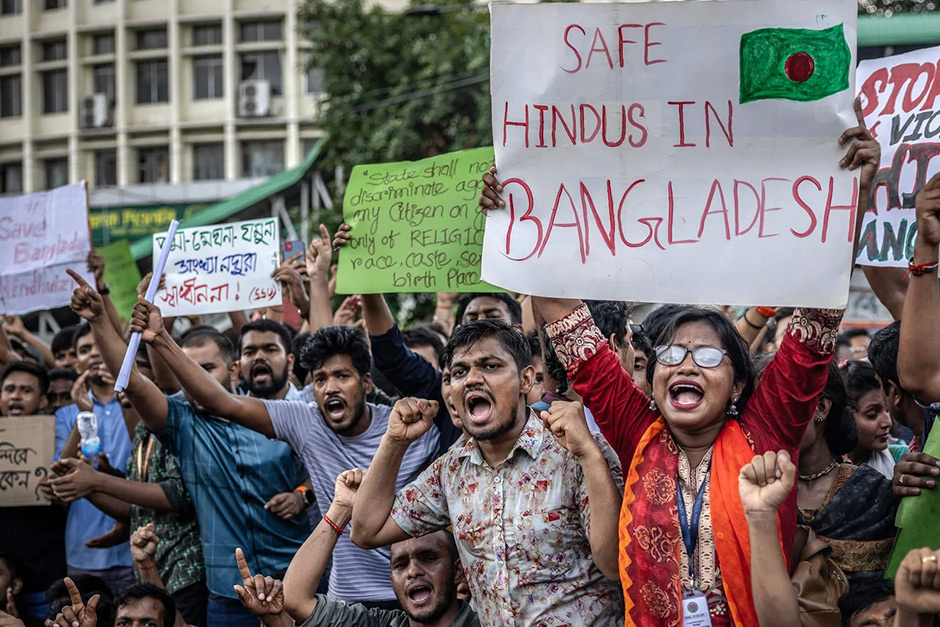
A groundswell of anger and concern recently culminated in Dhaka, where a prominent Hindu organization took to the streets, demanding urgent government intervention and justice for the alarming rise in violence against minority communities. The protest, spearheaded by the Bangladesh Hindu Mahajot, focused sharply on recent incidents of targeted lynchings and persecution, sending a clear message to authorities that the safety and rights of minorities cannot be overlooked. This development has resonated deeply across the border in India, where historical ties and shared cultural heritage ensure that the plight of minorities in Bangladesh remains a significant point of discussion and concern.
Protestors Demand Accountability and Protection
The streets around Dhaka’s National Press Club witnessed a significant turnout as members and supporters of the Bangladesh Hindu Mahajot gathered, holding placards and chanting slogans for justice. The protest specifically highlighted a series of incidents that have deeply unsettled the Hindu community. Among the most egregious were the alleged lynchings of individuals in various districts, often stemming from land disputes, accusations of blasphemy, or communal flare-ups that escalate rapidly. Activists recounted instances where homes were vandalized, businesses looted, and individuals brutally attacked, leading to fatalities in some cases.
Speakers at the rally underscored a perceived lack of decisive action from the authorities, often citing slow investigations and insufficient protection measures. They emphasized that while the Bangladeshi government often condemns such incidents, the practical implementation of justice and prevention remains a challenge. The protestors called for the immediate arrest and prosecution of perpetrators, swift compensation for victims, and the establishment of dedicated judicial mechanisms to handle cases of minority persecution. Furthermore, a key demand was for the government to take a proactive stance against extremist elements and propaganda that often fuels communal tensions, demanding a society where all citizens, irrespective of their faith, can live with dignity and security.
During the impassioned demonstration, a spokesperson for the Bangladesh Hindu Mahajot articulated the community’s deep-seated anguish. Goutam Kumar Saha, a senior leader, stated, “We are tired of mere condemnations. Our homes are attacked, our temples desecrated, and our people are being lynched. Where is the justice? We demand concrete action, not just assurances. The government must ensure that minorities in Bangladesh feel safe and protected, and that those who perpetuate this violence are brought to swift justice.” His words encapsulated the frustration felt by many, urging the Bangladeshi government to move beyond rhetoric and implement tangible measures for minority protection.
Echoes Across the Border: India’s Deepening Concern
The events unfolding in Bangladesh inevitably draw significant attention in India, a nation with whom Bangladesh shares not just a vast border but also a complex history and deep cultural linkages. News of targeted violence against Hindu minorities in Bangladesh often creates ripples of concern across Indian society and political circles. Several Indian social and political organizations have historically voiced their alarm over the safety of Hindus, Buddhists, and Christians in Bangladesh, urging both governments to address the issue collaboratively.
From an Indian perspective, the protection of minorities in its neighbouring countries is often seen as a matter of human rights, regional stability, and sometimes, a domestic political issue. Indian media outlets frequently cover these incidents, framing them within the broader narrative of India’s role in safeguarding the interests of its cultural and religious kin abroad. The recurring nature of these attacks has also led to calls from various Indian groups for more robust diplomatic engagement with Dhaka to ensure the safety and well-being of its minority populations.
While the Indian government maintains cordial relations with Bangladesh, incidents of minority persecution inevitably become a point of discussion. The delicate balance involves respecting Bangladesh’s sovereignty while expressing legitimate concerns about human rights. The protests in Dhaka serve as a potent reminder of the ongoing challenges faced by minority communities in the region and underscore the continuous need for vigilance, strong governance, and cross-border cooperation to foster an environment of peace and mutual respect.
The recent protest in Dhaka is a stark reminder of the persistent struggle for justice and security faced by minority communities in Bangladesh. The demands for accountability, protection, and an end to impunity resonate deeply, especially in India, given the intertwined histories and populations of the two nations. As the international community increasingly focuses on human rights, the world watches to see how Bangladesh will address these critical issues, ensuring that its diverse population can thrive in safety and equality.

