


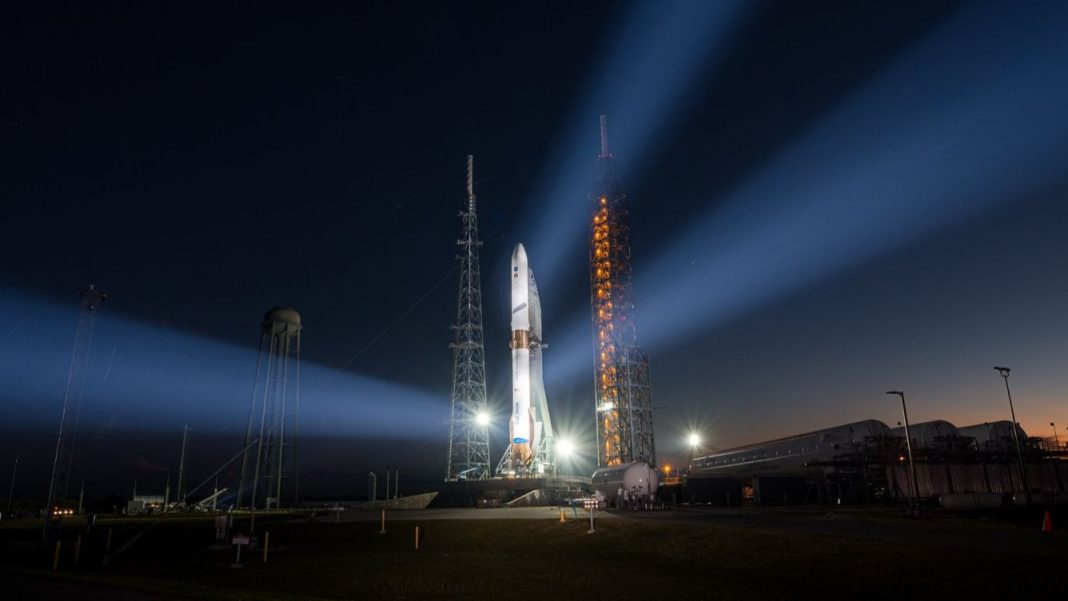
The landscape of space exploration is witnessing a pivotal moment, as a new generation of powerful rockets takes center stage. Today marks a significant occasion with Blue Origin’s impressive New Glenn rocket poised to launch NASA’s innovative ESCAPADE mission on its journey to Mars. This event combines the debut of a highly anticipated heavy-lift launch vehicle with a critical scientific endeavor aimed at unraveling the Red Planet’s atmospheric mysteries. It’s a testament to the evolving collaboration between commercial space ventures and national space agencies, pushing the boundaries of what’s possible in deep space exploration.
Unveiling New Glenn: Blue Origin’s Heavy Lifter
Blue Origin, founded by Jeff Bezos, has been steadily working towards its vision of space access, and New Glenn represents a monumental leap in that direction. Named after pioneering astronaut John Glenn, this two-stage heavy-lift orbital launch vehicle stands as a formidable new entrant in the commercial space market. Its most defining characteristic is the reusable first stage, designed to land vertically back on Earth after launch, similar to Blue Origin’s suborbital New Shepard rocket. This reusability is a cornerstone of Blue Origin’s philosophy, aiming to significantly reduce the cost of spaceflight and enable more frequent access to orbit and beyond.
The rocket is powered by Blue Origin’s BE-4 engines, which use liquid oxygen and liquefied natural gas (LNG) propellants. These engines are not only powerful but also designed for reliability and efficiency. New Glenn is engineered to deliver substantial payloads to various orbits, including geosynchronous transfer orbit (GTO) and even trans-lunar and trans-Mars injection trajectories. Its considerable lift capability makes it an ideal choice for ambitious missions like ESCAPADE, showcasing how next-generation private rockets are opening new avenues for scientific discovery and human expansion into the cosmos.
ESCAPADE: Unlocking Mars’ Atmospheric Secrets
NASA’s ESCAPADE (Escape and Plasma Acceleration and Dynamics Explorers) mission is far from a typical Mars orbiter. Instead of a single large spacecraft, ESCAPADE comprises two identical, small spacecraft designed to work in tandem. Their primary objective is to study Mars’ unique magnetosphere and its interaction with the solar wind, providing crucial insights into how the Red Planet has lost much of its atmosphere and water over billions of years. By observing Mars from two distinct viewpoints simultaneously, scientists can gain a more comprehensive, three-dimensional understanding of these complex processes.
The mission will investigate the structure and dynamics of Mars’ magnetosphere, focusing on the mechanisms responsible for atmospheric escape – the process where charged particles from the solar wind strip away atmospheric gases. Understanding this atmospheric loss is vital for piecing together Mars’ climatic history and assessing its past potential for habitability.
“ESCAPADE offers a unique dual perspective on Mars’ atmospheric loss, something previous single-probe missions couldn’t achieve,” commented Dr. Anya Sharma, a planetary scientist. “It’s crucial for understanding how planets lose their water and potential for life, lessons that extend far beyond Mars itself.” This innovative approach promises to deliver invaluable data that will refine our models of planetary evolution, not just for Mars, but for exoplanets as well.
A New Era for Deep Space Launches
The selection of New Glenn for a high-profile NASA mission like ESCAPADE underscores a broader trend in space exploration: the increasing reliance on commercial launch services for even the most critical scientific endeavors. This partnership exemplifies how government agencies are leveraging the innovation and capabilities of the private sector to achieve their ambitious goals. For Blue Origin, launching a deep-space NASA mission validates years of development and positions New Glenn as a trusted platform for future complex missions, from satellite deployment to crewed flights and lunar cargo deliveries.
This collaboration not only fosters competition and innovation within the space industry but also potentially frees up NASA’s resources for other research and development. The successful launch of ESCAPADE on New Glenn would be a powerful demonstration of this synergy, marking a new chapter where commercial launch providers are integral to humanity’s quest to explore and understand the solar system.
As the countdown proceeds, the launch of New Glenn carrying NASA’s ESCAPADE mission represents more than just a rocket ascent. It symbolizes the dawn of a new era in space exploration, one characterized by powerful new vehicles, innovative scientific approaches, and dynamic partnerships. The journey to Mars is long and challenging, but with each successful launch, humanity moves a step closer to unlocking the universe’s many secrets and perhaps, in time, extending our presence beyond Earth.

