


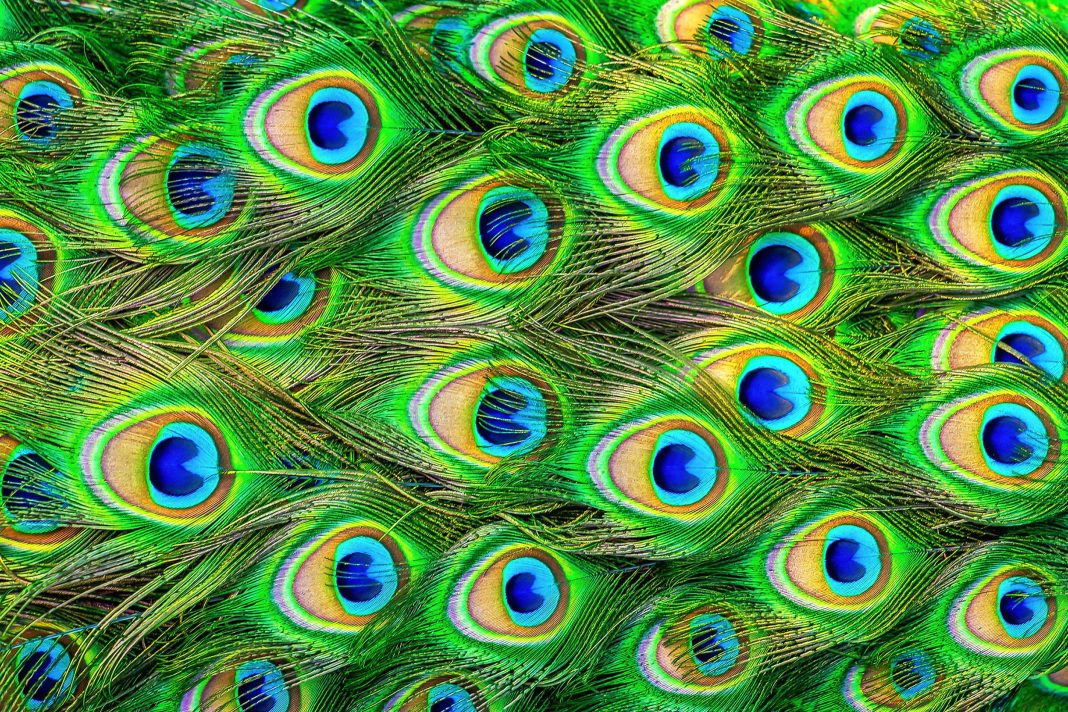
The phrase “peacock feathers” usually conjures images of vibrant iridescence, courtship displays, and perhaps even a little myth and magic. But what if we told you that these dazzling natural ornaments might possess an optical property previously thought to be exclusive to advanced human technology? Recent scientific exploration has illuminated a startling discovery: under specific conditions, the intricate structures within peacock feathers appear to exhibit a phenomenon akin to laser emission. Yes, you read that correctly – an animal kingdom first that’s redefining our understanding of natural physics.
The Brilliant Blueprint: How Peacock Feathers Manipulate Light
To grasp this groundbreaking revelation, we first need to appreciate the true genius behind a peacock’s display. Unlike most birds whose colors come from pigments, a peacock’s extraordinary hues are almost entirely structural color. This means the color isn’t in the feather’s chemical makeup, but in its physical structure. Imagine microscopic, precisely arranged lattices within each barbule of the feather. These nanostructures act like photonic crystals, interacting with light waves in incredibly sophisticated ways.
When white light hits these structures, certain wavelengths are reflected, while others are absorbed or transmitted. The angle at which you view the feather, and even the angle of the light source itself, changes the perceived color, creating that iconic shimmer and shifting brilliance. It’s an evolutionary marvel of light manipulation, designed to attract mates and intimidate rivals without expending energy on producing complex pigments.
From Iridescence to “Lasing”: A New Optical Frontier
The leap from structural color to “laser-like” emission is where the story gets truly intriguing. While peacocks aren’t naturally firing beams of light across the forest, researchers have discovered that their feathers possess an inherent ability for stimulated emission. In the world of optics, stimulated emission is the fundamental principle behind lasers: when excited, an atom or molecule can be prompted by an incoming photon to emit an identical photon, effectively amplifying the light.
In the case of peacock feathers, scientists have found that the precise, ordered architecture of the photonic crystals can, when externally stimulated by another light source, amplify specific wavelengths of light and emit them directionally. This isn’t a powerful, destructive laser beam, but rather a demonstration of a natural biological structure capable of coherent light amplification – a cornerstone of laser technology. It’s an astonishing natural analogue to engineered optical systems.
“It’s like nature designed its own microscopic optical amplifier,” remarked Dr. Anya Sharma, a materials scientist following the research. “This finding doesn’t mean peacocks are weaponizing their tail feathers, but it fundamentally shifts our understanding of advanced optics in living organisms. It’s an elegant example of evolutionary engineering.”
This discovery marks a profound moment, representing the first time such an advanced optical property has been identified in a naturally occurring biological system. It opens up a myriad of questions about how widespread these capabilities might be in the natural world and what evolutionary pressures might have led to their development.
Beyond the Glow: Implications and Inspiration
While the image of a peacock shooting laser beams remains firmly in the realm of science fiction, the scientific implications of this discovery are very real. Understanding how these biological structures achieve such sophisticated light manipulation could inspire new breakthroughs in biomimetics, leading to the development of novel optical materials, ultra-efficient sensors, or even new forms of display technology that are more sustainable and energy-efficient. Imagine paints or coatings that can dynamically change color and emit light based on their structure, or medical imaging devices inspired by a feather’s design.
This unprecedented insight into the peacock feather reminds us that the natural world is an unending source of wonder and innovation. What we perceive as mere beauty often hides layers of intricate, advanced physics, constantly challenging our assumptions about what is possible outside the laboratory. The next time you see a peacock’s mesmerizing display, remember: you’re not just witnessing beauty; you’re seeing a masterclass in natural optical engineering, with secrets still unfolding.

