


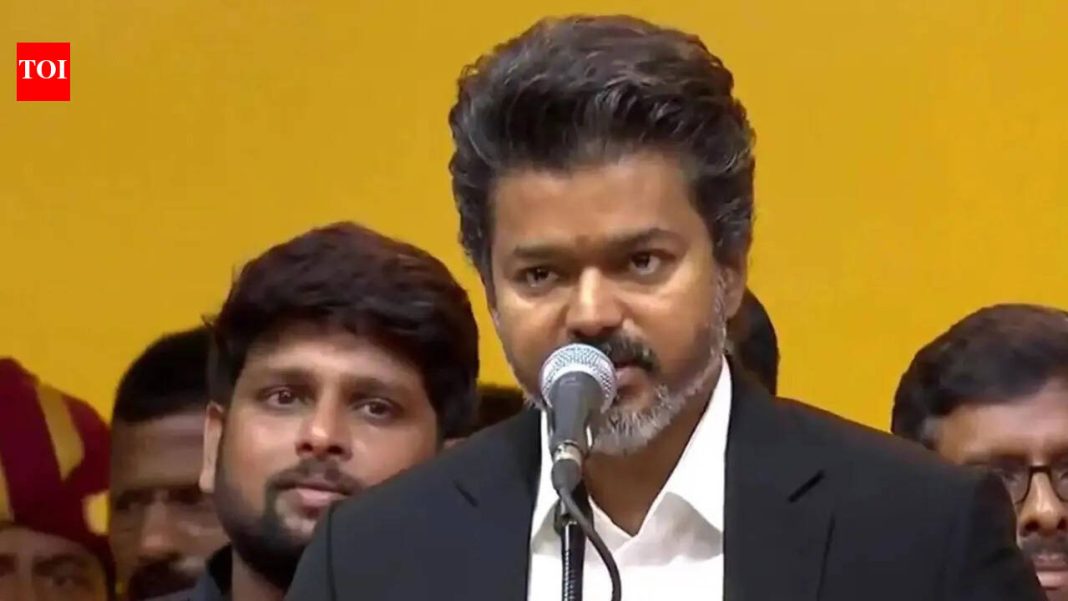
Tamil Nadu’s political landscape, long defined by its Dravidian giants and cinematic crossovers, appears poised for another significant recalibration. The recent, meticulously orchestrated event by actor Vijay, honouring students who scored high marks in board examinations, has sent ripples across the state, prompting observers to question whether this marks a fundamental shift in the regional political discourse. Dubbed a potential ‘rewriting of Tamil Nadu’s political grammar’ by some, the event was more than just a felicitation; it was a carefully choreographed statement of intent, meticulously crafted to resonate beyond the traditional political rhetoric.
Beyond the Silver Screen: A Direct Connect
The event itself was a masterclass in strategic communication, eschewing the bombast of traditional political rallies for a more refined, direct engagement. Instead of addressing a cheering throng from a distant podium, Vijay sat among the meritorious students, engaging them personally and emphasising the paramount importance of education. He urged them to read about national leaders, vote wisely, and question conventional narratives. This approach signals a departure from the typical celebrity-driven political entry, often characterised by grand speeches and immediate policy pronouncements.
What makes Vijay’s move particularly noteworthy is the leveraging of his colossal fan base. Unlike newly formed political parties that struggle to build grassroots structures, Vijay Makkal Iyakkam (VMI) boasts a disciplined, organised network of fan clubs across the state. These clubs, historically involved in social welfare activities, seamlessly transformed into a logistical backbone for the event, managing everything from student identification to venue coordination. This ready-made cadre, built organically over decades, provides a significant advantage, potentially bypassing the arduous process of establishing party machinery from scratch.
Navigating Tamil Nadu’s Actor-Politician Legacy
Tamil Nadu has a storied history of actors successfully transitioning into politics, with stalwarts like M.G. Ramachandran (MGR) and J. Jayalalithaa dominating the political stage for decades. Even recent aspirants like Kamal Haasan have attempted to carve a niche, while Rajinikanth’s anticipated entry generated immense speculation before being shelved. Vijay’s foray, therefore, isn’t an anomaly, but rather an evolution within a well-established tradition. However, his method seems to be forging a new path.
While MGR and Jayalalithaa leveraged their on-screen personas depicting saviours and strong leaders, often translating that into real-life political narratives, Vijay appears to be cultivating a more understated, thoughtful persona. His focus on education and social responsibility, rather than fiery rhetoric or populist promises, attempts to position him as a leader concerned with foundational societal upliftment. “Vijay’s strategy seems to be a slow burn, building credibility through sustained social engagement rather than an explosive launch,” observes Dr. K. Annamalai, a Chennai-based political analyst. “He’s learning from the past, not merely repeating it, and appealing to a segment of the electorate seeking fresh alternatives beyond traditional Dravidian politics.” This measured approach suggests a recognition of the complexities of modern Tamil Nadu politics, where charisma alone may no longer suffice.
The Road Ahead: Challenges and Opportunities
Despite the strategic prowess displayed, the road ahead for Vijay is fraught with challenges. Tamil Nadu’s political landscape is deeply entrenched, dominated by the DMK and AIADMK, both with formidable vote banks and established organizational structures. Vijay will need to articulate a clear ideological stance beyond his current focus on education, addressing complex issues ranging from economic development to social justice, and navigating the state’s intricate caste and community dynamics. Building trust and convincing a diverse electorate of his political capability, not just his cinematic appeal, will be paramount.
Yet, opportunities abound. A palpable yearning for alternative leadership exists among certain sections of the populace, particularly the youth who might be disillusioned with established parties. Vijay’s clean image and massive fan following could tap into this sentiment. His consistent focus on specific social themes also allows him to carve out a distinct identity, potentially positioning himself as a leader focused on foundational issues rather than mere electoral gains. The coming months will reveal whether this carefully constructed political grammar can translate into meaningful electoral success, or if it remains an interesting, yet ultimately ephemeral, footnote in Tamil Nadu’s dynamic political history.

