


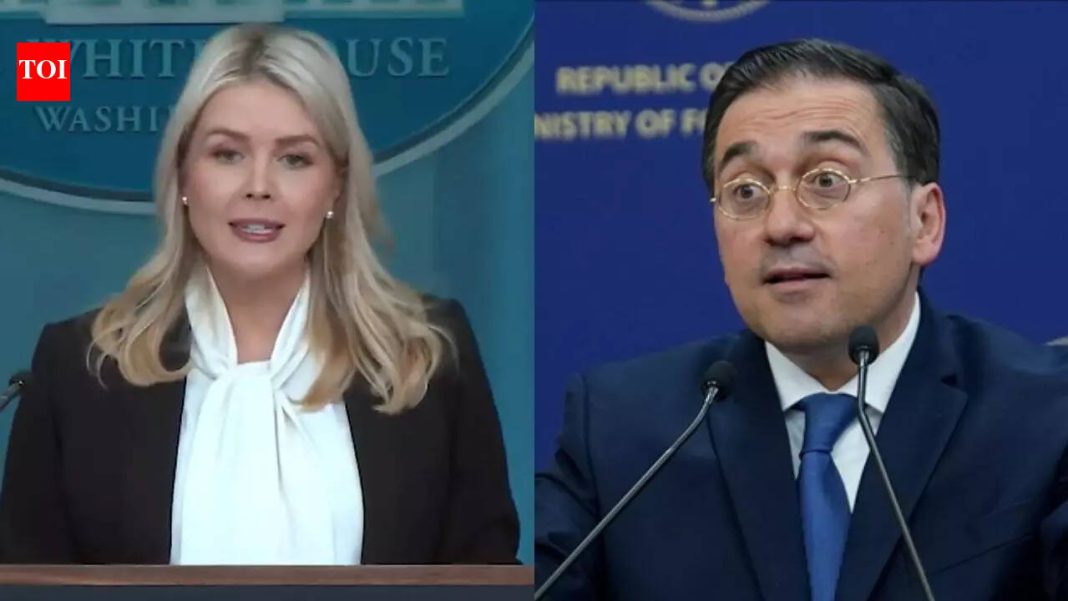
A curious diplomatic friction has emerged between two long-standing allies, the United States and Spain, over claims of enhanced military cooperation. The White House recently asserted that Spain had ‘agreed to cooperate with the U.S. military,’ a statement swiftly and unequivocally denied by Spain’s foreign minister. This public disagreement highlights the delicate balance of alliances, national sovereignty, and communication in global diplomacy, a dynamic keenly observed from India’s perspective on the evolving international order.
The White House Claim vs. Madrid’s Denial
The genesis of this diplomatic spat lies in a statement released by the White House following a meeting between U.S. President Joe Biden and Spanish Prime Minister Pedro Sánchez. The statement, issued by the National Security Council (NSC), notably mentioned that the two leaders “welcomed Spain’s agreement to cooperate with the U.S. military as Spain prepares to assume the Presidency of the Council of the European Union, reaffirming our shared commitment to regional stability and collective defense.” This sentence immediately raised eyebrows in Madrid.
Spain’s Foreign Minister, José Manuel Albares, wasted no time in refuting the American claim. Speaking publicly, Albares stated, “Spain has not agreed to cooperate with the U.S. military. We have a solid and long-standing bilateral relationship with the United States, and we are strong allies within NATO, but there is no such agreement beyond our existing frameworks.” He underscored that while discussions on various aspects of security cooperation are ongoing, particularly in the context of Spain’s upcoming EU presidency and its existing commitments as a NATO member, no new, specific agreement of the nature described by the White House had been reached. This strong denial indicates either a significant communication breakdown or a strategic misinterpretation of ongoing dialogues by one side.
The US maintains a notable military presence in Spain, including naval bases like Rota, which is a crucial hub for the U.S. Sixth Fleet. Therefore, “cooperation” in a general sense is an ongoing reality. However, the phrasing “agreement to cooperate” implies a new, formal understanding or an expansion of existing arrangements, which Spain evidently believes is not the case. The incident casts a spotlight on the meticulous wording required in international statements and the potential for missteps, even between close allies.
Geopolitical Context and Alliance Dynamics
This diplomatic friction unfolds against a backdrop of heightened geopolitical tensions, particularly in Europe. The ongoing conflict in Ukraine has spurred NATO members, including Spain, to reassess their defense capabilities and deepen security cooperation. The U.S. has been at the forefront of rallying European support and strengthening military alliances to counter perceived threats. From Washington’s vantage point, perhaps the White House statement was an attempt to signal reinforced transatlantic unity and Spain’s commitment to broader security initiatives, potentially ahead of its EU presidency, where it could play a pivotal role in European defense policy.
However, for Spain, explicitly agreeing to “cooperate with the U.S. military” outside of established NATO channels or existing bilateral accords might carry different implications. Madrid, while a committed NATO member, also navigates its foreign policy with a keen eye on its own strategic autonomy and regional partnerships within the EU. An unplanned public announcement of such an agreement could be seen as circumventing parliamentary oversight or even undermining Spain’s independent foreign policy posture. The pushback from Minister Albares demonstrates a clear intent to manage perceptions and maintain control over Spain’s narrative regarding its international commitments.
This incident underscores the complexities of modern alliance management. While the U.S. often seeks to consolidate support and project a unified front, smaller allies like Spain are equally keen to define the terms of their engagement, ensuring that their sovereignty and diplomatic processes are respected. The exact nature of the discussions that led to the White House’s claim remains unclear, but the public disagreement highlights the need for precise communication and mutual understanding, especially in sensitive military and defense matters.
An Indian Perspective on Diplomatic Nuances
From an Indian perspective, such a diplomatic imbroglio between major global powers and their allies offers valuable insights into the intricate dance of international relations. India, historically a proponent of non-alignment and now increasingly advocating for strategic autonomy, watches keenly how established alliances evolve and manage internal disagreements. The pushback from Spain against a seemingly assertive statement from a powerful ally like the U.S. resonates with India’s own emphasis on national interests and independent decision-making in its foreign policy pursuits.
For New Delhi, observing these dynamics reinforces the importance of clear, unambiguous communication and respecting the sovereign decisions of all nations, regardless of their relative power. While India has significantly deepened its strategic partnership with the U.S. in recent years, particularly in defense and technology, it consistently emphasizes a multi-aligned approach rather than exclusive alliances. The Spain-U.S. episode serves as a reminder that even the closest of allies can encounter friction when it comes to defining the scope and nature of their cooperation, especially when statements are made without complete consensus or prior diplomatic clearance. It illustrates the ongoing challenge of balancing collective security with individual national prerogatives on the global stage.
The swift denial by Spain’s foreign minister signals a firm assertion of national sovereignty and diplomatic protocol. While the U.S. and Spain are undoubtedly strong partners, this incident reveals the need for meticulous coordination and respect for each nation’s internal processes, even in what might seem like routine declarations of cooperation. The coming days will likely see further diplomatic exchanges to clarify the misunderstanding and ensure that this public friction does not lead to a lasting chill in an otherwise robust bilateral relationship.

