


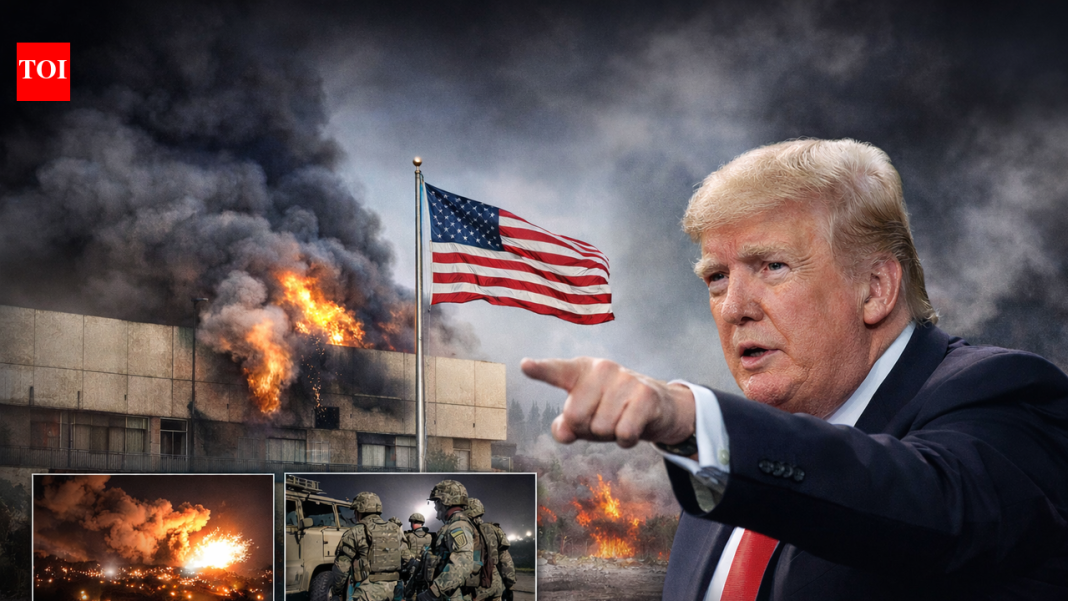
The Middle East, a crucible of geopolitical tension, finds itself once again under the intense global spotlight following a series of highly unusual moves by the United States. Reports confirm the closure of three US embassies in Gulf nations and an urgent directive to American citizens to leave the broader Middle East region. This unprecedented diplomatic shift, coupled with the unpredictable nature of former President Donald Trump’s past foreign policy decisions, has ignited a flurry of speculation: is the US preparing for a significant move, and is Donald Trump, a potential future leader, signalling something big? For India, a nation with deep strategic and economic ties to the region, these developments warrant close attention.
Unprecedented Diplomatic Measures and Travel Advisories
The recent announcements from Washington have sent ripples through international diplomatic circles. The US State Department confirmed the temporary closure of its diplomatic missions in Bahrain, Kuwait, and Qatar, citing unspecified but “elevated security concerns.” Concurrently, a wider travel advisory has been issued, urging all non-essential American personnel and citizens to consider immediate departure from several Middle Eastern countries. This advisory isn’t merely a caution; it carries an unusual urgency, advising Americans to “maintain a high level of vigilance” and “depart commercial means as soon as possible.”
Such comprehensive closures and widespread evacuation advisories are not routine. They typically precede or accompany periods of extreme geopolitical instability or imminent threats. While official statements from the US government have remained deliberately vague about the precise nature of the threats, the gravity of the measures suggests a credible and pressing concern for the safety of American nationals and diplomatic staff.
For India, the stability of the Gulf region is paramount. Millions of Indian expatriates reside and work across these nations, contributing significantly to both the Indian economy through remittances and the host nations’ economies. Any major disruption, whether diplomatic or security-related, has immediate and profound implications for their safety and livelihoods, potentially triggering complex evacuation scenarios that India has managed in the past.
The Trump Factor: Speculation and Geopolitical Ramifications
The timing of these events, against the backdrop of an impending US presidential election and Donald Trump’s prominent role, inevitably fuels a unique brand of speculation. Trump’s foreign policy during his presidency was marked by a readiness to challenge established norms, engage in direct confrontation, and often employ brinkmanship. His “America First” approach led to significant shifts in US engagement with global issues, particularly in the Middle East.
The question on many minds is whether these diplomatic actions are purely a precautionary measure by the current administration, or if they hint at a more assertive, perhaps even confrontational, US posture that aligns with a potential future Trump administration’s agenda. Some analysts suggest that a protective withdrawal of personnel could be a prelude to a more aggressive diplomatic or even military action targeting specific adversaries in the region, particularly Iran, a long-standing flashpoint.
“This isn’t just routine security posturing,” commented Dr. Priya Sharma, a geopolitical analyst based in New Delhi. “The broad scope of the advisory and the specific embassy closures suggest a significant intelligence assessment of a looming threat or, equally plausible, a deliberate de-escalation of US presence ahead of a decisive policy shift. The shadow of past Trump-era unpredictability certainly adds to the current uncertainty.”
Conversely, others argue that these measures could also be interpreted as an overreaction to intelligence that, while concerning, may not necessarily point to immediate kinetic action. Regardless, the perception of increased US assertiveness or a willingness to take unilateral action could destabilise an already fragile region, impacting global energy markets, shipping lanes, and international trade—all areas where India has substantial interests. India’s nuanced foreign policy seeks to maintain strong relationships with all stakeholders, making regional escalation a complex challenge.
Conclusion: Navigating a Shifting Geopolitical Landscape
The closure of three US Gulf embassies and the sweeping travel advisories underscore a palpable increase in tension across the Middle East. While the precise reasons remain officially undisclosed, the implications are far-reaching. Whether these actions are a defensive maneuver against an imminent threat, a strategic withdrawal preceding a bold foreign policy move, or simply a heightened state of caution, the world is watching closely.
For nations like India, which are deeply intertwined with the economic and demographic fabric of the Middle East, monitoring these developments is crucial. The stability of this region is not merely a foreign policy concern but a direct determinant of India’s energy security, trade routes, and the well-being of its vast diaspora. As the situation unfolds, clarity on US intentions will be vital for global stability and for countries like India to effectively navigate an increasingly complex geopolitical landscape.
*

