


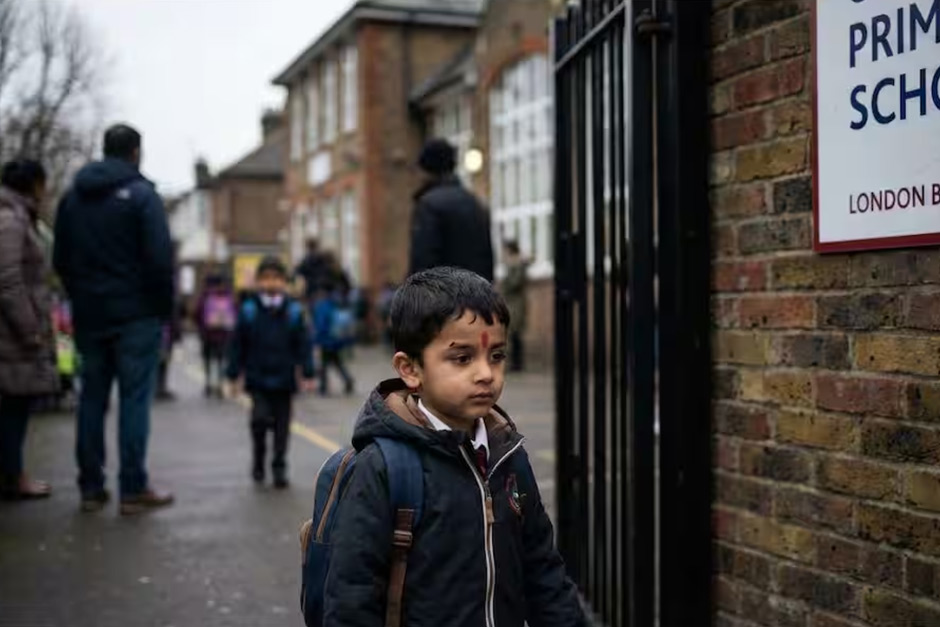
A recent incident in London has brought the delicate balance between religious freedom, cultural identity, and educational policies into sharp focus, reverberating through the Indian diaspora and sparking discussions back home. Hindu parents in the UK capital have reportedly removed their five-year-old son from a primary school following a dispute over the child wearing a tilak (a sacred mark) to class. This decision underscores the persistent challenges faced by minority communities in preserving their cultural and religious practices within a predominantly secular or different-cultural framework.
The Incident Unfolds: A Cultural Stand-off in London
The controversy emerged from St Stephen’s Primary School in East Ham, London, where a young Hindu boy, identified as a five-year-old, was reportedly asked by school authorities to remove the tilak he wore on his forehead. According to the parents, the mark was applied after morning prayers as is customary in many Hindu households, symbolising devotion and blessings. They argue that the tilak is an integral part of their religious observance and cultural heritage, no different from other religious symbols permitted or accommodated in UK schools.
The school’s stance, while not publicly detailed, is generally understood to stem from its uniform policy, which often aims to maintain a neutral and inclusive environment, avoiding any display that could be seen as proselytising or causing distraction. However, for the parents, this request felt like a direct challenge to their religious freedom and a denial of their son’s cultural identity. Unable to reach a satisfactory resolution with the school, they took the significant step of withdrawing their child, opting to seek an educational environment that they believe would be more accommodating of their traditions.
Navigating Identity: Tilak, Uniforms, and UK Law
For those unfamiliar, the tilak is a mark worn on the forehead, often made of sandalwood paste (chandan), vermilion (sindoor), or sacred ash (vibhuti). Its significance varies; it can represent a blessing from a deity, a mark of piety after a puja (worship), or simply a cultural embellishment. For many Hindus, especially those in the diaspora, wearing a tilak is a visible affirmation of their faith and a connection to their roots.
The UK, a multicultural nation, has a complex legal landscape regarding religious symbols in schools. The Equality Act 2010 protects individuals from discrimination based on religion or belief. However, schools also have the autonomy to set their own uniform policies, which must balance religious freedom with the need to maintain an orderly and inclusive learning environment. This balance has been tested previously in cases involving Sikh turbans, Muslim headscarves, and Christian crucifixes, often leading to nuanced judgments.
In this particular instance, the parents feel their cultural and religious expression has not been adequately respected. “Incidents like these highlight the unique challenges faced by the diaspora in upholding their cultural and religious identity in foreign lands,” commented Priti Singh, a community advocate based in London. “The tilak is not merely an accessory; it is a sacred mark, a daily ritual for many, and asking a child to remove it can feel like a direct assault on their heritage and sense of self. Schools need to foster an environment where children feel proud of their identity, not compelled to hide it.”
Echoes in the Diaspora: Indian Perspectives on Cultural Preservation
The news of the incident quickly resonated within the Indian community, both in the UK and back in India. Many view it as a symptom of a broader issue: the struggle for cultural preservation among second and third-generation immigrants. While integration into host societies is essential, the question of where the line is drawn between adaptation and assimilation often arises.
For Hindu parents living abroad, maintaining cultural practices and instilling them in their children is a crucial aspect of identity formation. When these practices are questioned or prohibited in public institutions like schools, it can lead to feelings of alienation and a perceived marginalisation of their traditions. Conversely, some argue that school policies are necessary for maintaining neutrality and avoiding any form of religious display that might make other students or families uncomfortable, or be seen as disruptive.
This London incident is not just a localised dispute; it’s a microcosm of the ongoing global conversation about multiculturalism, religious accommodation, and the role of education systems in diverse societies. It compels us to consider how schools can better understand and adapt to the varied cultural and religious backgrounds of their student population, fostering an environment where every child feels respected and included without compromising their fundamental identity.
The resolution of such conflicts often requires open dialogue, mutual understanding, and a willingness from all parties to find common ground that respects both institutional policies and individual freedoms. As the global Indian diaspora continues to grow, such conversations will undoubtedly become more frequent, shaping the future of cultural expression in an interconnected world.

