


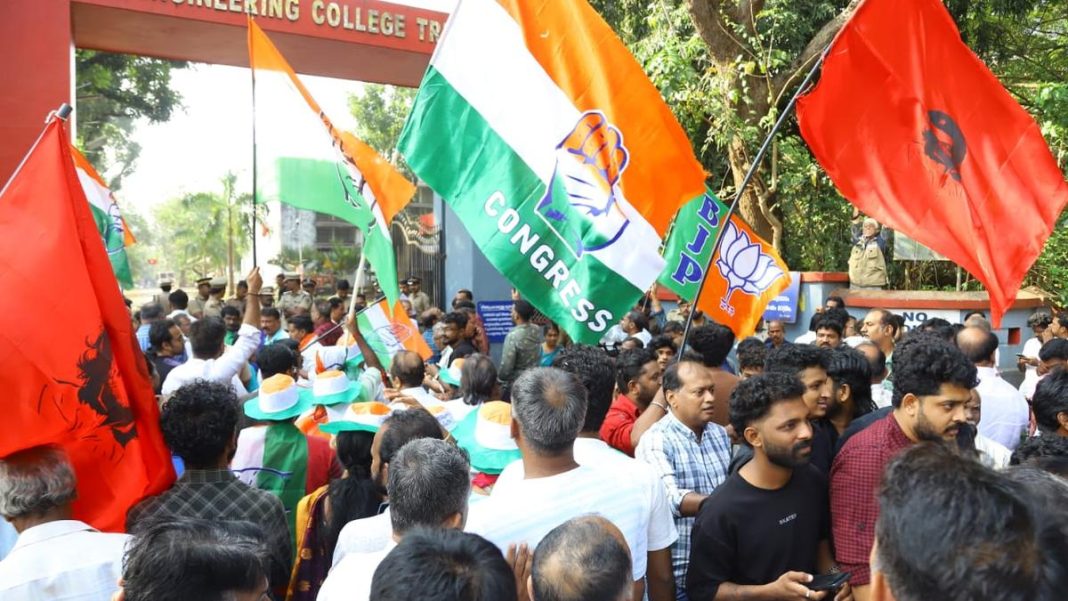
Thrissur, often dubbed the cultural capital of Kerala, appears set for a significant political shift as early trends and analysis from the recently concluded local body elections strongly indicate the United Democratic Front (UDF) is poised to reclaim the Thrissur Corporation. This potential victory marks a significant turnaround, particularly given the expectations surrounding a “Suresh Gopi wave” that many in the Bharatiya Janata Party (BJP) had hoped would sweep the civic body polls. However, the ground reality suggests that the much-anticipated surge failed to materialise, leaving the BJP to reconsider its grassroots strategy in the state.
For the ruling Left Democratic Front (LDF), losing control of Thrissur Corporation would be a considerable setback, forcing an introspection into their local governance and anti-incumbency factors. The UDF’s robust performance, conversely, signals renewed energy and a successful strategy at the ward level, connecting with voters on issues close to their everyday lives.
The Shifting Tides of Thrissur Corporation Politics
Thrissur Corporation has historically witnessed fluctuating political allegiances. While the LDF has held sway in recent terms, their grip has often been contested. The 2020 local body elections saw the LDF securing a comfortable majority, but even then, the UDF and BJP had shown pockets of strength. This time, however, the narrative seems to have distinctly shifted. Factors contributing to the UDF’s resurgence are multi-faceted, ranging from perceived anti-incumbency against the incumbent LDF council to effective localised campaigning by UDF candidates focusing on civic amenities, waste management, and infrastructure development.
“The results from Thrissur are a clear reflection of the local populace’s priorities,” explains Dr. Ranjit Menon, a political analyst based in Kochi. “While state and national issues certainly play a role, local body elections are primarily decided on immediate concerns – roads, water, sanitation. The UDF appears to have connected better on these very issues, presenting credible alternatives to the voters.”
The UDF leadership had put in significant effort at the grassroots level, identifying strong candidates and empowering them with local autonomy in campaign execution. This decentralised approach, coupled with a concerted effort to consolidate traditional support bases, seems to have paid dividends. The early leads and projected seat counts indicate a clear majority for the UDF, potentially paving the way for a smooth transition of power within the Corporation.
The ‘Suresh Gopi Wave’: A Ripple, Not a Tsunami
One of the most talked-about aspects leading up to the Thrissur local body elections was the potential impact of actor-turned-politician Suresh Gopi. Having been a prominent figure in the BJP’s Kerala campaign and recently nominated to the Rajya Sabha, Gopi’s public image and strong personal connect, particularly in Thrissur where he had contested the Lok Sabha elections, generated considerable buzz. The BJP had high hopes that his popularity would translate into votes at the ward level, significantly boosting their seat tally in the Thrissur Corporation.
However, preliminary results and detailed analysis suggest that the anticipated “Suresh Gopi wave” largely failed to materialise in the local context. While the BJP might see a marginal increase in its vote share in some wards, it has not been sufficient to dislodge the traditional dominance of the UDF and LDF. The party’s ambitious targets for securing a significant number of seats, let alone emerging as a kingmaker, appear to have fallen short.
Political observers point out that celebrity appeal, while effective in parliamentary or assembly elections, often struggles to translate directly into local body polls. These elections are fought on a different terrain, demanding strong ward-level organisation, deeply entrenched local networks, and candidates with a proven track record in community service. The BJP, despite its national prominence, still faces challenges in building this grassroots infrastructure in many parts of Kerala, including Thrissur. The party’s inability to field a sufficient number of strong, locally credible candidates across all wards might have diluted any potential Gopi effect, confining it to individual pockets of influence rather than a widespread surge.
UDF’s Resurgent Strategy and Future Implications
The UDF’s impending victory in Thrissur Corporation is not merely a testament to the LDF’s challenges or the BJP’s unfulfilled aspirations; it underscores a calculated and effective strategy. The front focused on highlighting perceived failures of the incumbent council, such as slow project implementation, inadequate waste management solutions, and issues with urban planning. Their campaign resonated with the electorate by offering tangible solutions and presenting a vision for better civic governance.
This success in Thrissur could have broader implications for Kerala politics. It provides a much-needed morale boost for the UDF ahead of upcoming state assembly elections, projecting an image of resurgence and renewed vigour. For the LDF, it necessitates a thorough review of their local-level strategies and a re-engagement with the electorate on everyday issues. As for the BJP, while Suresh Gopi remains a significant asset, the Thrissur outcome serves as a crucial reminder that celebrity charisma alone cannot substitute for robust party organisation and sustained grassroots engagement in Kerala’s unique political landscape.
The stage is now set for the UDF to take charge of Thrissur Corporation, promising a new era of civic administration for the cultural capital. The political narrative leading up to this point has undoubtedly offered valuable lessons for all major political players in the state.

