


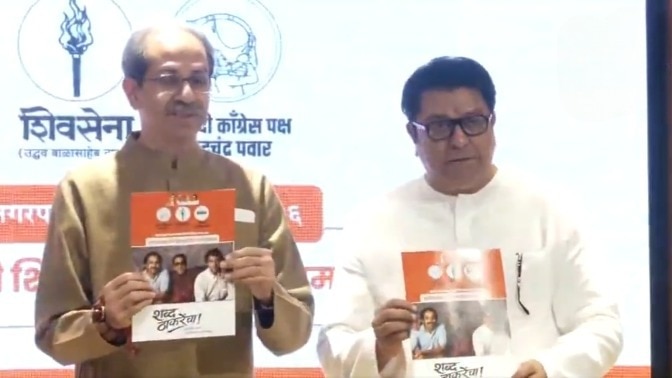
As the political temperature in Mumbai steadily rises in anticipation of the long-delayed Brihanmumbai Municipal Corporation (BMC) elections, two prominent figures from Maharashtra’s political landscape, Uddhav Thackeray and Raj Thackeray, have independently released their respective ‘Vachan Namas’ or pledge documents. These manifestos, outlining their visions for India’s financial capital, not only highlight their distinct approaches to civic governance but also, notably, converge on a common target: the Bharatiya Janata Party (BJP). This rare alignment, despite the deep-seated rivalry between the estranged Thackeray cousins, signals a significant shift in Mumbai’s political narrative.
The ‘Vachan Nama’ Unveiled: Promises for Mumbai
Uddhav Thackeray, leading the Shiv Sena (Uddhav Balasaheb Thackeray) faction, launched his ‘Vachan Nama’ with a strong emphasis on strengthening Mumbai’s local self-governance and ensuring transparency. His document reportedly focuses on core civic issues, promising improved infrastructure, better public health facilities, efficient waste management, and accessible housing solutions for Mumbaikars. Thackeray’s promises also include enhancing green spaces and preserving Mumbai’s unique cultural heritage, often stressing the city’s autonomy and its ability to manage its own affairs without external interference.
Concurrently, Raj Thackeray’s Maharashtra Navnirman Sena (MNS) also presented its ‘Vachan Nama’, which, while rooted in the party’s traditional ‘Marathi manoos’ (Marathi people) plank, addresses broader civic concerns. The MNS manifesto is expected to advocate for more efficient urban planning, streamlining of administrative processes, and ensuring accountability in civic projects. Raj Thackeray’s vision often intertwines Marathi identity with the city’s development, promising solutions that cater to the needs of the local populace while aiming for global standards in urban amenities. Both documents, though from different political stables, underscore a shared understanding of the urgent need for robust local leadership and efficient civic administration.
A Common Target: BJP in the Crosshairs
Perhaps the most intriguing aspect of these parallel manifesto releases is their shared critique of the BJP, currently a dominant force in Maharashtra politics through its alliance with the Eknath Shinde-led Shiv Sena. Uddhav Thackeray, whose government was unseated by the Shinde-BJP alliance, has been particularly vocal in accusing the BJP of attempting to centralise power and diminish Mumbai’s administrative and financial autonomy. His ‘Vachan Nama’ implicitly and explicitly positions his party as the true guardian of Mumbai’s interests against what he perceives as the BJP’s attempts to control the city from Delhi or Nagpur.
“Mumbai’s soul lies in its local self-governance, a principle being systematically eroded by those sitting in Delhi and Nagpur, trying to dictate terms to a city they barely understand,” Uddhav Thackeray stated, hinting at the BJP’s alleged centralisation attempts and the state government’s perceived interference in BMC affairs. Raj Thackeray, while not always as direct, has also periodically expressed concerns about the perceived neglect of Maharashtra’s issues and the overreach of central authority, which aligns indirectly with Uddhav’s criticism. This convergence of criticism from two leaders who have historically been fierce rivals offers a compelling narrative for the upcoming polls, potentially uniting a segment of the anti-BJP vote.
The Shifting Sands of Mumbai Politics
The BMC, often dubbed Asia’s richest civic body, controls an annual budget larger than that of several Indian states, making its elections a high-stakes affair. For decades, the Shiv Sena, under the Thackeray family’s leadership, has held sway over the corporation. However, the political landscape has drastically altered since 2019, with the Shiv Sena’s vertical split and the formation of a new state government. The BJP, along with the Eknath Shinde faction, is poised to mount a formidable challenge, aiming to capture the BMC for the first time.
In this evolving scenario, the ‘Vachan Namas’ from both Uddhav and Raj Thackeray are not just blueprints for urban development but also strategic political documents designed to rally their respective bases and project themselves as the authentic voice of Mumbai. The common thread of targeting the BJP, regardless of their past animosities, indicates a tactical recalibration by the Thackeray cousins. This could potentially consolidate anti-incumbency sentiments against the ruling state government and its BJP ally, adding another complex layer to the already intricate political dynamics of Mumbai’s civic polls. The coming months are set to witness an intense electoral battle, where these pledges and criticisms will undoubtedly shape public discourse.

