


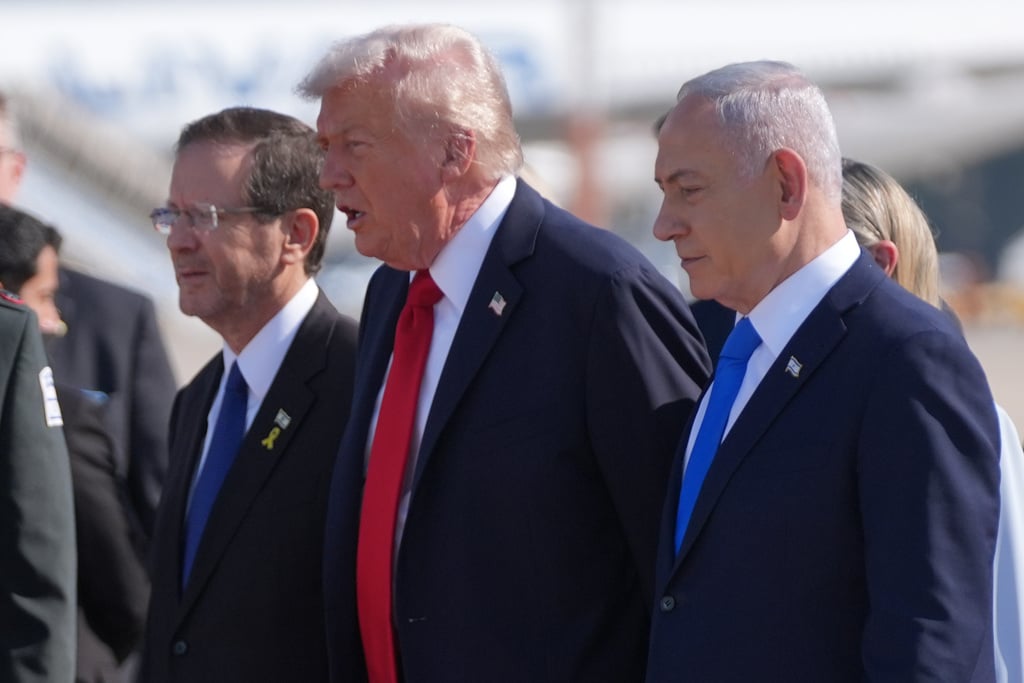
In a surprising and forthright declaration that has reverberated across international political circles, former US President Donald Trump recently lashed out at Israeli President Isaac Herzog, asserting that Herzog should be “ashamed of himself” for not pardoning former Israeli Prime Minister Benjamin Netanyahu. The comments have reignited discussions about judicial independence, the limits of presidential power, and the intricate relationship between global leaders, particularly as seen from an Indian perspective keenly observing geopolitical shifts.
The Unconventional Outburst: Trump’s Demand for a Pardon
Donald Trump’s criticism of President Herzog stems from the ongoing legal challenges faced by Benjamin Netanyahu, who is currently embroiled in multiple corruption trials in Israel. Netanyahu, Israel’s longest-serving prime minister, stands accused of bribery, fraud, and breach of trust in three separate cases. These trials have deeply polarized Israeli society, with his staunch supporters viewing them as a politically motivated witch hunt, while critics demand accountability and the rule of law.
Trump’s statement, made during an interview, expressed strong disapproval of Herzog’s inaction. “I think that Isaac Herzog should be ashamed of himself for not pardoning Netanyahu,” Trump reportedly stated, implying that a pardon was warranted to alleviate Netanyahu’s legal troubles. This intervention by a former American head of state into the internal legal proceedings of a sovereign nation is highly unusual. It underscores the unique bond Trump perceived with Netanyahu during their overlapping tenures, often characterized by shared conservative ideologies and close diplomatic cooperation.
However, the concept of a presidential pardon in Israel, as in many democracies, is typically reserved for individuals who have been convicted and sentenced. Netanyahu’s trials are ongoing, meaning he has not yet been found guilty or handed down a sentence. This fundamental procedural aspect makes Trump’s demand particularly complex and, arguably, premature. President Herzog, whose role is largely ceremonial but carries significant moral weight, is expected to remain above partisan fray and respect the judicial process, rather than intervene in a live criminal proceeding.
Presidential Powers and the Israeli Judicial Landscape
President Isaac Herzog’s office holds the power to grant pardons or commute sentences, a prerogative that embodies mercy and statesmanship. However, exercising this power during an active trial, especially for a prominent political figure, would be an unprecedented move with profound implications for the independence of Israel’s judiciary. Such an action would likely be perceived as an egregious overreach, undermining the very foundations of the rule of law and potentially setting a dangerous precedent.
The Israeli legal system, like India’s, prides itself on its independence and its commitment to due process. Allowing political pressure, whether domestic or international, to influence ongoing trials would erode public trust in institutions vital for a functioning democracy. Herzog, himself a former leader of the Labour Party and a figure known for his measured approach, has consistently maintained that he will respect the legal process and the judiciary’s autonomy. His position demands impartiality, and any move to intervene in Netanyahu’s trials would be met with severe condemnation from various quarters within Israel, not least from the legal fraternity and those who champion judicial integrity.
The Israeli presidency is designed to be a unifying figure, a moral compass for the nation, rather than an active player in political disputes or legal battles. For Herzog to accede to Trump’s demand would be to politicize an office that strives for non-partisanship and to compromise the integrity of Israel’s legal framework.
Global Resonance and an Indian Perspective
Donald Trump’s outspoken criticism of President Herzog has wider implications for international diplomacy and the norms governing relations between nations. It raises questions about the acceptable limits of foreign intervention in sovereign legal matters. From a global standpoint, such statements can be viewed either as a powerful expression of solidarity among political allies or as an unwelcome intrusion that disregards national sovereignty and democratic processes.
For India, a nation that deeply values its own judicial independence and the principle of non-interference in internal affairs, such an incident would likely be observed with a nuanced understanding. India has consistently upheld the sanctity of its legal institutions and would generally frown upon external pressures attempting to influence its judicial outcomes. While India maintains strong strategic partnerships with both the United States and Israel, the underlying principle of respecting national sovereignty and the autonomy of the judiciary remains paramount.
The episode also highlights a broader trend in global politics where populist leaders often champion individuals perceived as fellow travelers, sometimes blurring the lines between personal loyalty and the demands of institutional integrity. The perceived interconnectedness of leaders like Trump and Netanyahu, who both faced significant legal and political challenges during and after their tenures, underscores a particular brand of international camaraderie that can sometimes challenge conventional diplomatic protocols.
Ultimately, Trump’s sharp rebuke of President Herzog casts a spotlight on the delicate balance between political influence, judicial independence, and international relations. While the statement may resonate with some of Netanyahu’s fervent supporters, it places President Herzog in a difficult position, requiring him to steadfastly uphold the principles of his office and the integrity of Israel’s legal system against external pressures.

