


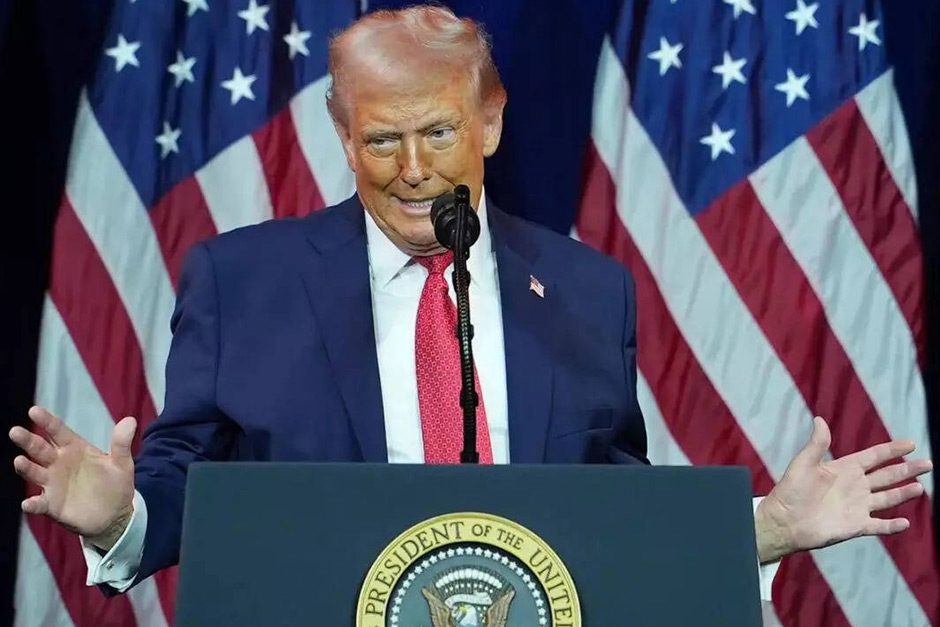
The geopolitical landscape is often a stage for intricate power plays, and few narratives have been as enduringly complex as the relationship between the United States and Venezuela. Recent remarks from former US President Donald Trump have once again thrust this dynamic into the spotlight, sparking speculation and analysis across the globe. Speaking on his potential future foreign policy directions, Trump dropped a significant hint regarding Venezuela, stating, “Time will tell… but it will be a period of time, and eventually I’ll go down to Venezuela.” He then added the provocative observation that “When I left, Venezuela was ready to crash. We would have taken it over, we would have drilled all their oil, and we would have paid off the United States.” This statement, particularly the implication of the US “running” Venezuela and his planned visit, signals a potential recalibration of US strategy towards the crisis-ridden South American nation, prompting a global ripple of questions, not least for a major energy consumer like India.
Trump’s Cryptic Hints and the Shadow of Intervention
Donald Trump’s pronouncements have a distinct characteristic: they are often open to multiple interpretations, yet rarely lack impact. His latest comments on Venezuela are no exception. The phrase “Time will tell” suggests a deliberate, albeit unspecified, duration for US involvement or influence in Venezuela’s affairs. More strikingly, the assertion that the US “would have taken it over” and “drilled all their oil” harks back to an era of resource-driven foreign policy, a notion that could send shivers down the spines of nations sensitive to sovereignty and non-interference. For many, including observers in India, this evokes memories of past interventions and raises concerns about the potential for destabilization in a region already grappling with significant challenges.
The US policy towards Venezuela under the Trump administration was characterized by intense pressure, including crippling sanctions aimed at isolating Nicolás Maduro’s government and supporting opposition figures like Juan Guaidó. While these measures severely impacted Venezuela’s economy, they did not lead to the desired regime change. Trump’s current remarks seem to imply a readiness to consider more direct forms of engagement or oversight, perhaps even suggesting a form of stewardship over the nation’s vast oil reserves. This approach contrasts sharply with conventional diplomatic norms and could complicate efforts by other international actors, including those from Asia, to foster stability through dialogue and multilateral cooperation. The prospect of the US “running” another sovereign nation, even under the guise of stabilizing it, is a significant departure from standard international relations and warrants careful consideration of its geopolitical ramifications.
Geopolitical Chessboard: Reactions and Stakes
The implications of Trump’s statements extend far beyond the Americas. Venezuela, possessing the world’s largest proven oil reserves, is a critical player in global energy markets. Any significant shift in its governance or oil production capacity has direct consequences for countries like India, which imports over 80% of its crude oil requirements. India, while maintaining a neutral stance on Venezuela’s internal politics, has a vested interest in the stability of global oil supplies and prices. Unilateral actions or prolonged uncertainty in a major producing nation could lead to market volatility, directly impacting India’s economy and energy security. Historically, India has advocated for multilateral solutions and non-interference in the internal affairs of sovereign nations, a principle that would be severely tested by any US attempt to “run” Venezuela.
Moreover, Venezuela has strong strategic ties with other global powers, notably Russia and China, both of whom have provided significant financial and military support to the Maduro regime. These countries view US pressure on Venezuela as an encroachment on their own geopolitical interests and a challenge to a multi-polar world order. Any overt move by the US to exert direct control could escalate tensions, drawing in these major powers and transforming Venezuela from a regional crisis into a broader international flashpoint. The phrase, “eventually I’ll go down to Venezuela,” could be interpreted as a confident declaration of anticipated success in influencing the country’s future, or perhaps even as a subtle hint at a future state visit under a new political order. Such a visit, if it materializes, would undoubtedly be framed as a symbolic end to the current crisis, yet the path to that point is fraught with considerable challenges and potential for conflict.
The Road Ahead: Uncertainty and Global Vigilance
The future of Venezuela remains highly uncertain, and Trump’s comments add another layer of complexity to an already intricate situation. Whether his remarks are a tactical ploy, a statement of intent for a potential second term, or simply a reflection of his past thinking, they undeniably underscore the unresolved nature of the Venezuelan crisis. For the international community, including India, the message is clear: vigilance is paramount. The world will be watching closely to see how these hints translate into policy, if at all, and what repercussions they might have for global stability, energy markets, and the fundamental principles of national sovereignty.
The unfolding narrative in Venezuela serves as a stark reminder of the delicate balance between national interest, international law, and geopolitical ambition. As Trump himself noted, “Time will tell,” and the world waits to see what shape that ‘time’ will ultimately take for Venezuela and its place on the global stage.

