


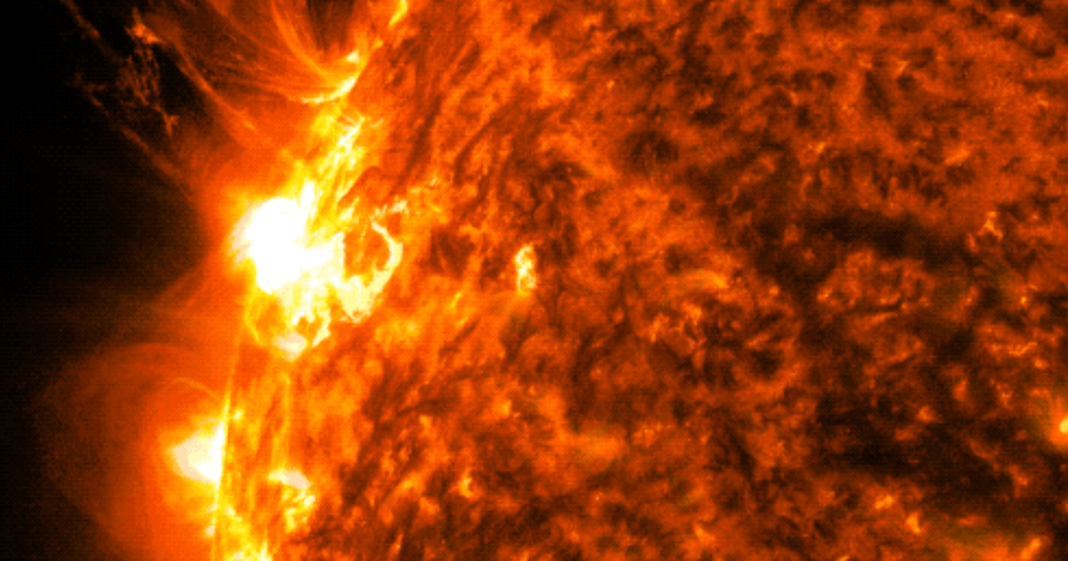
The sun, our colossal celestial neighbor, just reminded us who’s boss. A powerful solar flare has erupted, sending a wave of charged particles hurtling towards Earth, prompting space weather forecasters to issue a geomagnetic storm watch. It’s a stark, dazzling reminder of the incredible dynamics happening just 93 million miles away, and it means our planet’s magnetic field is about to get a cosmic shake-up.
Solar Fury Unleashed: A Powerful Eruption
Imagine an explosion so immense it dwarfs anything human-made – that’s essentially what a solar flare is. These aren’t just pretty light shows; they’re intense bursts of radiation and energy from the sun’s surface, often accompanied by a Coronal Mass Ejection (CME). This recent event was significant, classified as a powerful flare, meaning it packed a substantial punch. When such a flare occurs, it ejects billions of tons of solar material and magnetic fields into space. If Earth happens to be in the firing line, as we are now, that material travels across the vacuum, eventually colliding with our planet’s protective magnetic bubble, the magnetosphere.
The energy from these flares travels at the speed of light, reaching us in just over eight minutes, but the slower-moving CME can take days to arrive. It’s the arrival of this plasma cloud that triggers the geomagnetic storm. This particular eruption was strong enough to warrant immediate attention from space weather agencies, signaling that the geomagnetic storm watch isn’t just a precaution, but an expectation of impact.
Decoding the Storm: What to Expect on Earth
So, what exactly is a geomagnetic storm, and what does a “watch” mean for us down here? When the sun’s charged particles hit Earth’s magnetosphere, they cause fluctuations in our planet’s magnetic field. These storms are categorized on a scale from G1 (minor) to G5 (extreme). A watch means conditions are favorable for a storm of a certain intensity to occur. While the precise strength of this upcoming storm is still being assessed as the CME travels, the very issuance of a watch indicates a noticeable impact is likely.
The most visually stunning effect of a geomagnetic storm is the aurora borealis (Northern Lights) and aurora australis (Southern Lights). These incredible light shows occur when the solar particles interact with gases in Earth’s atmosphere, exciting them and causing them to glow. A stronger storm means these auroras could be visible much further from the poles than usual, turning night skies into a canvas of greens, reds, and purples for many more stargazers.
Beyond the breathtaking visual spectacle, geomagnetic storms can have other, more subtle impacts. They can interfere with satellite communications, potentially affecting GPS signals or radio transmissions. Power grids can experience minor fluctuations, though modern infrastructure is built to withstand most common solar events. For astronauts in low Earth orbit, there’s a slight increase in radiation exposure, which is always carefully monitored. As one keen sky-watcher, Elara Vance, put it: “I’ve been watching the sun for years, but this recent flare felt particularly intense. It’s a humbling reminder of the sheer power of our star, and I’m really hoping for some spectacular auroras across wider latitudes!“
Gazing Up: The Beauty and the Business of Space Weather
The geomagnetic storm watch serves as a dual reminder: of the profound beauty of our solar system and the increasing interconnectedness of our modern world with events far beyond our atmosphere. While significant disruptions are rare and typically managed by robust systems, the watch encourages us to be aware and perhaps, to look up. It’s a chance to witness one of nature’s grandest light shows, a direct consequence of the sun’s immense power and our planet’s cosmic shield.
For scientists and engineers, these events are invaluable. They provide real-time data to better understand solar physics, improve space weather forecasting models, and enhance the resilience of our technological infrastructure against future solar outbursts. So, as the solar winds make their journey, keep an eye on the news, and more importantly, keep an eye on the sky. You might just catch a glimpse of Earth’s magnetic ballet, orchestrated by our fiery star.

