


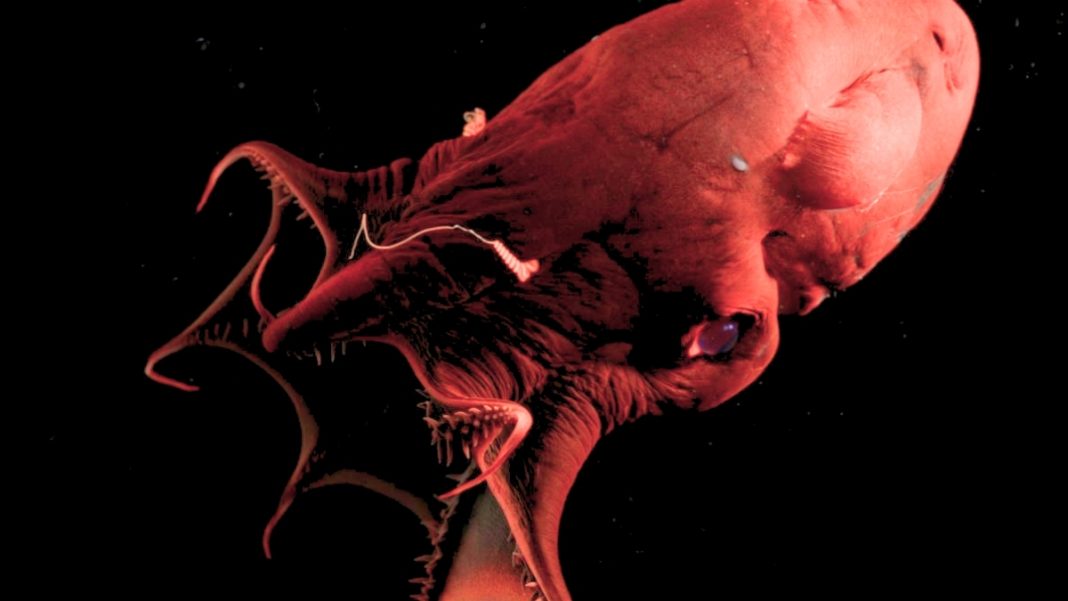
Deep within the abyssal plains, a creature lurks with a name that conjures images straight from a horror novel: the ‘Vampire Squid From Hell’ (scientifically known as Vampyroteuthis infernalis). Despite its fearsome moniker, this enigmatic deep-sea dweller is far from a monster. Instead, it’s a living relic, a crucial evolutionary puzzle piece that has recently shed remarkable light on the ancient origins of one of the ocean’s most intelligent inhabitants: the octopus.
A Living Fossil in the Abyss
Vampyroteuthis infernalis is not truly a squid, nor is it an octopus. It belongs to its own unique order, Vampyromorphida, making it the sole surviving member of a lineage that dates back millions of years. Living in the aphotic zone, typically between 600 and 1200 meters deep, this cephalopod has adapted to its extreme environment in fascinating ways. Its most striking feature is its cape-like webbing connecting its eight arms, which are lined with spine-like fleshy filaments rather than suckers. It also possesses two unique retractile filaments, whose function has long puzzled scientists, alongside large eyes and photophores that allow it to glow in the perpetual darkness.
For decades, scientists have recognized Vampyroteuthis as an evolutionary oddity. Its unique blend of features – some reminiscent of squids, others of octopuses, and many entirely its own – positioned it as a sort of evolutionary “missing link.” It’s a creature that seems to have paused in time, preserving ancestral traits that have been lost or significantly altered in its more modern relatives. This ‘living fossil’ status makes it invaluable for tracing the evolutionary pathways of cephalopods, helping us understand how modern forms like the charismatic octopus came to be.
Unraveling the Octopus Ancestry
Recent investigations into the morphology and genetics of Vampyroteuthis infernalis have solidified its pivotal role in understanding octopus evolution. By meticulously studying its anatomical structures and comparing its genetic makeup to other cephalopods, researchers have confirmed that Vampyroteuthis represents an ancient branch that diverged before the split between modern octopuses (Octopoda) and the squid-cuttlefish lineage (Decapodiformes). In essence, it shows us what the common ancestor of octopuses and squids might have looked like, leaning more heavily towards the octopod side.
Specifically, the arrangement of its arms, the presence of its unique filaments (which are thought to be remnants of a more ancient pair of tentacles), and its overall body plan offer profound clues. It suggests that the eight-armed body plan of octopuses is a more ancient feature, rather than a secondary reduction from a 10-armed ancestor. “It’s like finding a missing page in a very old family album,” one marine biologist noted, “Vampyroteuthis doesn’t just fill a gap; it redefines our understanding of the whole cephalopod lineage and points directly to the deep roots of octopuses.” This deep-sea enigma provides a direct window into the evolutionary innovations that eventually led to the cunning, multi-limbed predators we recognize as octopuses today.
The ‘Vampire Squid From Hell,’ with its daunting name and ghostly presence, is far more than a deep-sea curiosity. It stands as a testament to evolution’s ingenuity, preserving a blueprint of cephalopod ancestry. Through its study, we gain an unparalleled understanding of how octopuses, with their incredible intelligence and complex behaviors, first emerged from the primordial ocean. It reminds us that even in the darkest corners of our planet, hidden histories await discovery, continually reshaping our perception of life’s intricate tapestry.

