


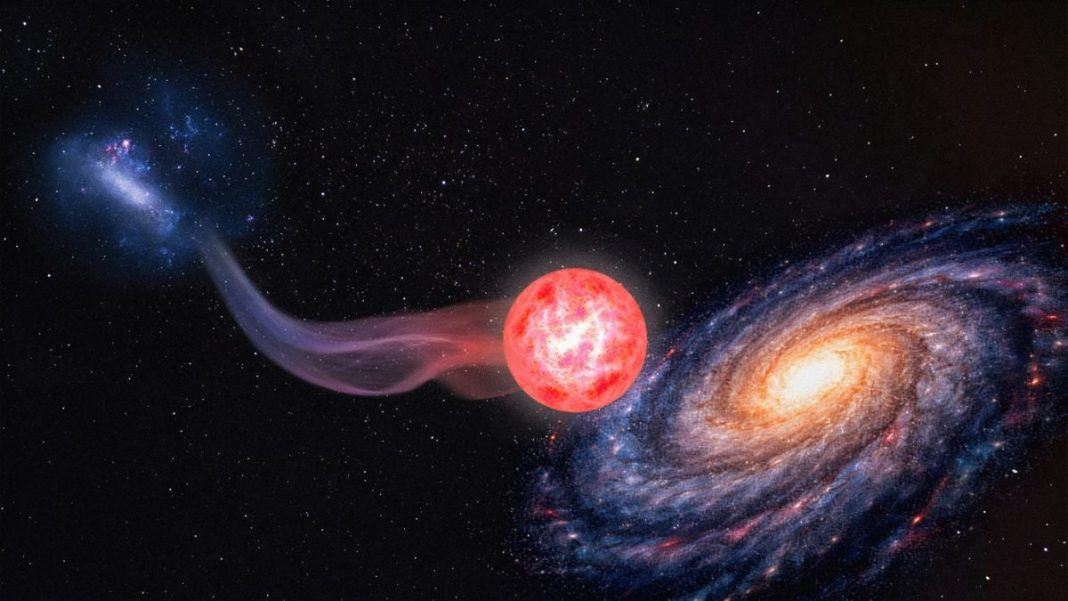
Imagine finding a priceless artifact from the dawn of civilization, not in a remote, inaccessible archaeological dig, but right in your own neighborhood. That’s essentially what astronomers have done, but on a cosmic scale. The universe’s most pristine ancient star, a relic almost as old as time itself, has been discovered much closer to us than previously imagined, offering an unprecedented window into the cosmos’s infancy.
What Makes a Star “Pristine”? A Glimpse into the Early Universe
To understand the significance of this discovery, we first need to define what “pristine” means in astronomical terms. When the Big Bang occurred, the universe was incredibly simple, composed almost entirely of hydrogen, helium, and a tiny trace of lithium. There were no heavier elements—no carbon, no oxygen, no iron, the building blocks of planets and life. These heavier elements, which astronomers call “metals,” were forged inside the very first stars through nuclear fusion, and then dispersed into space when those stars exploded as supernovae.
A “pristine” or “extremely metal-poor” star, therefore, is one that formed before much of this cosmic enrichment had taken place. These stars are essentially cosmic time capsules, preserving the chemical composition of the universe just moments after its birth. Most of these primordial behemoths are theorized to exist in the farthest reaches of space, or in the ancient halos of massive galaxies, making them incredibly difficult to study in detail. That’s why this newfound star’s proximity is such a game-changer.
A Cosmic Time Capsule, Closer Than We Thought
The surprise isn’t just that we’ve found another ancient star, but its relatively close cosmic address. For decades, the prevailing models of stellar evolution and galactic formation suggested that such primordial stars would be exceptionally rare and incredibly distant, often billions of light-years away. To find one in what could be considered our cosmic “neighborhood” challenges some of these long-held assumptions.
Its proximity means astronomers can study it with an unparalleled level of detail, using current observational technology. We can analyze its light spectrum with greater precision, revealing its exact chemical makeup – or lack thereof – with far more accuracy than possible for more distant objects. This isn’t just academic; it provides direct empirical data to test theories about the conditions of the early universe, the lives of the very first stars, and how the chemical elements that now make up everything around us first came into being. As Dr. Anya Sharma, a leading astrophysicist, recently commented, “It’s like finding a truly untouched historical document from ancient times, not in a digital archive, but physically in your local library. The direct access it offers is transformative for our research.”
Unlocking the Universe’s First Chapters
This stellar discovery opens new avenues for understanding the cosmos. By studying this star, scientists hope to piece together a clearer picture of galactic chemical evolution: how the universe transitioned from a simple soup of hydrogen and helium to the complex, element-rich tapestry we see today. It could also shed light on the initial conditions for galaxy formation, revealing how the first structures emerged from the cosmic dark ages.
Ultimately, this close-by ancient star isn’t just a fascinating anomaly; it’s a profound connection to our own origins. Every atom of carbon in our bodies, every speck of iron in our blood, was once forged inside stars. By understanding the universe’s most pristine stellar relics, we gain a deeper appreciation for the grand cosmic story that led to our very existence. The universe continues to surprise us, proving that sometimes, the most profound answers are closer than we ever dared to imagine.

