


Gaze up at the night sky. What do you see? Pinpricks of light, distant galaxies, the familiar glow of our moon. It feels vast, doesn’t it? But what if I told you that for all the stars we can see, millions upon millions more have been hiding in plain sight, just waiting for the right kind of vision to reveal them?
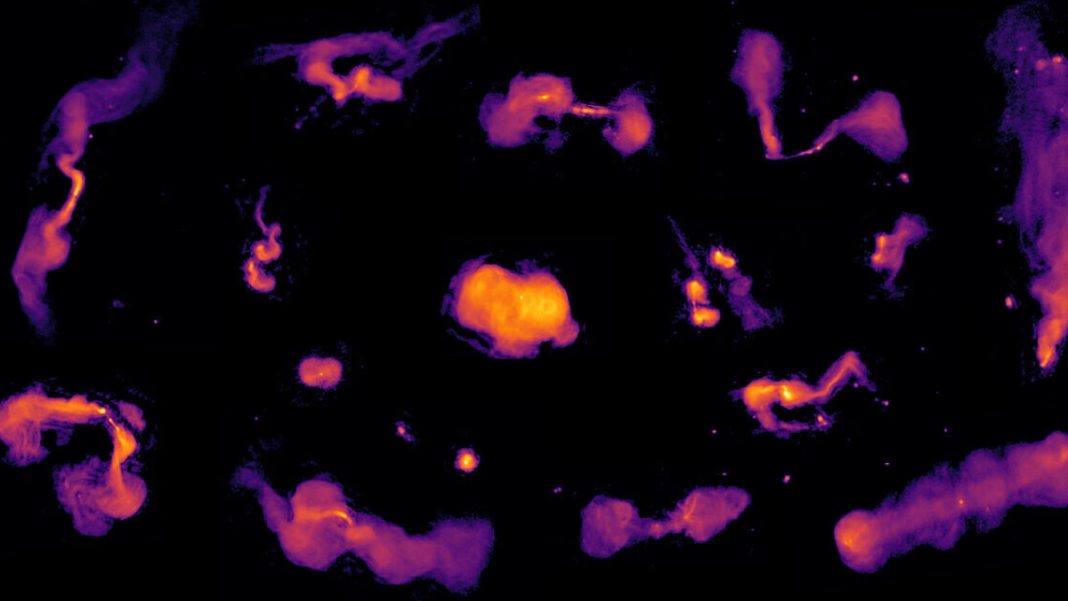
That’s exactly what just happened. In a mind-boggling feat of cosmic cartography, scientists have produced the biggest radio map of the sky ever, unveiling an astonishing 13.7 million previously hidden objects. Think about that for a second: 13.7 million new points of interest, new mysteries, new data points in our ongoing quest to understand the universe. It’s like discovering an entire continent you never knew existed, but out in the cosmic ocean.
The Universe’s New Glasses: How We Found What Was Hidden
So, how did we manage to spot what was essentially invisible? The secret lies not in our eyes, or even traditional optical telescopes, but in listening to the universe’s radio whispers. This incredible achievement comes courtesy of the Australian Square Kilometre Array Pathfinder (ASKAP) telescope, a network of 36 dish antennas located in remote Western Australia. Unlike visible light, radio waves can pierce through thick clouds of cosmic dust and gas that would otherwise obscure distant galaxies and phenomena.
Imagine trying to see through a dense fog with your regular eyesight; it’s impossible. Now imagine having a special instrument that can “hear” the sounds from beyond the fog. That’s essentially what radio astronomy does for the universe. ASKAP’s advanced technology allowed researchers to scan vast swathes of the sky with unprecedented speed and sensitivity, collecting an enormous amount of data that, when processed, painted this breathtaking new picture of the cosmos.
Millions of Whispers from the Deep
What exactly are these 13.7 million newfound objects? The vast majority are distant galaxies, many of which were previously too faint or too shrouded in cosmic dust for our optical telescopes to detect. Among them are active galactic nuclei – the incredibly bright centers of galaxies powered by supermassive black holes greedily devouring matter. We’re also talking about vast regions of star formation, and even echoes from the very early universe.
This isn’t just about counting more dots in the sky. Each of these newly charted points of light is a data point, a clue, a puzzle piece that contributes to our understanding of the universe’s grand narrative. As Dr. Anya Sharma, a theoretical astrophysicist, eloquently put it, “This isn’t just about counting more dots in the sky. It’s about unveiling the invisible architecture of the universe, offering clues to how galaxies form, evolve, and interact over billions of years. Each one of these new objects is a puzzle piece.” This monumental map is poised to redefine our understanding of how galaxies are distributed across the universe, how they interact, and even the role of dark matter and dark energy.
Peeking Beyond the Veil: What Comes Next?
This isn’t just a static map; it’s a dynamic treasure trove for astronomers worldwide. The data collected by ASKAP will serve as a foundational resource for countless future studies. Scientists will pore over these millions of new objects, classifying them, studying their properties, and using them to test existing theories about cosmic evolution.
Every time we push the boundaries of our perception, whether it’s through a more powerful microscope or a more sensitive telescope, we unlock new realms of knowledge. This gargantuan radio map is a testament to human ingenuity and our insatiable curiosity. It reminds us that even when we think we’ve seen it all, the universe has endless wonders waiting to be discovered, continually inviting us to look a little closer, listen a little harder, and dream a little bigger.
The cosmos just got a whole lot busier, and we’re just getting started exploring its newfound depths.

