


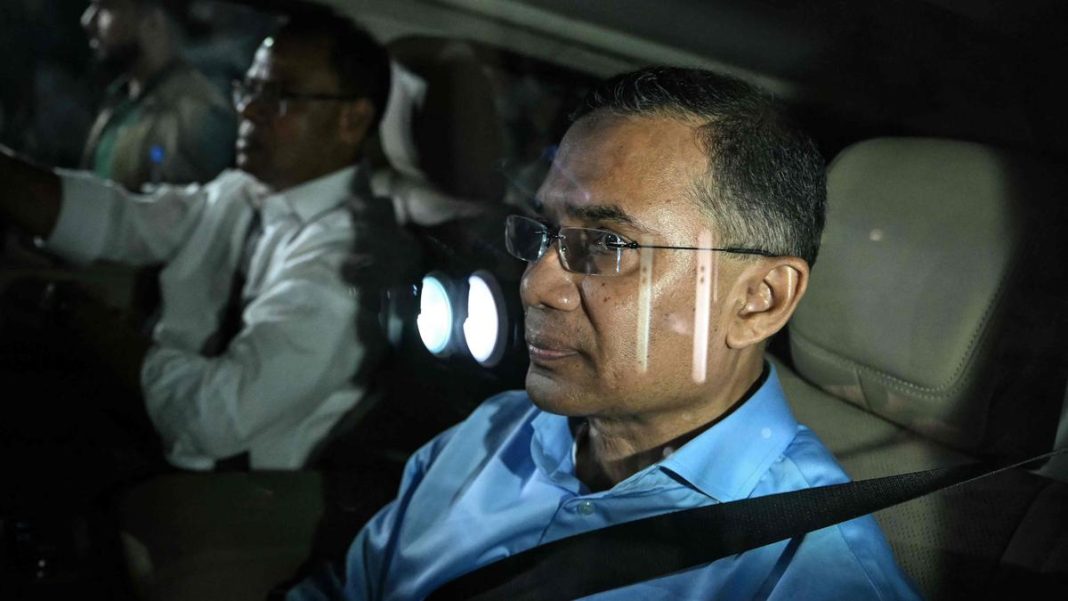
In a significant development echoing across the political corridors of South Asia, Tarique Rahman, the acting chairman of the Bangladesh Nationalist Party (BNP) and son of former Prime Minister Khaleda Zia, has reportedly initiated a series of outreaches to various opposition leaders. This strategic move comes ahead of the swearing-in ceremony of Bangladesh’s newly formed government, following the controversial general elections in January that saw the BNP boycott the polls. Operating from his exile in London, Rahman’s efforts signal a renewed push to consolidate anti-establishment forces and challenge the legitimacy of the incumbent Awami League’s mandate, casting a keen watch from New Delhi on the unfolding dynamics.
Strategic Manoeuvres from Exile
Despite being away from Bangladesh for over a decade, Tarique Rahman remains a pivotal figure in Bangladeshi politics, albeit a contentious one. His alleged outreach is not just limited to factions within his own party but extends to leaders of other smaller opposition parties, civil society figures, and even former political allies who have found themselves marginalized in the current political landscape. The timing of this initiative is crucial: occurring in the immediate aftermath of an election widely criticized for its lack of inclusiveness and ahead of the new government’s formal assumption of power.
Sources close to the BNP suggest that Rahman’s objective is multi-pronged. Firstly, it aims to foster a united opposition front capable of mounting a sustained political challenge to the Awami League government, both inside and outside parliament. Secondly, it seeks to maintain political relevance for the BNP and its allies, who risk further marginalization if they fail to adapt to the new realities. Thirdly, and perhaps most importantly, the outreach is seen as an attempt to keep the narrative of a “flawed election” alive, potentially pushing for international recognition of the need for fresh, fair, and participatory polls. Leading a movement from exile presents unique challenges, yet Rahman’s network and influence within the BNP remain considerable, making his strategic directives impactful.
The Political Landscape and India’s Watch
Bangladesh’s political arena has been characterized by intense rivalry between the Awami League and the BNP for decades. The recent elections, which the BNP and its allies boycotted, led to a landslide victory for the Awami League, effectively creating a one-party dominant legislature. This has left a vacuum for a credible opposition, a space Rahman is evidently attempting to fill through his current manoeuvres. His outreach targets those disillusioned by the current political climate, seeking to coalesce disparate voices into a more coherent and formidable opposition.
From an Indian perspective, developments in Bangladesh are always viewed with strategic importance. India shares a long border with Bangladesh and has deep historical, cultural, and economic ties. New Delhi generally prefers a stable and friendly government in Dhaka, primarily due to regional security concerns, counter-terrorism cooperation, and connectivity initiatives. While India has officially acknowledged the outcome of the recent elections, the consolidation of a strong, unified opposition in Bangladesh, particularly one led by figures historically perceived as less aligned with Indian interests, introduces an element of careful observation for policymakers in New Delhi.
“This isn’t merely about forming an alliance; it’s a strategic move to keep the opposition relevant and united against a powerful incumbent,” states Dr. Rohan Mitra, a Dhaka-based political analyst. “Rahman is attempting to project strength and an alternative vision, even from afar, which India will undoubtedly be scrutinizing for its potential long-term implications on regional stability and bilateral relations.”
Implications for Regional Dynamics
The success or failure of Tarique Rahman’s outreach could have significant ramifications beyond Bangladesh’s borders. A revitalized and unified opposition, even if operating largely outside the formal parliamentary structure, could lead to heightened political agitation and potentially challenge the stability that India values in its eastern neighbour. Increased political volatility in Bangladesh could impact cross-border trade, infrastructure projects, and even regional security cooperation against extremism.
India’s “Act East” policy heavily relies on robust connectivity and stability in its immediate neighbourhood, including Bangladesh. Any perception of instability or a shift in the political alignment of Bangladesh could necessitate a recalibration of India’s strategic approach. The challenge for Rahman will be to convert this outreach into tangible political momentum without exacerbating internal divisions within the opposition or inciting unrest that could be detrimental to the broader goal of democratic accountability. The coming months will reveal whether this strategic push from London can truly reshape Bangladesh’s political landscape and, by extension, influence regional dynamics.
As the new government in Dhaka prepares for its tenure, Tarique Rahman’s efforts from exile underscore the lingering political tensions and the unresolved questions surrounding Bangladesh’s democratic future. India, alongside other regional and international stakeholders, will be closely observing how these intricate political chess moves play out, understanding that Bangladesh’s internal stability is intrinsically linked to broader regional peace and prosperity.

