


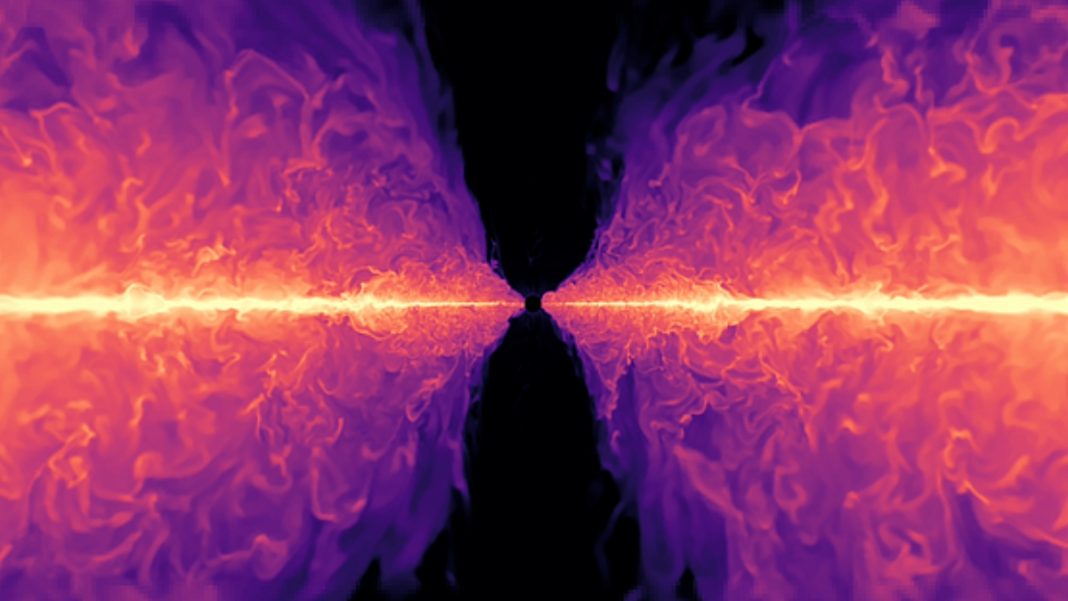
Black holes. The very phrase conjures images of cosmic voids, impenetrable horizons where gravity reigns supreme and all light vanishes. For decades, our understanding of these enigmatic beasts was largely theoretical, based on equations and distant observations. We knew they consumed matter, but what truly happened in the fiery maelstrom just outside their point of no return? Thanks to the unparalleled might of supercomputers, we’re finally getting an incredibly detailed, and frankly, astonishing, look at the brutal, beautiful ballet of destruction and creation that unfolds near a black hole.
The Cosmic Crucible: Plasma and Magnetic Fury
Imagine gas, heated to millions of degrees, swirling faster than anything you can conceive, compressed and stretched by immense gravity. This isn’t just ordinary gas; it’s a superheated plasma, a soup of charged particles. As this plasma spirals towards the black hole, it forms an accretion disk—a cosmic feeding frenzy. For a long time, the precise dynamics of this disk, especially how it generates the incredible energy we observe, remained elusive. Enter supercomputers.
These computational titans run complex simulations that marry general relativity, electromagnetism, and fluid dynamics, modeling the intricate dance of plasma and powerful magnetic fields in three dimensions. What they reveal is breathtaking. Instead of a smooth, orderly swirl, the accretion disk is a turbulent, chaotic powerhouse. Magnetic fields, previously underestimated in their complexity, are shown to be the true architects of this chaos. They twist, snap, and reconnect, generating immense friction and heating the plasma to incredible temperatures, far beyond what simple gravitational compression could achieve. It’s a dynamic, ever-changing environment where magnetic forces channel energy with surprising efficiency.
“It’s like watching a cosmic ballet where the dancers are superheated plasma and the choreographer is an invisible, yet incredibly potent, magnetic force field,” shares Dr. Aris Thorne, a theoretical astrophysicist whose work often involves interpreting these simulations. “The sheer complexity that supercomputers can model is transforming our ‘what ifs’ into ‘what is’ with stunning clarity.”
From Swirls to Streams: Unraveling Jet Formation
One of the most profound mysteries surrounding black holes has been the existence of relativistic jets. These are collimated beams of matter and energy that blast out from the poles of many black holes, extending thousands, even millions, of light-years into space. It seemed counterintuitive: how could a cosmic vacuum also be a cosmic cannon?
The latest supercomputer simulations have provided a crucial piece of the puzzle. They show how the intense magnetic fields threading through the accretion disk become incredibly twisted and amplified by the black hole’s powerful rotation and the swirling plasma. These magnetic field lines act like a colossal, invisible slingshot. As particles of plasma become trapped and accelerated along these twisted fields, they are funneled away from the black hole’s poles, gaining immense speed and energy. The simulations demonstrate the precise mechanism by which this magnetic “engine” extracts energy from the spinning black hole and the accretion disk itself, launching those powerful, universe-shaping jets.
These jets aren’t just astrophysical curiosities. They play a vital role in galaxy evolution, capable of heating vast gas clouds and influencing star formation across entire galaxies. Understanding their origin through these simulations is like finally seeing the blueprints for one of the universe’s most powerful engines.
Peering into the Abyss, One Byte at a Time
The insights delivered by supercomputers are nothing short of revolutionary. They’ve allowed us to move beyond simplified models and witness the astonishing, multi-faceted reality of black hole environments. We’re seeing how extreme gravity, superheated plasma, and incredibly strong magnetic fields conspire to create some of the most energetic and dynamic phenomena in the cosmos.
These virtual laboratories are not just showing us what happens near black holes; they are pushing the boundaries of our fundamental understanding of physics. As computational power continues its exponential climb, we’re not just observing the universe; we’re stepping into its most extreme corners, one byte at a time, illuminating its deepest secrets with unprecedented detail. The universe is a messy, magnetic, and magnificent place, and we’re finally getting to see the truth of it.

