


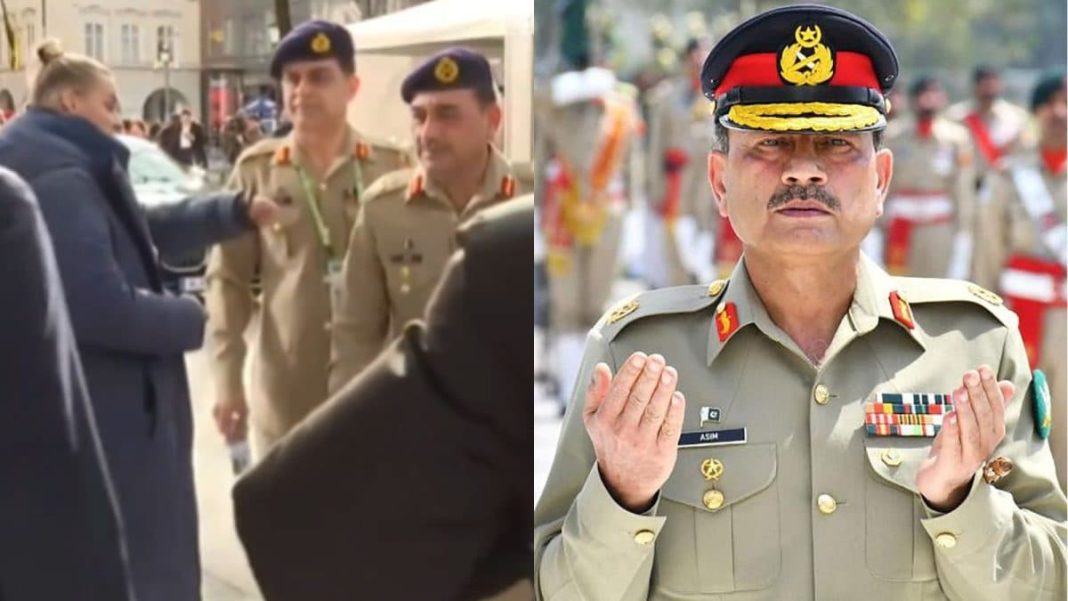
The global stage of diplomacy and security discussions often provides moments of high-stakes deliberation, but sometimes, it’s the seemingly mundane incidents that capture worldwide attention. Such was the case at the recent Munich Security Conference (MSC), an annual gathering of international leaders, defence ministers, and security experts. Amidst weighty discussions on global challenges, an interaction involving Pakistan’s Chief of Army Staff (COAS), General Asim Munir, quickly became the subject of intense social media chatter, particularly resonating across India and Pakistan. The viral moment, dubbed the “security check,” saw General Munir reportedly stopped for an ID verification, sparking a flurry of reactions ranging from amusement to geopolitical speculation.
The Viral Moment: “Stop, Where’s Your ID?”
The incident unfolded during the high-profile Munich Security Conference, where General Asim Munir was a prominent participant. Videos and accounts circulating widely on social media platforms, including X (formerly Twitter) and YouTube, depicted what appeared to be a security personnel halting the Pakistani COAS and requesting identification. While the exact details of the exchange remain subject to various interpretations, the visual quickly went viral. Many social media users shared clips with captions like “Stop, Where’s Your ID?” highlighting the perceived unusual nature of such a senior military official being subjected to a standard security check in public view at an international event.
The virality of the incident was not merely about the visual itself, but the immediate and diverse reactions it generated. In India, the clip quickly became a talking point across news channels and social media. Commentators and online users frequently contrasted the incident with India’s diplomatic standing, often drawing parallels or making inferences about Pakistan’s perceived international image. Memes and satirical posts proliferated, reflecting a certain schadenfreude among some sections of the Indian public. Conversely, Pakistani users and officials largely dismissed the incident as a routine security protocol, emphasizing that such checks are standard at high-security international gatherings, regardless of the individual’s rank. This stark divergence in interpretation underscored the highly charged information environment surrounding events involving figures from both nations.
Protocol, Perception, and Diplomatic Nuances
At an event as critical and high-security as the Munich Security Conference, security protocols are invariably stringent. Attendees, from heads of state to delegates, are expected to adhere to established procedures designed to ensure the safety of all participants. In this context, a request for identification, even for a high-ranking military official, could be viewed as a routine application of these protocols rather than a specific slight. International conferences often employ multiple layers of security, and badge checks are a common feature at various entry points and zones within the venue.
However, the viral spread of the incident highlights the potent role of perception in international relations, especially in the age of instant information. For many, particularly in regions with historical rivalries, such moments are often interpreted through a nationalistic lens. In India, the incident fueled narratives that questioned Pakistan’s diplomatic prestige and influence on the global stage. Some analysts suggested that the public nature of the check, regardless of its routine nature, could be seen as an indicator of how a country’s representatives are perceived or treated in international forums. This perspective often contrasts with India’s own efforts to project an image of rising global influence and diplomatic gravitas.
A diplomatic analyst, speaking on the condition of anonymity, commented on the broader context: “While security protocols at international conferences are stringent for all attendees, regardless of rank, the viral nature of this particular interaction highlights the intense public and media scrutiny faced by high-profile military figures on the global stage. It’s less about the security check itself and more about the narrative that subsequently forms around it.” This sentiment underscores how even standard procedures can take on magnified significance when involving prominent figures from geopolitically sensitive regions.
Broader Implications for Regional Discourse
The “security check” incident, though seemingly minor on its own, became a microcosm of the intense information warfare and perception battles that often play out between India and Pakistan. It demonstrated how any event involving a key figure from either nation is immediately scrutinized, amplified, and reinterpreted through existing political and nationalistic frameworks. The incident did not lead to any formal diplomatic protests or statements, yet its impact on public discourse was undeniable.
For TrendLyric.com readers, this event offers a crucial insight into the dynamics of contemporary media and international relations. It illustrates how social media can transform a routine procedural check into a widely debated diplomatic talking point, influencing public opinion and reinforcing pre-existing narratives. The incident served as a stark reminder that in the interconnected world, the optics of an event can often outweigh its intended reality, particularly when viewed through the prism of competing national interests and public sentiment.
Ultimately, while General Asim Munir’s “security check” at the Munich Conference was likely a standard part of event security, its journey from a momentary interaction to a viral sensation underscores the amplified scrutiny faced by international figures and the powerful role of digital platforms in shaping global perceptions. The incident, irrespective of its original intent, certainly resonated across the subcontinent, contributing another layer to the complex tapestry of India-Pakistan discourse.

