


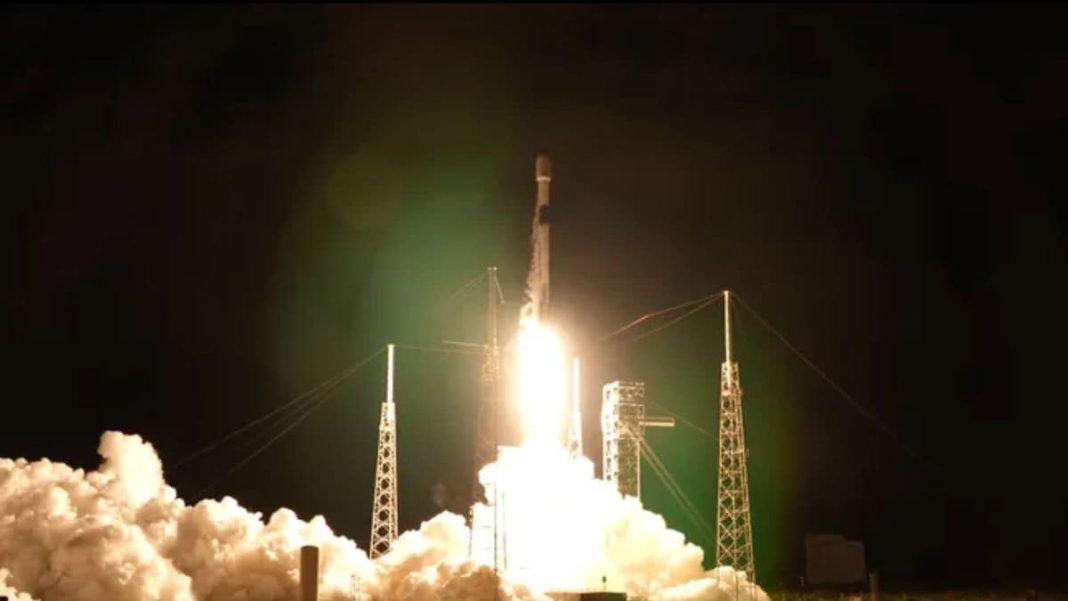
SpaceX continues its relentless pace in expanding its Starlink constellation, recently executing yet another successful launch that added 29 more satellites to its burgeoning network. The mission, originating from Florida’s Cape Canaveral Space Force Station, underscored the company’s operational efficiency and the advanced reusability of its Falcon 9 rocket. This rapid deployment of Low Earth Orbit (LEO) satellites marks another significant step towards Starlink’s vision of providing global broadband internet, a development keenly observed by nations worldwide, including India, as they navigate their own digital transformation journeys.
The Relentless March of Starlink and Reusability’s Triumph
The recent mission saw a seasoned Falcon 9 rocket ascend into orbit, carrying its precious cargo of 29 Starlink satellites. Following a flawless liftoff, the first stage of the Falcon 9 performed its signature landing back on a droneship in the Atlantic Ocean, marking yet another successful recovery and demonstrating SpaceX’s mastery of reusable rocket technology. This operational model is crucial to their aggressive launch schedule, which has seen hundreds of Starlink satellites deployed annually, creating the world’s largest satellite constellation.
Each new batch of satellites enhances Starlink’s capacity, reduces latency, and expands its potential coverage area. These satellites operate in LEO, significantly closer to Earth than traditional geostationary satellites, which dramatically cuts down on signal delay, making them suitable for activities like online gaming and video conferencing. SpaceX’s ability to turn around Falcon 9 rockets in a matter of weeks, sometimes even days, has fundamentally reshaped the economics and accessibility of space, lowering costs and accelerating the deployment of critical infrastructure like Starlink.
Starlink’s Global Vision and India’s Evolving Digital Landscape
Starlink’s ambitious goal is to provide high-speed, low-latency internet access to every corner of the globe, particularly targeting remote and underserved regions where terrestrial broadband infrastructure is scarce or non-existent. This vision resonates strongly with countries like India, which possess a vast geography and a significant digital divide. Despite being home to one of the world’s largest internet user bases, millions in rural India still lack reliable and affordable high-speed connectivity.
While Starlink has faced regulatory hurdles in India in the past, leading to the refund of pre-orders, the nation’s interest in satellite internet remains robust. Indian telecom giants like Reliance Jio and Bharti Airtel-backed OneWeb are already making strides in the satellite broadband sector, alongside new entrants eyeing the lucrative market. The government, through initiatives like BharatNet, also continues its efforts to connect villages with optical fibre. However, the unique challenges of India’s diverse terrain often make satellite-based solutions an attractive, and sometimes the only, viable alternative for rapid deployment.
The global proliferation of LEO constellations, spearheaded by players like Starlink, puts pressure on local regulators and telecom providers to innovate and adapt. It highlights the potential for satellite technology to bridge connectivity gaps, a crucial factor for India’s aspirations towards a fully digital economy and society. As India continues to evolve its policies around satellite communications, the advancements made by companies like SpaceX serve as benchmarks for what is technologically possible.
“The ongoing expansion of LEO satellite constellations like Starlink is a game-changer for global connectivity,” says Dr. Ananya Sharma, a Bengaluru-based telecom policy analyst. “Even if Starlink itself isn’t operational in India yet, its sheer scale and technological prowess influence how we, as a nation, perceive and plan for satellite broadband. It compels us to accelerate our own infrastructure development and regulatory frameworks to harness the potential of this technology for India’s vast underserved population.”
The Future of Connectivity: A Race for the Skies
The launch of 29 new Starlink satellites is more than just another mission; it’s a testament to a broader trend towards a satellite-driven future for internet access. The competition in this space is intensifying, with Amazon’s Project Kuiper, OneWeb, and others vying for market share. This competition is expected to drive down costs, improve services, and expand coverage, ultimately benefiting consumers globally. For India, this means a wider array of options and potentially more affordable satellite internet solutions in the coming years, provided the regulatory environment supports their entry and operation.
The continuous deployment of satellites by SpaceX and its competitors signals a new era of global connectivity. As these networks mature, they hold the promise of truly ubiquitous internet access, fostering economic growth, enabling remote education and healthcare, and connecting communities like never before. The journey of these 29 new satellites from Florida to orbit is a small, yet significant, part of this larger narrative, echoing the future of how we stay connected.
*

