


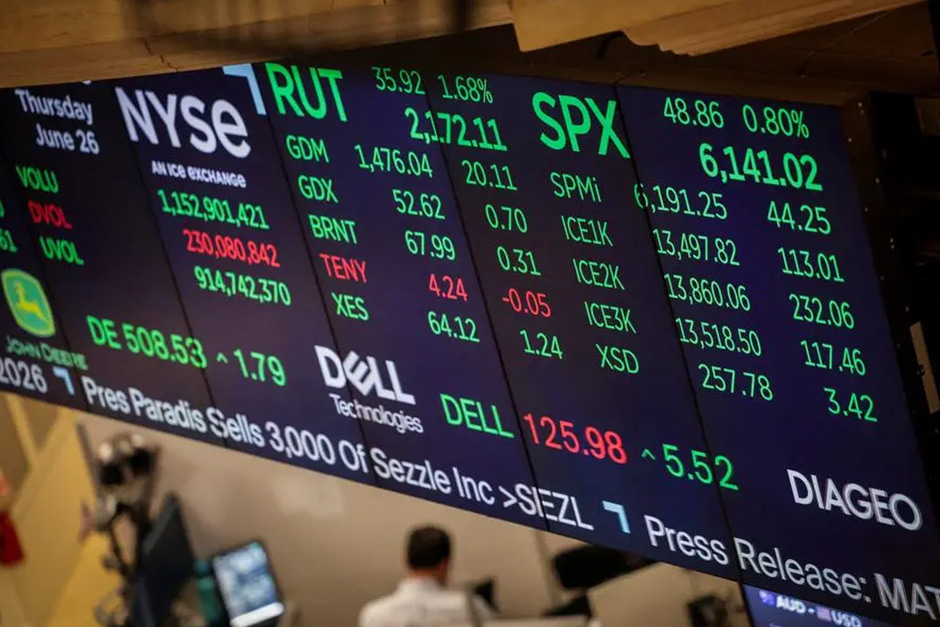
Recent trading sessions have seen benchmark indices, the S&P 500 and Dow Jones Industrial Average, close at unprecedented highs. This remarkable ascent has unfolded even as discussions around the independence of the Federal Reserve have garnered attention, with many market participants seemingly prioritizing other factors in their immediate investment calculus.
The Engines of Market Momentum
The S&P 500 and Dow’s journey to record levels isn’t happening in a vacuum. A confluence of factors appears to be bolstering investor confidence. Strong corporate earnings reports from various sectors have consistently exceeded expectations, providing tangible evidence of business health. Alongside this, robust economic data, including steady employment figures and resilient consumer spending, paints a generally positive picture of an economy that continues to defy some earlier predictions of slowdowns.
The market also appears to be pricing in a relatively stable outlook for interest rates, with expectations of potential future adjustments that could further support economic activity. This optimistic blend of solid financial performance and encouraging economic indicators seems to be a primary driver behind the current market enthusiasm, overshadowing some of the broader macroeconomic uncertainties that often captivate headlines.
Why Traders Are Shrugging Off Fed Independence Worries
Amidst this market optimism, a nuanced conversation around the Federal Reserve’s independence has periodically surfaced. The core concern revolves around the principle that a central bank should operate free from political pressures to effectively manage monetary policy and maintain economic stability. When this independence is perceived to be challenged, it can raise questions about future policy decisions and their potential impact on inflation and growth, theoretically leading to increased market volatility.
Yet, the market’s response suggests that for many traders, these discussions, while important, are not currently overriding the immediate economic signals. Investors often prioritize tangible data points like corporate earnings, inflation reports, and job growth. As one veteran market observer recently commented, “While the long-term health of our financial institutions, including the Fed’s independence, is undoubtedly crucial, day-to-day trading is often driven by earnings reports, consumer confidence, and the prevailing economic narrative. Traders are generally reacting to the data in front of them right now.” This perspective highlights a tendency to differentiate between theoretical institutional concerns and practical, short-to-medium term investment drivers.
A Balancing Act of Perception and Performance
This market behavior highlights an ongoing tension between institutional integrity discussions and the raw data of economic performance. Investors are continuously evaluating various inputs – from geopolitical events to domestic policy debates – but their current actions suggest a strong inclination towards tangible economic health and corporate profitability. It underscores the market’s forward-looking nature, often attempting to discount future events while simultaneously remaining anchored to present-day realities.
Conclusion
In essence, the market’s ability to reach new pinnacles while simultaneously acknowledging underlying discussions about central bank autonomy speaks volumes about prevailing investor sentiment. It suggests a current environment where the pursuit of growth and the evidence of economic resilience are powerful enough to overshadow certain institutional concerns. As these dynamics continue to evolve, observers will be keen to see how this delicate balance of perception and performance continues to shape the trajectory of major indices.

