


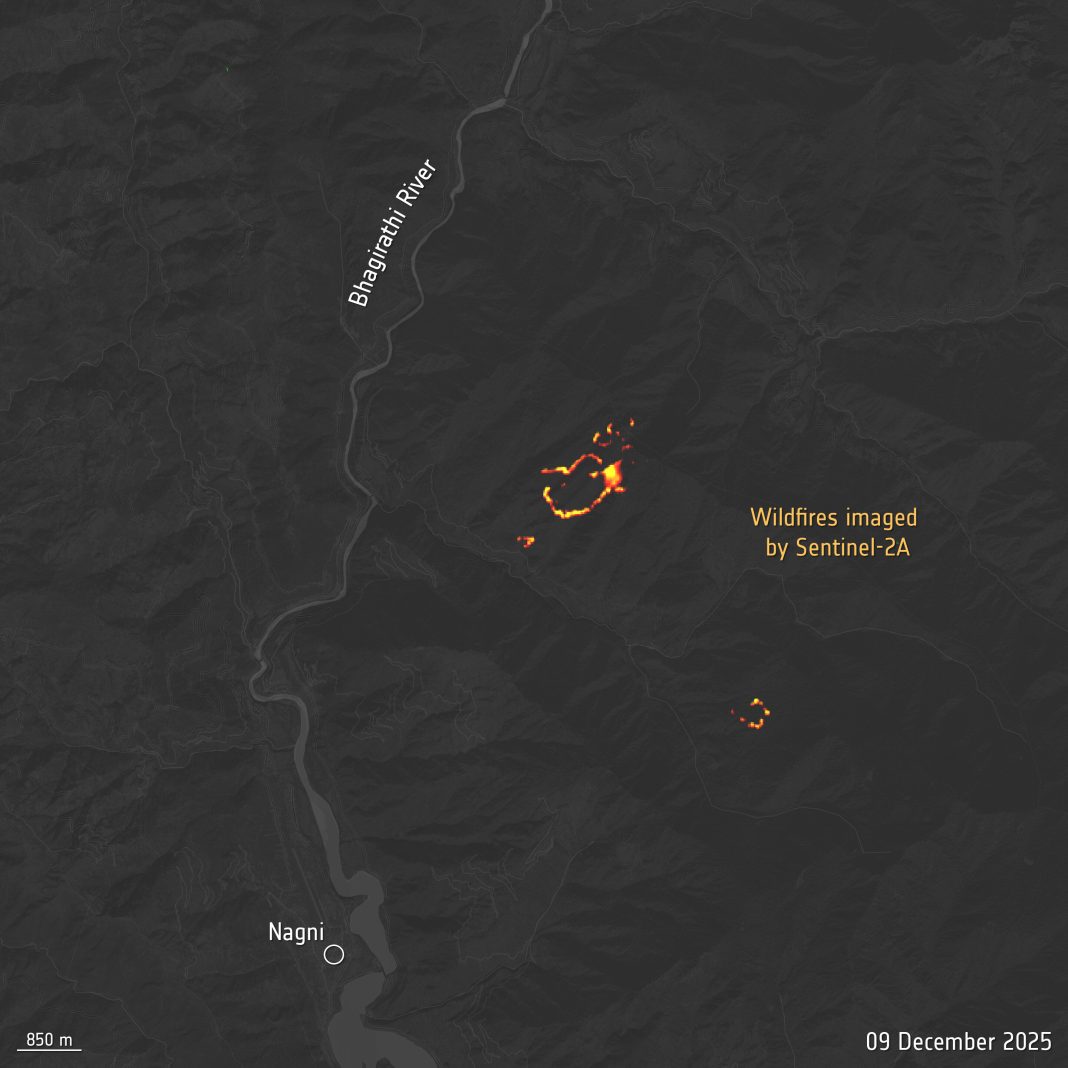
In the vast expanse of Earth observation, satellites tirelessly orbit our planet, capturing invaluable data that shapes our understanding of dynamic landscapes and human activities. Among these technological marvels is the European Space Agency’s (ESA) Sentinel-2 mission, a twin pair of satellites renowned for their high-resolution optical imagery. While primarily designed to observe the Earth in daylight, the concept of “Sentinel-2 explores night vision” might initially seem paradoxical. However, a deeper look reveals how the mission, through its detailed daytime observations, provides crucial foundational insights that are indispensable for understanding, planning, and responding to events that unfold after sundown, particularly within the diverse and challenging terrains of India.
Illuminating the Dark: Sentinel-2’s Indirect Night-Time Contributions
Sentinel-2 is equipped with an advanced multispectral imager that captures reflected sunlight across 13 spectral bands, offering resolutions ranging from 10 to 60 metres. Its primary applications include monitoring land cover change, agriculture, forest management, water bodies, and coastal zones. Crucially, Sentinel-2 does not possess traditional night vision capabilities, such as thermal infrared sensors that detect heat emitted by objects, or low-light visible sensors designed to pick up faint ambient light like moonlight or artificial illumination. Its strength lies in its ability to provide incredibly detailed and up-to-date maps of the Earth’s surface during the day.
How, then, does it “explore night vision”? The answer lies in its foundational data. Accurate, high-resolution daytime maps of infrastructure, land use, and terrain are paramount for any nocturnal operation. For instance, in disaster management, whether it’s planning for night-time search and rescue operations after a flood or navigating through areas affected by earthquakes, Sentinel-2’s pre-disaster imagery can pinpoint crucial details: the exact location of roads, buildings, bridges, and even temporary settlements that might not be visible or safely accessible in the dark. In India, with its varied geography prone to natural calamities, this geospatial intelligence is vital for agencies like the National Disaster Response Force (NDRF).
Furthermore, Sentinel-2’s ability to detect subtle changes over time, such as new construction or deforestation during the day, can indirectly inform night-time monitoring efforts. Identifying rapid urban sprawl in cities like Bengaluru or Hyderabad, for example, helps planners anticipate new areas of human activity and associated infrastructure needs, which naturally translate into night-time light emissions and energy demands. This proactive mapping during daylight hours forms the bedrock for understanding and managing the nocturnal landscape.
Mapping the Unseen: Geospatial Data for Nocturnal Planning
While satellites like the Suomi NPP VIIRS DNB (Visible Infrared Imaging Radiometer Suite Day/Night Band) directly capture night-time lights, Sentinel-2’s detailed daytime imagery offers a complementary layer of context. Imagine monitoring the expansion of illegal mining activities in resource-rich states like Jharkhand or Chhattisgarh. While night-time satellite imagery might reveal new clusters of lights indicative of such operations, Sentinel-2’s high-resolution daytime observations can precisely map the associated deforestation, earthworks, and infrastructure development, providing irrefutable evidence and aiding in planning enforcement actions, some of which might need to be conducted under the cover of darkness.
The agricultural sector in India also benefits. By mapping crop types, irrigation patterns, and soil moisture during the day, Sentinel-2 data supports precision agriculture. This daytime intelligence can inform night-time irrigation schedules or pest control applications, optimizing resource use and minimizing waste. Similarly, in remote border regions, understanding the exact topography, vegetation cover, and access routes from Sentinel-2’s daylight scans is crucial for security forces planning night patrols or surveillance missions. The precision of its mapping ensures that ground teams have the most accurate situational awareness possible, even when their own visibility is limited.
The integration of Sentinel-2 data with other geospatial technologies amplifies its impact. When combined with ground-based sensors, drones, or other satellite missions (including those with night-time capabilities), Sentinel-2’s contribution solidifies a comprehensive understanding of the Earth. This holistic approach is essential for addressing complex challenges, from monitoring illegal fishing in coastal waters to tracking wildlife movements in national parks, where operations often span across day and night cycles.
“The ability to precisely map our dynamic landscape during the day, even with Sentinel-2’s optical sensors, provides an invaluable foundation for understanding and managing our planet’s nocturnal challenges, from disaster response to urban growth. It’s about building a complete picture, day and night, for a more resilient India.” – Dr. Anjali Sharma, Geospatial Scientist at the Indian Institute of Remote Sensing (IIRS), Dehradun.
The Future of Integrated Geospatial Intelligence
The exploration of “night vision” by Sentinel-2 isn’t about literally seeing in the dark, but rather about providing the indispensable groundwork that makes effective night-time operations and analysis possible. Its consistent, high-resolution daytime data forms a critical layer in the ever-evolving tapestry of geospatial intelligence. For a nation like India, grappling with rapid development, climate change impacts, and diverse security needs, leveraging Sentinel-2’s capabilities means more informed decision-making, better preparedness for emergencies, and a clearer understanding of its vast and varied geography, day in and day out.
As technology advances, the synergy between different satellite missions – those excelling in daylight optical imaging like Sentinel-2, and those specializing in night-time light detection or thermal sensing – will only deepen. This integrated approach promises a future where our understanding of Earth is seamless, bridging the gap between day and night, empowering us to tackle global and local challenges with unprecedented clarity and precision.
—

