


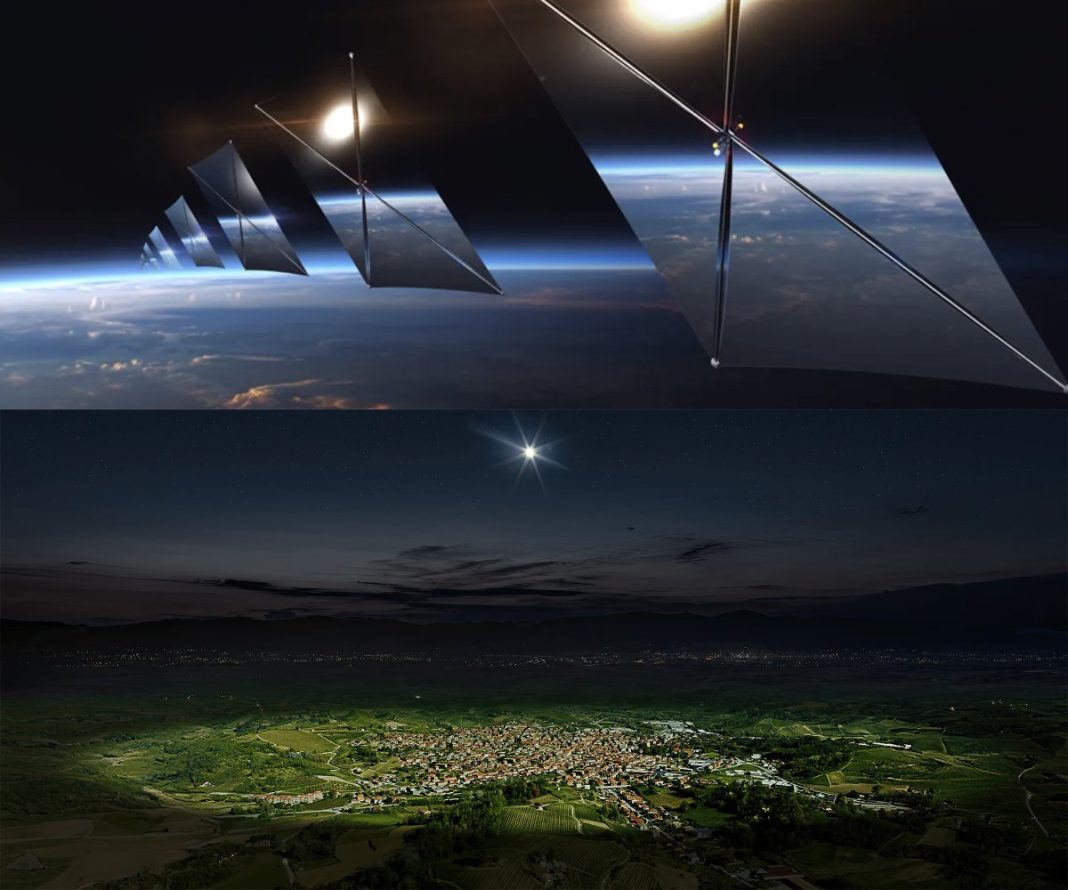
Imagine a world where the night sky, instead of being a canvas of twinkling stars and a serene moon, is illuminated by a persistent, artificial glow from giant mirrors orbiting our planet. Sounds like something out of a futuristic novel, doesn’t it? Well, this isn’t just fiction. The concept of massive space mirrors designed to reflect sunlight back to Earth, ostensibly to “light up” specific regions, has been floated by some with grand visions – often for exclusive, high-end applications catering to the wealthy. However, the scientific community is largely saying a resounding “no” to these dazzling, yet deeply problematic, proposals.
The Lure of the Artificial Dawn (and its Dark Side)
The allure of a manufactured dawn might seem captivating to a select few. Perhaps for extending opulent events, enhancing private estates, or even unique agricultural experiments in controlled environments, the idea of bespoke daylight could hold a certain charm. Proponents might argue for its novelty or even its potential to energize specific areas. Yet, beneath this shiny facade lies a multitude of serious concerns that scientists are quick to point out. The primary objections aren’t about technological feasibility, but about the profound and potentially irreversible ecological, astronomical, and social consequences.
The most immediate and pervasive worry revolves around light pollution. We already grapple with the detrimental effects of terrestrial light pollution, obscuring our view of the cosmos and disrupting natural ecosystems. Introducing giant, orbital light sources would amplify this problem exponentially, bathing vast areas in an unnatural, constant luminosity. This isn’t just about losing the beauty of the Milky Way; it’s about fundamentally altering one of Earth’s most basic rhythms: day and night.
Ecosystems, Astronomy, and the Greater Good
The delicate balance of Earth’s ecosystems relies heavily on the natural cycle of light and darkness. Nocturnal animals, from insects crucial for pollination to predators that hunt under the cover of night, would face unprecedented disruption. Their breeding patterns, migration routes, and foraging behaviors are intricately linked to the absence of sunlight. Birds, bats, and countless invertebrate species could see their very survival threatened by a perpetual twilight. Even plant growth, which responds to day-length cues, could be thrown into disarray. “The night sky isn’t just a view; it’s a vital part of our planet’s ecological and scientific infrastructure,” asserts Dr. Elara Vance, a leading astrophysicist. “To artificially tamper with it for luxury is to ignore centuries of natural evolution and astronomical discovery.“
Beyond the biological impact, astronomers worldwide are unified in their opposition. Ground-based observatories, already battling local light pollution, would find their work severely compromised or rendered impossible by such an endeavor. The faint signals from distant galaxies, exoplanets, and other celestial phenomena that offer profound insights into the universe’s origins and evolution would be washed out by the pervasive glare from these orbital mirrors. This isn’t just about hindering research; it’s about potentially blinding humanity to the cosmos itself.
Furthermore, the ethical implications are stark. If the primary beneficiaries are a privileged few, while the costs – ecological disruption, astronomical loss, and the loss of a natural night sky for everyone else – are borne globally, it raises serious questions of environmental justice and equity. The consensus among the scientific community is clear: prioritizing such niche desires over planetary health and universal access to natural phenomena is an untenable proposition.
A Call for Planetary Stewardship
Ultimately, the scientific community’s firm “no” to giant space mirrors isn’t merely a rejection of a technological concept; it’s a powerful affirmation of planetary stewardship. It highlights the critical importance of preserving our natural environment, including the delicate rhythm of day and night, and safeguarding our ability to explore and understand the universe around us. As we look towards the future, the emphasis remains on sustainable, Earth-centric solutions that benefit all of humanity and protect the intricate web of life, rather than catering to exclusive and environmentally perilous luxuries.

