


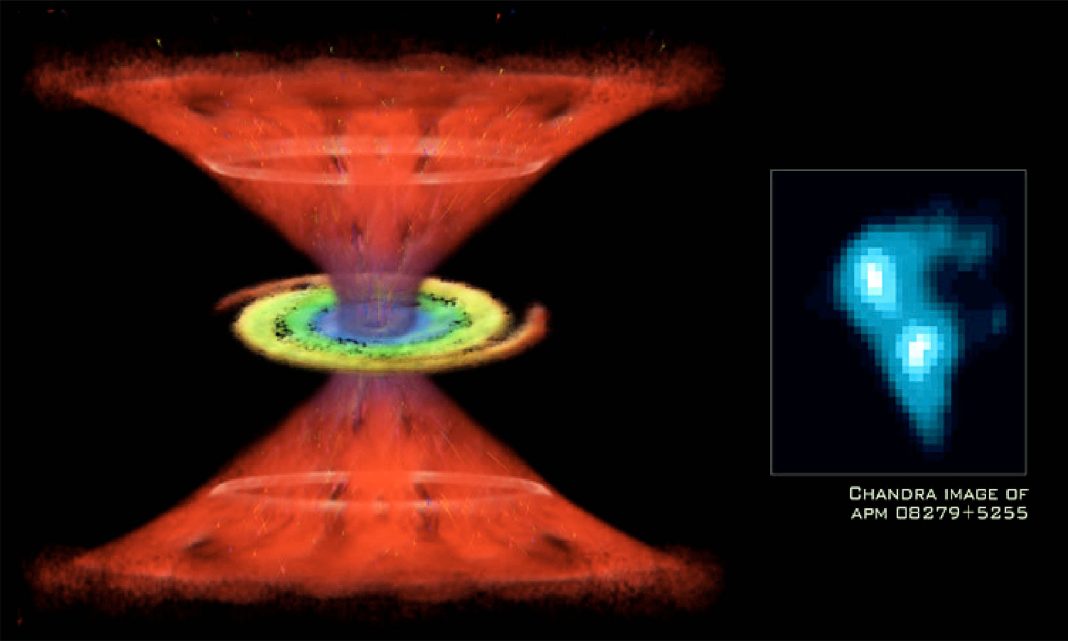
Imagine the deepest, bluest ocean you’ve ever seen. Now, multiply its vastness by trillions. That’s the kind of mind-boggling scale we’re talking about with a recent cosmic revelation: scientists have reportedly found a black hole surrounded by enough water to fill trillions of Earth’s oceans. It’s a discovery that doesn’t just splash; it makes waves across our understanding of the universe.
For most of us, black holes conjure images of destructive cosmic vacuum cleaners, objects so dense that not even light can escape their gravitational pull. The idea of water – the very essence of life as we know it – existing in such close proximity to one seems like something out of science fiction. Yet, the universe continues to surprise us, proving once again that its reality is often stranger and more wondrous than anything we could invent.
The Universe’s Largest Water Cooler
This isn’t water in the form of a vast, liquid ocean swirling around a black hole, as spectacular as that image might be. Instead, we’re talking about colossal amounts of water vapor, detected in the incredibly hot, turbulent environment of an accretion disk surrounding a supermassive black hole. This particular black hole is a quasar, an active galactic nucleus powered by its central black hole, consuming surrounding matter and spewing out immense energy. The water vapor is likely spread across vast regions of this disk, a cosmic cloud of H₂O molecules.
The sheer quantity is what truly boggles the mind. Trillions of Earth’s oceans. It’s almost impossible to conceptualize. Our planet, with its vast Pacific, Atlantic, Indian, Southern, and Arctic oceans, feels like an immense blue marble. To think of trillions of those watery volumes existing in another part of the cosmos, especially near such an extreme object, completely reshapes our perception of water’s prevalence in the universe. It suggests that water, a key ingredient for life, might be far more common and distributed than previously imagined, even in the most unlikely of cosmic neighborhoods.
Beyond the Incredible: Implications for Life and Origins
So, what does this extraordinary finding mean for us? For starters, it provides crucial insights into the early universe. Quasars are incredibly distant, meaning the light we’re seeing from this water-rich environment has traveled billions of years to reach us. Essentially, we’re looking back in time, observing conditions that existed when the universe was much younger. This discovery suggests that water was abundant even in these nascent stages, offering clues about how planets, stars, and even galaxies formed.
It also sparks renewed wonder about the potential for life elsewhere. While direct habitability near a black hole is a non-starter, the widespread presence of water – the universal solvent and a critical molecule for all known life – in such extreme conditions broadens the possibilities. As Dr. Eleanor Vance, an astrophysicist, aptly put it, “This isn’t just a record-breaking amount of water; it’s a profound testament to the universe’s chemical factory, capable of synthesizing the fundamental building blocks of life in places we once thought utterly hostile. It fundamentally shifts our understanding of water’s cosmic abundance.”
This incredible find isn’t just a scientific curiosity; it’s a profound reminder of the universe’s infinite capacity for surprise. It challenges our assumptions, expands our horizons, and fuels our inherent drive to explore and understand the cosmos. Who knows what other incredible secrets are waiting to be unveiled in the depths of space?
The universe continues to prove that it is far more dynamic, more surprising, and more wondrous than we could ever dream. And sometimes, those dreams involve oceans of water near cosmic behemoths, urging us to look up and ponder the incredible story unfolding above our heads.

