


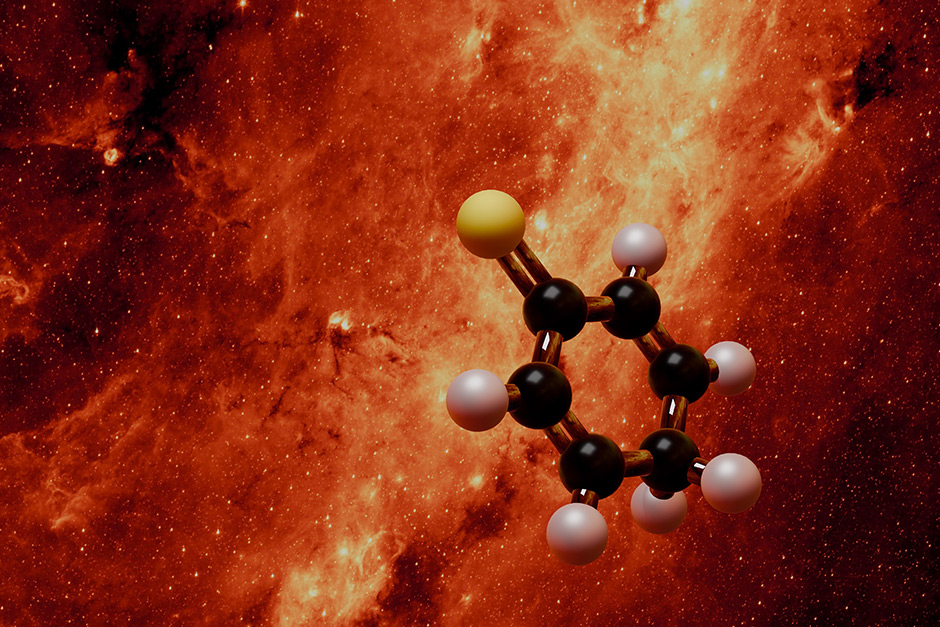
Imagine peering into the vast, dark canvas of space, not just seeing stars and galaxies, but spotting the very first threads of life. For millennia, humanity has gazed upwards, pondering our origins. How did life, in all its intricate glory, begin on our pale blue dot? What if the answers weren’t just hidden in ancient Earth rocks, but are actively drifting among the cosmic dust and gas clouds far, far away?
Recent groundbreaking news from the scientific community has thrown a powerful new beam of light onto this ultimate question. Scientists have discovered a complex organic molecule in the depths of space, a finding that’s sending ripples of excitement through astrobiology labs worldwide. It’s not just any molecule; it’s one that strongly hints at the fundamental building blocks of life being forged in the universe itself, long before any planet was even ready to host it.
A Cosmic Catalyst Found
The molecule in question, identified in an expansive interstellar cloud – a stellar nursery where new stars are born – is a surprising find. While astronomers have detected simpler organic molecules in space before, this particular discovery represents a significant leap. It’s a prebiotic molecule, meaning it’s a precursor to the more complex biological compounds essential for life as we know it, like amino acids or sugars. Think of it as a crucial ingredient on the universal grocery list for life.
Finding such a molecule in a harsh, cold environment so far from any habitable zone suggests that the chemical processes required to create these fundamental components are not unique to Earth. They are happening out there, in the cosmic crucible, perhaps quite commonly. This discovery bolsters the idea that the universe might be inherently “primed” for life, scattering its essential ingredients like cosmic stardust.
Rewriting Life’s Opening Chapter
Why is this such a big deal? For years, scientists have debated whether life’s foundational molecules originated on Earth through specific geological and atmospheric conditions, or if they were delivered from space via meteorites and comets. This new discovery leans heavily towards the latter, suggesting that the “seeds” of life could have been raining down on early Earth, ready to kickstart biology.
Imagine tiny, microscopic packages of life’s potential, delivered from beyond our solar system, perhaps hitching a ride on icy comets that bombarded our young planet. This doesn’t just answer questions about Earth; it opens up staggering possibilities for life elsewhere. If these building blocks are being created universally, then the chances of other planets and moons harboring life, even microbial, suddenly seem much higher.
“This isn’t just about finding a new molecule; it’s about discovering a universal truth,” explains Dr. Anya Sharma, a theoretical astrobiologist we spoke with. “It profoundly shifts our perspective, suggesting that life’s starting gun fired across the cosmos, not just in one isolated corner. It makes you wonder how many other worlds out there received the same cosmic delivery.”
The Universe’s Infinite Potential
This revelation isn’t just a win for chemistry or astronomy; it’s a win for our collective imagination. It whispers of a universe brimming with potential, where the fundamental chemistry required for life isn’t an anomaly but a standard feature. It pushes us to look harder, to build better telescopes, and to send more ambitious probes, all in the hope of finding further evidence of life’s ubiquitous nature.
The search for extraterrestrial life has often felt like looking for a needle in an impossibly vast haystack. But if the hay itself is made of life’s essential threads, the search becomes less daunting and infinitely more exciting. We are on the precipice of understanding not just how our life began, but how life itself begins, everywhere and anywhere in the universe.
This discovery reminds us that we are part of an immense cosmic story, a grand narrative written in starlight and stardust. And as we continue to unravel its secrets, we find ourselves a little less alone, a little more connected to the boundless wonders above.

