


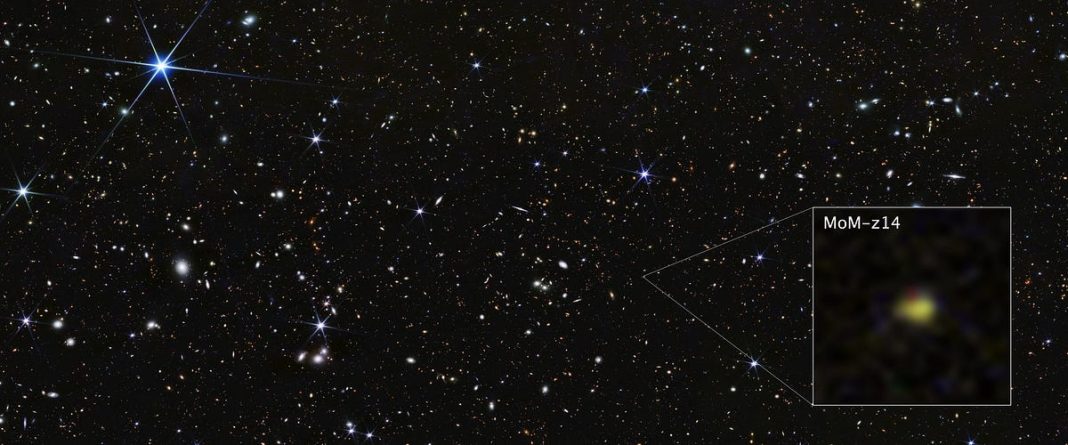
The cosmos is a vast, ancient tapestry, and occasionally, scientists pull back a corner to reveal a thread far older and more intricate than previously imagined. Such is the case with a recent monumental discovery: a galaxy that formed an astonishingly short 280 million years after the Big Bang. This finding isn’t just a new dot on a cosmic map; it’s a profound re-evaluation of how quickly the universe sprang to life and began assembling its grand structures.
An Unprecedented Glimpse into the Early Universe
To truly grasp the significance of this discovery, we need to consider the timeline of the universe. The Big Bang, the event that created everything, occurred approximately 13.8 billion years ago. For the first few hundred million years, the universe was largely a “cosmic dark age”—a period after the initial glow faded but before the first stars and galaxies had ignited. Scientists theorized that large, complex structures like galaxies would take considerable time to coalesce from the primordial gas and dark matter.
Finding a fully-formed galaxy just 280 million years into this cosmic saga is akin to finding a sprawling city shortly after the ground was broken for its first building. It suggests that star formation and galaxy assembly processes were far more efficient and rapid in the universe’s infancy than current models predict. This early galaxy provides a direct observation from a time when the universe was less than 2% of its current age, offering a window into the “epoch of reionization” when the first stars and galaxies began to light up the cosmos and transform the neutral hydrogen gas that pervaded space.
“It’s like finding a fully grown tree in a forest that we thought was still just saplings,” explains Dr. Anya Sharma, a theoretical astrophysicist. “This fundamentally changes our timelines for how quickly the universe assembled its structures.”
The Cosmic Time Machine: How We See So Far Back
How do scientists spot something so incredibly distant and ancient? The answer lies in the fundamental principles of light and the expansion of the universe. When we look at distant objects in space, we’re essentially looking back in time. The light from this newly discovered galaxy has traveled for 13.5 billion years to reach us, meaning we are observing it as it appeared shortly after its birth.
The instrument primarily responsible for this groundbreaking observation is the James Webb Space Telescope (JWST). Unlike its predecessor, Hubble, JWST specializes in observing the universe in infrared light. As the universe expands, light from distant objects gets stretched, shifting towards the redder (longer wavelength) end of the spectrum—a phenomenon known as “redshift.” Galaxies from the extremely early universe are so redshifted that their visible light shifts entirely into the infrared range. JWST’s advanced infrared cameras and spectrographs are uniquely equipped to detect these faint, stretched signals, allowing astronomers to pierce through the cosmic dark ages and witness the very first flickers of galactic light.
Rewriting Cosmic History Books
This discovery isn’t merely an intriguing anomaly; it presents a significant challenge to existing cosmological models. The sheer speed at which this galaxy appears to have formed suggests that the mechanisms driving early star formation and galaxy growth might be more complex or different than previously understood. It prompts a re-examination of how early dark matter halos, the invisible scaffolding upon which galaxies are built, might have aggregated, and how efficiently gas was converted into stars in such a young universe.
The finding opens a new frontier for research. Scientists will now seek to understand what kind of stars populated these nascent galaxies, how heavy elements were produced so early, and what implications this has for the evolution of the universe as a whole. This early galaxy serves as a tantalizing hint that the universe might have been “waking up” and forming complex structures much faster and more vigorously in its infancy than we had ever dared to imagine.
The identification of this extremely ancient galaxy marks a pivotal moment in our quest to understand cosmic origins. It pushes the boundaries of our knowledge, inviting us to revise our timelines and perhaps even our fundamental theories about how the universe evolved from a uniform expanse to the structure-rich cosmos we inhabit today. As JWST continues its observations, we can anticipate many more revelations that will undoubtedly continue to reshape our cosmic story.

