


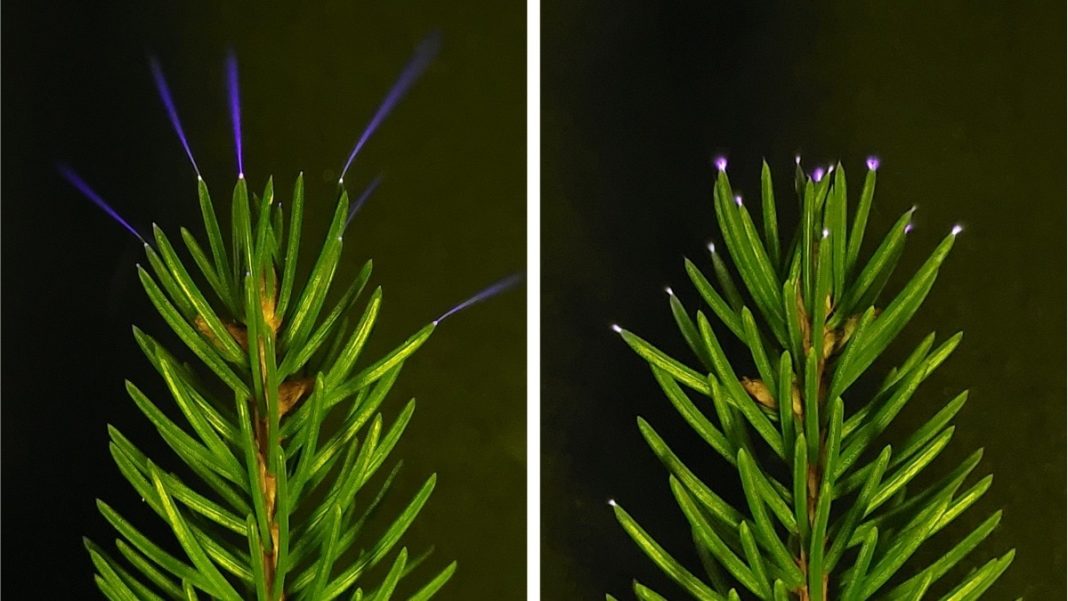
For a century, the idea lay dormant in scientific journals – a theoretical whisper suggesting that trees might not merely stand as passive observers of the Earth’s dramatic atmospheric electricity, but actively participate in its silent, invisible dance. Early 20th-century physicists, armed with rudimentary instruments and keen observational skills, theorised that trees, with their intricate branching structures and countless leaf tips, could act as natural conduits, facilitating the exchange of electrical charge between the ground and the sky. Now, international research teams have finally captured irrefutable visual evidence of these faint, electric sparkles emanating from trees, turning a century-old hypothesis into a stunning modern reality.
The Unseen Dance: A Century of Theory
The concept of atmospheric electricity has fascinated scientists for centuries, from Benjamin Franklin’s daring kite experiments to the complex models of today. Early in the 20th century, as understanding of electromagnetic phenomena grew, some scientists began to speculate on the role of flora in this grand electrical system. They proposed that trees, especially tall ones, could act as “point discharge” mechanisms. Imagine a tree reaching skyward; its myriad leaves and branches, ending in sharp points, could create localized electric fields strong enough to ionize the air around them, especially when the atmospheric electric field is intensified, such as during thunderstorms or even under clear skies. This ionization, they theorised, would result in tiny, continuous, and often invisible electrical discharges – a gentle, crackling exchange of charge.
However, capturing these fleeting phenomena proved incredibly challenging. The “sparkles” or “coronas” were expected to be extremely faint, easily obscured by ambient light, atmospheric conditions, and the sheer difficulty of observing such microscopic electrical activity on a large, dynamic organism like a tree. Without the advanced sensor technology and high-speed imaging capabilities available today, direct observation remained elusive, relegating the idea to the realm of intriguing, unproven theory for generations.
Capturing the Invisible: The Breakthrough
Fast forward to the present, and the convergence of sophisticated optics, ultra-sensitive photodetectors, and high-speed cameras has finally allowed scientists to pierce through the veil of invisibility. Recent collaborative efforts involving teams from various international institutions have deployed state-of-the-art equipment in diverse forested regions, from temperate woodlands to tropical rainforests. These advanced setups were designed to detect minute light emissions and electromagnetic signatures that would have been imperceptible to earlier generations of researchers.
The results are nothing short of spectacular: researchers have successfully recorded faint, intermittent electrical discharges from the canopy of trees, confirming the long-held theory. These discharges manifest as tiny, bluish or purplish glows – genuine “electric sparkles” – emanating primarily from the tips of leaves and branches. These observations typically occur when the ambient atmospheric electric field is elevated, demonstrating how trees actively participate in the global electrical circuit. “It’s like finally hearing the silent symphony that nature has been playing for a hundred years,” says Dr. Anjali Sharma, a lead researcher in atmospheric physics, reflecting on the discovery. “This validation underscores the incredible foresight of early scientists and opens new avenues for understanding our planet’s fundamental processes.” The breakthrough not only confirms historical hypotheses but also provides crucial data on the frequency, intensity, and environmental conditions under which these discharges occur.
Implications for India and Beyond
This groundbreaking discovery holds significant implications, particularly for countries like India with its vast and diverse forest ecosystems, ranging from the dense rainforests of the Western Ghats to the Himalayan temperate forests and the mangrove forests of the Sundarbans. Understanding how trees interact with atmospheric electricity can have far-reaching effects on various fields.
Firstly, it could refine our models of atmospheric chemistry and cloud formation. The ionization of air caused by these discharges can create aerosols and reactive chemical species, influencing air quality and potentially affecting regional weather patterns. For India, grappling with air pollution challenges and the vagaries of monsoon cycles, this knowledge could be invaluable. Secondly, it offers new perspectives on lightning strike prediction and protection. If trees are actively modulating local electric fields, understanding this interaction could lead to more accurate lightning forecasts and improved strategies for safeguarding both natural environments and human infrastructure, especially in regions prone to severe thunderstorms.
Furthermore, the discovery adds a new layer to our understanding of forest ecology and tree physiology. Are these electrical interactions vital for tree health or communication? Could they influence nutrient uptake or resistance to pests? This interdisciplinary research underscores the profound interconnectedness of biological and geophysical systems, revealing trees not just as carbon sinks or oxygen producers, but as dynamic electrical components of our living planet. It prompts us to re-evaluate how forests contribute to the Earth’s electrical balance and, by extension, to global climate regulation.
The capture of electric sparkles on trees marks a momentous occasion in scientific discovery, bridging a century of theoretical inquiry with modern technological prowess. It reminds us that even in our highly observed world, nature continues to hold profound secrets, silently at play, waiting for the curious mind and the right tools to reveal their subtle brilliance. This newfound understanding promises to enrich our perception of forests and the crucial role they play in the intricate electrical tapestry of Earth.

