


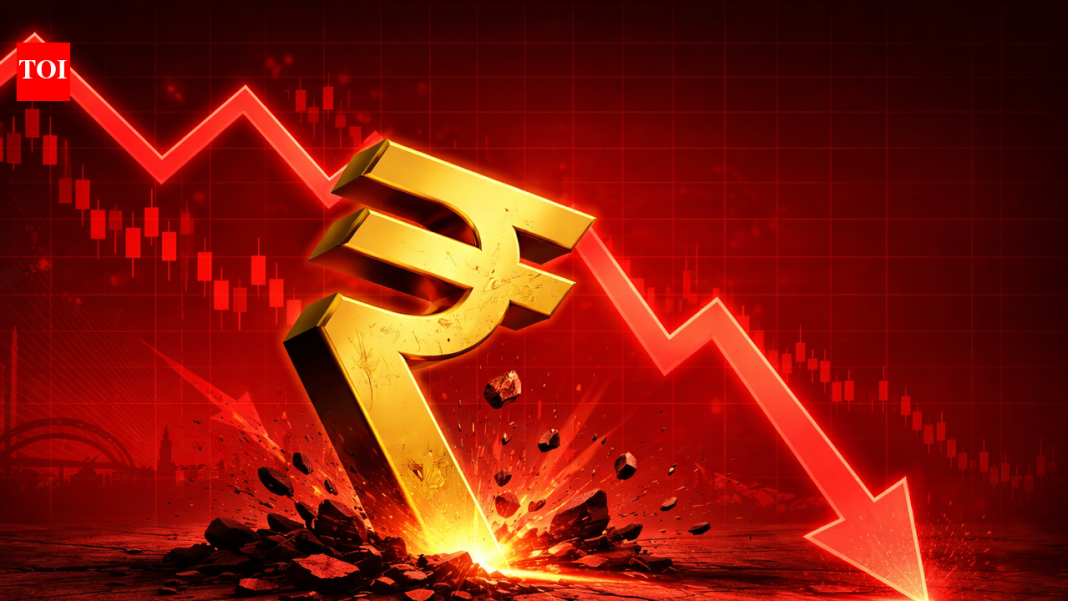
The Indian Rupee has once again found itself battling significant global headwinds, plummeting to a new historic low of 93.94 against the US Dollar. This latest dip marks a critical moment for the Indian economy, signaling the escalating impact of international geopolitical tensions, particularly those emanating from the Middle East, coupled with broader global economic shifts. The depreciation, while partly a reflection of dollar strength, has far-reaching implications for India’s trade, inflation trajectory, and overall economic stability.
Global Headwinds Fuel Dollar’s Ascent
The primary catalyst for the Rupee’s recent slide is a potent combination of geopolitical instability and a strengthening US Dollar. Tensions in the Middle East have significantly escalated, raising concerns about potential disruptions to global oil supplies. India, being one of the world’s largest net importers of crude oil, is acutely vulnerable to such developments. Higher crude oil prices translate directly into increased demand for US dollars to fund these essential imports, naturally exerting downward pressure on the Rupee.
Beyond oil, the US Dollar continues to benefit from its enduring status as a safe-haven asset. During periods of global uncertainty and risk aversion, investors traditionally flock to the perceived safety and liquidity of the dollar, pulling capital from emerging markets like India. This “flight to safety” effect is compounded by the US Federal Reserve’s sustained hawkish stance. With US interest rates remaining relatively high, the allure of better returns in the US market encourages foreign portfolio investors (FPIs) to withdraw funds from Indian equities and debt, further exacerbating the Rupee’s weakness.
“The current depreciation is a confluence of persistent external pressures, primarily geopolitical risk driving crude higher and the ongoing global monetary tightening cycle favouring the dollar,” remarked Dr. Anjali Sharma, a Mumbai-based macroeconomist. “While the RBI has demonstrated a robust defence of the Rupee historically, it’s a continuous battle against formidable global currents.”
Economic Ripples: Impact on India
A weakening Rupee, especially one hitting record lows, sends ripples across various facets of the Indian economy. For consumers, the most immediate and tangible impact is often felt through rising inflation. As imports become costlier – ranging from crude oil and edible oils to electronics and capital goods – these higher costs are invariably passed on to the end consumer. This phenomenon is particularly challenging in India, where managing inflation remains a key policy objective for the Reserve Bank of India (RBI).
Businesses relying heavily on imported raw materials or components face increased operational costs, potentially squeezing profit margins or necessitating price hikes for their finished products. While a weaker Rupee theoretically makes Indian exports more competitive in international markets, this benefit is often mitigated by a global economic slowdown or the increased cost of imported inputs for export-oriented industries. On the other hand, non-resident Indians (NRIs) and their families stand to benefit from the current scenario, as their remittances in dollars fetch a higher Rupee equivalent.
The depreciation also raises concerns about India’s external debt servicing. A stronger dollar means that repaying dollar-denominated loans becomes more expensive in Rupee terms, posing a challenge for corporations and government entities with significant foreign currency borrowings. Foreign direct investment (FDI) inflows, while generally more resilient, could also face headwinds if investors perceive higher currency volatility as an increased risk.
RBI’s Tightrope Walk: Managing Volatility
The Reserve Bank of India plays a crucial role in managing the Rupee’s exchange rate, though its stated policy is to intervene only to curb excessive volatility rather than targeting a specific level. In response to the Rupee’s recent declines, the RBI is likely to continue its strategy of intervening in the foreign exchange market by selling dollars from its substantial foreign exchange reserves. Such interventions aim to increase dollar supply in the market, thereby absorbing some of the depreciation pressure on the Rupee.
However, continuous intervention can lead to a depletion of reserves, albeit from a healthy base. The central bank must balance the imperative to maintain currency stability with the need to preserve its foreign exchange buffer. Another policy tool at the RBI’s disposal is monetary policy. While an interest rate hike could make the Rupee more attractive to foreign investors, potentially slowing capital outflows, the RBI must also consider its impact on domestic economic growth and existing inflation pressures. Raising rates to defend the currency could inadvertently stifle credit growth and investment, impacting India’s overall growth trajectory.
The current environment demands a delicate balancing act from policymakers. While external factors are largely beyond India’s control, prudent fiscal management, continued efforts to attract stable foreign investment, and targeted interventions by the RBI will be crucial in navigating these turbulent currency waters. The Rupee’s journey ahead will largely depend on the evolution of geopolitical tensions and the global monetary policy landscape, making vigilance and adaptability paramount for India’s economic resilience.

