


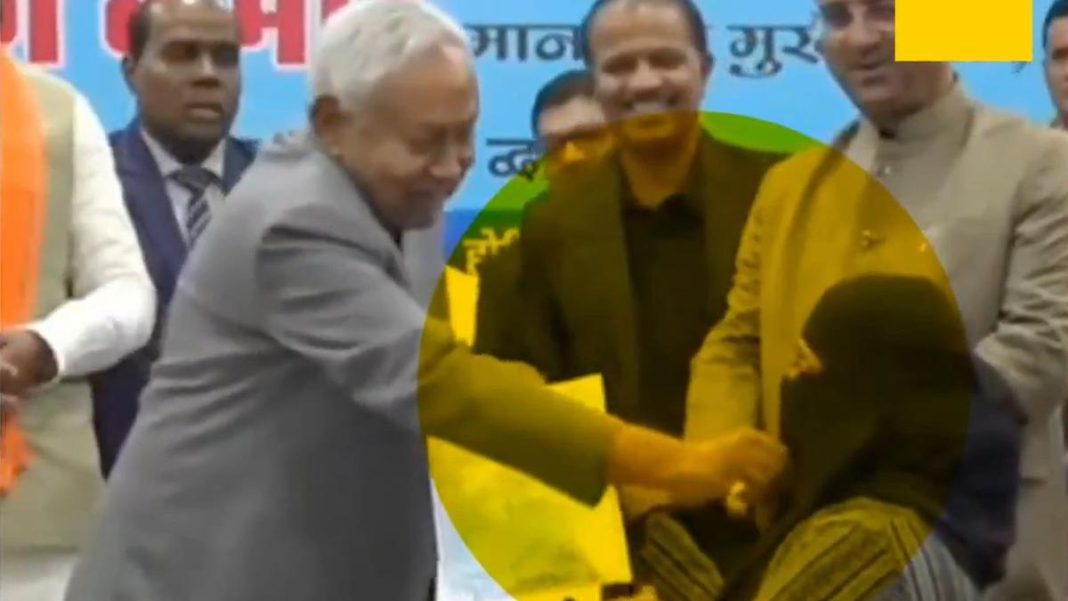
A recent video showing Bihar Chief Minister Nitish Kumar removing a woman’s hijab during a public event has ignited a significant political firestorm, drawing sharp criticism from the Rashtriya Janata Dal (RJD) and sparking a wider debate about respect for religious symbols and personal autonomy. The incident, which quickly went viral across social media platforms, has put the Janata Dal (United) leader on the defensive and provided fresh ammunition to the opposition in a politically charged state.
The Viral Incident and Immediate Reactions
The controversial video clip, widely circulated since its emergence, captures Chief Minister Nitish Kumar at what appears to be a public interaction or a grievance redressal camp in Bihar. In the footage, as he converses with a woman, the Chief Minister is seen reaching out and removing her head covering, which appears to be a hijab or a similar headscarf. The exact context leading up to this action remains a point of contention and speculation. While some initial reports suggested the woman might have been feeling unwell, or that the CM was attempting to adjust something, the visual act itself quickly overshadowed any potential underlying explanation.
The immediate reaction on social media was one of shock and concern. Many users highlighted the perceived disrespect for a woman’s personal choice and religious attire, irrespective of intent. In a country as diverse as India, where religious symbols hold deep cultural and personal significance, such an act by a prominent public figure inevitably triggers intense scrutiny. Critics were quick to point out that even if the intent was benevolent, the act of a male Chief Minister publicly removing a woman’s head covering without her explicit consent is seen by many as an overreach and an infringement on her dignity.
RJD’s Strong Condemnation and Political Fallout
The Rashtriya Janata Dal, Bihar’s principal opposition party, wasted no time in seizing upon the incident, launching a scathing attack on Chief Minister Nitish Kumar. Senior RJD leaders and spokespersons condemned the act as an affront to religious freedom and a display of authoritarianism. They accused the Chief Minister of disrespecting Muslim women and their cultural practices.
Tejashwi Yadav, the leader of the opposition and a vocal critic of the Nitish Kumar government, was among those who lambasted the CM. The RJD framed the incident as symptomatic of a deeper insensitivity towards minorities and a disregard for constitutional values. Party spokespersons highlighted the importance of maintaining neutrality and respect for all communities, particularly by individuals holding high public office.
“This act by Chief Minister Nitish Kumar is highly objectionable and reflects a profound lack of respect for personal dignity and religious sentiments,” stated an RJD spokesperson. “It is not just about a piece of cloth; it is about the autonomy of a woman and her right to practice her faith without interference, especially from the state’s highest executive. Such behavior from a Chief Minister is unacceptable and sets a dangerous precedent.“
The RJD’s criticism also carries significant political weight in Bihar, a state where political alliances and narratives often hinge on issues of social justice, secularism, and representation. With a substantial Muslim population, the incident is likely to resonate deeply within various communities, potentially influencing political discourse and electoral calculations in the run-up to future elections.
Questions of Intent and Public Scrutiny
While the video has sparked outrage, the Chief Minister’s office or the JD(U) has yet to offer a comprehensive official explanation that might clarify the circumstances or the intent behind Kumar’s action. The absence of a clear and immediate clarification has further fueled speculation and allowed the opposition’s narrative to gain traction. Supporters of the Chief Minister might argue that his intentions were misinterpreted, perhaps an attempt to assist the woman or a spontaneous gesture misconstrued in the viral snippet.
However, in the age of instant information and widespread social media consumption, public figures are under constant scrutiny. Actions, regardless of underlying intent, are often judged by their visible impact and perceived implications. The incident underscores the delicate balance public officials must maintain, particularly concerning interactions that touch upon personal space, religious attire, and cultural norms.
The controversy around Nitish Kumar’s action serves as a stark reminder of the heightened sensitivity surrounding religious symbols and personal autonomy in India’s diverse social fabric. As the RJD continues its attack, and public debate intensifies, the Bihar Chief Minister faces a crucial test of his administration’s ability to address concerns about cultural respect and reassure various communities that their dignity and choices will be upheld.
The political ramifications of this incident are still unfolding, and it remains to be seen how the ruling alliance will navigate this sensitive issue and what long-term impact it will have on Bihar’s political landscape.

