


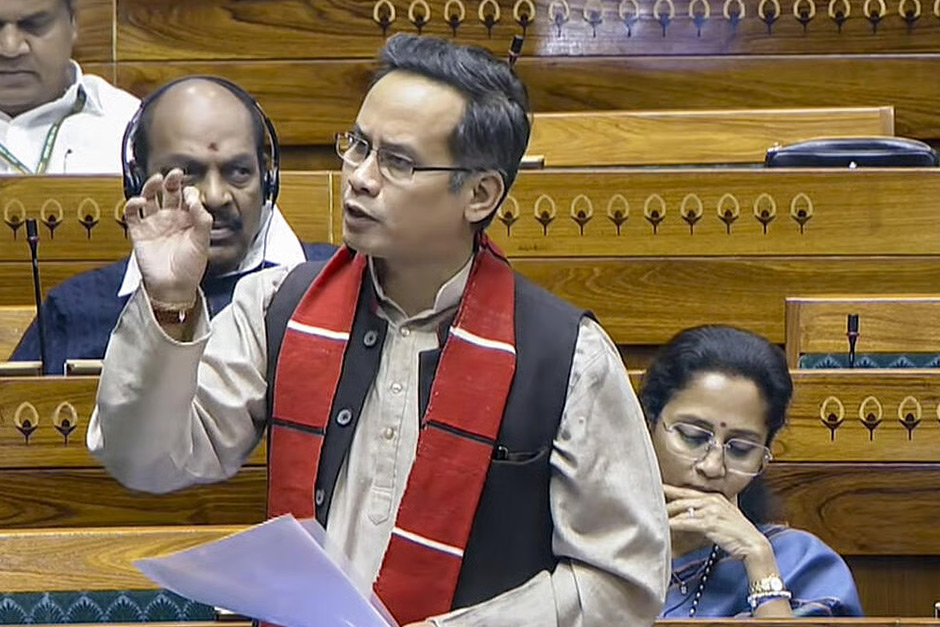
The timeless strains of Vande Mataram, a song deeply intertwined with India’s freedom struggle, have once again taken centre stage in the nation’s political discourse. Recently, Prime Minister Narendra Modi’s remarks concerning the song sparked a sharp retort from Congress MP Gaurav Gogoi, who accused the PM of “rewriting history” and giving the sacred song a “political colour.” This exchange highlights the ongoing battle over historical narratives and the interpretation of national symbols in contemporary Indian politics.
The Contention Over Vande Mataram’s Legacy
The controversy ignited following Prime Minister Modi’s statements, where he reportedly suggested that Vande Mataram had been neglected or politicized by previous governments, implying a lack of appropriate reverence for its place in India’s heritage. This assertion, made in a public forum, drew immediate and strong criticism from the opposition, particularly from the Indian National Congress.
Gaurav Gogoi, a prominent Congress leader and MP from Kaliabor, Assam, wasted no time in countering the Prime Minister’s narrative. He firmly rejected the notion that Vande Mataram was ever sidelined by the Congress. Speaking to the media, Gogoi stated:
“Prime Minister Modi is rewriting history. The Congress has consistently upheld the legacy of Vande Mataram. To suggest otherwise is to give a political colour to a song that embodies the spirit of our nation and its freedom struggle. We have always revered it, and its place in our history is sacrosanct.”
Gogoi’s remarks underscore a fundamental disagreement over historical facts and the ownership of national symbols. He emphasized that the Congress, from its inception, had championed the song and integrated it into its political and cultural fabric, making it an undeniable part of India’s national awakening. The accusation of “rewriting history” suggests a deliberate attempt, according to Gogoi, to appropriate a shared legacy for partisan gains.
Congress’s Stance and Historical Context
Gogoi’s claim that the Congress has consistently upheld the song’s legacy is rooted in historical fact. Vande Mataram, penned by Bankim Chandra Chattopadhyay in 1870 and published in his novel Anandamath in 1882, quickly became an anthem for freedom fighters across the subcontinent. Its evocative lyrics, celebrating the motherland, resonated deeply with the burgeoning nationalist movement. The song was first publicly sung by Rabindranath Tagore at the 1896 session of the Indian National Congress.
Throughout the freedom struggle, Vande Mataram was a rallying cry, sung at countless political gatherings, protests, and revolutionary acts. Leaders from various ideological backgrounds, including those who would later form the core of the Congress party, embraced it enthusiastically. It was not merely a song but a symbol of defiance against colonial rule and an expression of a unified Indian identity. The Congress, as the leading political organization advocating for independence, naturally adopted and promoted the song extensively.
Even after independence, when the Constituent Assembly faced the task of choosing national symbols, Vande Mataram was given the status of the National Song of India, alongside Jana Gana Mana as the National Anthem. This decision reflected its profound historical significance and the widespread reverence it commanded across the political spectrum, including from leaders of the Congress who played a pivotal role in drafting the Constitution.
Political Discourse and Cultural Heritage
The current debate surrounding Vande Mataram is not an isolated incident but rather indicative of a broader trend in Indian politics where historical figures, events, and cultural symbols are frequently reinterpreted through a contemporary political lens. Such discussions often serve to bolster specific ideological positions or to challenge existing narratives.
Critics argue that politicizing national symbols like Vande Mataram can inadvertently dilute their unifying power. When a song universally cherished for its role in the freedom struggle becomes a point of partisan contention, it risks fragmenting national sentiment rather than fostering it. For many, Vande Mataram transcends political affiliations, representing a collective memory of sacrifice and patriotism.
The exchange between Gaurav Gogoi and PM Modi underscores the delicate balance between historical accuracy and political messaging. While political leaders often seek to connect with the public through appeals to shared heritage, the manner in which history is invoked can either unite or divide. As India continues to evolve, the discourse around its foundational symbols like Vande Mataram will likely remain a significant feature of its public life, reflecting ongoing debates about identity, history, and nationhood.
Ultimately, the discussion around Vande Mataram reminds us that national symbols are not static; their meanings are continuously shaped by interpretation, memory, and the political climate of the day. The challenge lies in ensuring that these symbols continue to inspire unity and respect for the diverse strands of India’s rich historical tapestry.

