


“`html
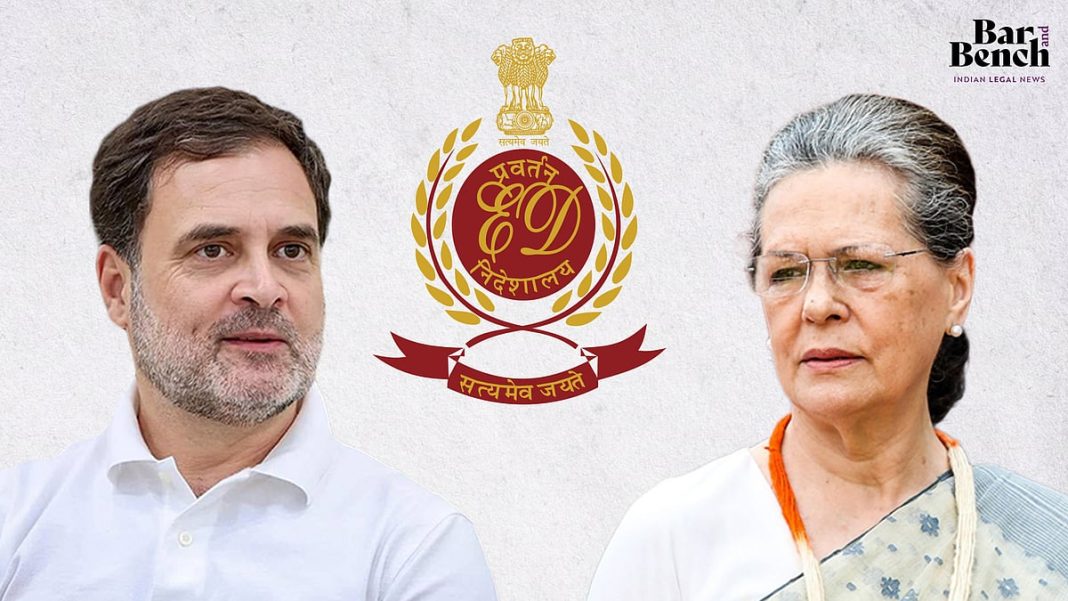
In a significant legal development that has garnered widespread attention across India, a Delhi Court recently dismissed a complaint filed by the Enforcement Directorate (ED) against Congress leaders Sonia Gandhi and Rahul Gandhi in connection with the National Herald money laundering case. This ruling provides a substantial measure of relief to the veteran politicians, marking a crucial turn in a protracted legal battle that has spanned over a decade and remained a consistent point of political contention.
The case, rooted in allegations surrounding the acquisition of Associated Journals Limited (AJL) by Young Indian Pvt. Ltd. (YI), has seen intense scrutiny from various investigative agencies. The ED’s involvement specifically centered on potential money laundering under the Prevention of Money Laundering Act (PMLA). The court’s decision, therefore, is not merely a procedural step but a substantive dismissal of the ED’s specific allegations and its attempt to initiate proceedings against the Gandhis on those grounds.
The Court’s Verdict and its Rationale
The Delhi Court, presided over by Additional Chief Metropolitan Magistrate (ACMM) Shubham Gupta, dismissed the Enforcement Directorate’s complaint citing a lack of sufficient grounds to proceed. The court observed that the ED’s application seeking to make Young Indian (YI) a party to the original complaint filed by Bharatiya Janata Party (BJP) leader Subramanian Swamy was not maintainable under the relevant provisions of the law. Specifically, the court noted that the ED’s role in a PMLA case is to investigate and file a prosecution complaint, not to intervene in a private criminal complaint in this manner.
The ED had sought to bring YI into the fold of Swamy’s case, arguing that YI was directly involved in the alleged money laundering scheme. However, the court’s decision highlighted a fundamental procedural flaw in the ED’s approach, effectively stating that the agency’s complaint could not be entertained in the context it was presented. This legal interpretation emphasizes the strict procedural boundaries within which investigative agencies must operate, particularly when dealing with complex cases involving high-profile individuals.
The ruling indicates that the specific allegations and evidence presented by the ED at this juncture were deemed insufficient or improperly structured to warrant further judicial action against the Gandhis via this particular complaint. This doesn’t necessarily exonerate them from all aspects of the broader National Herald case, which originated from Swamy’s private criminal complaint, but it certainly removes a significant immediate legal hurdle posed by the central investigative agency.
A Decade-Long Legal Saga: Understanding the National Herald Case
The National Herald case dates back to 2012 when BJP leader Subramanian Swamy filed a private criminal complaint accusing Sonia Gandhi, Rahul Gandhi, and others of cheating and breach of trust in the acquisition of Associated Journals Limited (AJL) by Young Indian Private Limited (YI). AJL, established in 1937 by Jawaharlal Nehru, was the publisher of the National Herald newspaper and held valuable real estate assets across various cities.
The crux of Swamy’s allegations was that the Congress party had given a loan of Rs. 90.25 crore to AJL. Subsequently, this debt was assigned to Young Indian Pvt. Ltd. (YI) for a mere Rs. 50 lakh. The Gandhis, along with other Congress leaders, are major shareholders in YI. Swamy contended that this transaction was a fraudulent scheme designed to unlawfully acquire AJL’s assets, estimated to be worth hundreds of crores, and amounted to a criminal breach of trust.
The case has since seen multiple legal twists and turns, including summons issued to the Gandhis and their appearances in court. The Enforcement Directorate later initiated its own probe under the Prevention of Money Laundering Act (PMLA), investigating the financial transactions involved for potential money laundering offenses. The ED’s investigation led to the questioning of both Sonia and Rahul Gandhi, and a provisional attachment of assets worth Rs. 752 crore linked to AJL, though this attachment was later challenged.
This prolonged legal battle has not only involved intricate financial and legal arguments but has also been highly politicized, with the Congress party consistently alleging political vendetta by the ruling government. The case has been a recurring theme in political discourse, often used by the opposition to target the Gandhi family and by the Congress to highlight perceived misuse of central agencies.
Implications and Future Trajectory
The dismissal of the ED’s complaint provides an undeniable moment of respite for Sonia Gandhi and Rahul Gandhi. It significantly weakens the ED’s direct attempt to prosecute them on money laundering charges arising from this specific complaint within the broader National Herald context. While the underlying private criminal complaint by Subramanian Swamy continues, the ED’s independent push has hit a roadblock.
Legal experts view this as a critical win for the defence. As a prominent legal analyst, who wished to remain anonymous due to the ongoing political sensitivity, remarked, “This dismissal underscores the importance of stringent evidence and adherence to procedural norms in PMLA cases. It offers a significant legal victory for the Gandhis, at least regarding this specific line of attack by the ED.”
However, the National Herald case, in its various iterations, may not be entirely over. The ED could potentially appeal this decision or pursue other avenues of investigation. The original private criminal complaint by Subramanian Swamy also remains active, indicating that the legal scrutiny on the Gandhis and Young Indian in connection with AJL’s assets will likely persist in some form. Nonetheless, for now, the Delhi Court’s ruling marks a crucial legal reprieve, altering the immediate landscape of one of India’s most high-profile legal battles.
The development is being closely watched across political spectrums, influencing narratives around accountability, due process, and the independence of investigative agencies in India. While this chapter concludes with relief for the Gandhis, the broader narrative of the National Herald case continues to unfold.

