


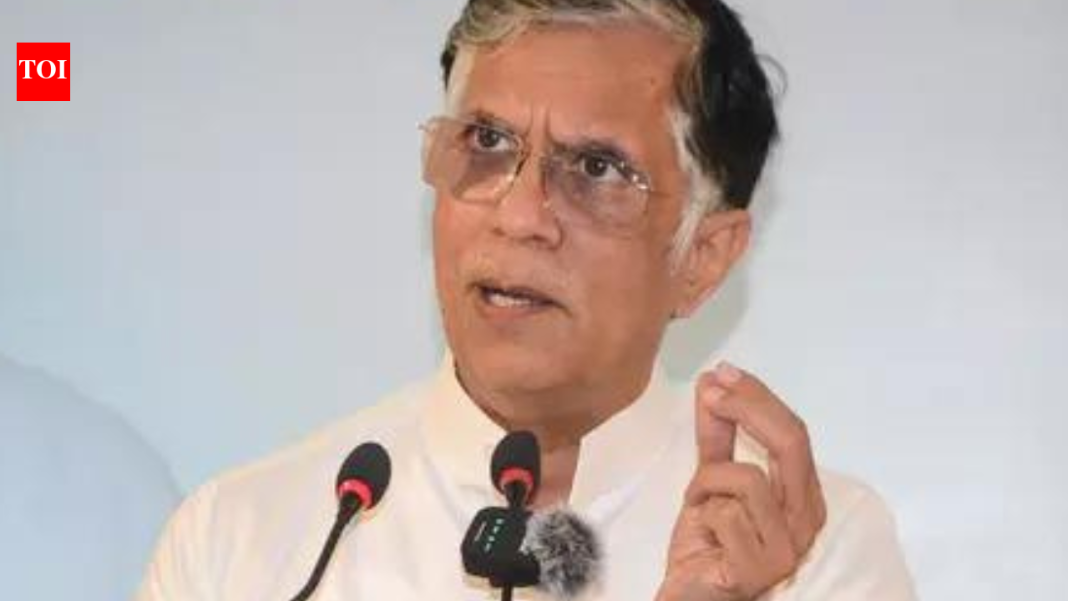
In a significant legal development amidst India’s charged political landscape, Congress leader Pawan Khera has approached the Telangana High Court, seeking anticipatory bail in a case linked to alleged derogatory remarks made against Prime Minister Narendra Modi. This move comes after Khera was granted interim protection from arrest by the Supreme Court of India in February 2023, following a dramatic arrest at Delhi airport. The legal battle, which has drawn national attention, underscores the complexities surrounding free speech, political criticism, and the application of law in high-profile cases.
The genesis of the controversy lies in comments made by Khera during a press conference in February 2023, where he allegedly mispronounced PM Modi’s full name, leading to multiple First Information Reports (FIRs) being filed against him across different states, including Assam and Uttar Pradesh. Khera’s legal team has consistently maintained that the remarks were a slip of the tongue and not intended to incite any form of animosity or disrespect. However, the ruling party, particularly figures like Assam Chief Minister Himanta Biswa Sarma, strongly condemned the statements, asserting that they crossed a line of permissible political discourse.
The Legal Labyrinth: From Arrest to Supreme Court Intervention
Pawan Khera’s legal saga escalated dramatically on February 23, 2023, when he was deplaned and arrested at Delhi’s Indira Gandhi International Airport while on his way to Raipur for a Congress party plenary session. The arrest, carried out by Assam Police, sparked immediate outrage from the Congress party, which termed it a blatant abuse of power and an attack on democratic dissent. The party promptly moved the Supreme Court, challenging the legality of the arrest and the multiple FIRs.
The Supreme Court swiftly intervened, granting Khera interim bail on the same day of his arrest. A bench led by Chief Justice of India D.Y. Chandrachud observed that the multiple FIRs in different states could cause prejudice and harassment to Khera. The court also directed the consolidation of all FIRs against him at a single location, which was subsequently decided to be the Hazratganj police station in Lucknow, Uttar Pradesh. This crucial directive aimed to streamline the legal proceedings and prevent Khera from having to seek legal relief in various jurisdictions for the same alleged offense. While the Supreme Court provided significant relief by granting interim protection and consolidating cases, it also allowed Khera to seek regular bail from the competent court in the jurisdiction where the consolidated FIR would be heard.
However, an FIR was also reportedly filed in Telangana, necessitating Khera’s current approach to the Telangana High Court. This highlights the intricate nature of legal challenges when a single incident triggers complaints across federal boundaries, often leading to prolonged judicial engagement.
Seeking Regular Bail: Khera’s Arguments in Telangana
Khera’s application for anticipatory bail in the Telangana High Court is a logical next step in securing permanent legal protection. His legal counsel is expected to reiterate arguments centered on the lack of malicious intent behind his remarks, emphasizing that they were part of a political commentary that may have been clumsy but not criminal. The legal team is likely to argue that the charges, including those under sections related to promoting enmity between different groups, are disproportionate and politically motivated. They will also stress Khera’s full cooperation with all previous legal processes, including adhering to the conditions of his Supreme Court-granted interim bail.
The core of Khera’s defense rests on the premise that his comments, even if deemed inappropriate by some, fall under the ambit of freedom of speech and expression guaranteed by Article 19(1)(a) of the Indian Constitution. Legal experts often point out the fine line between legitimate political criticism and speech that genuinely incites hatred or violence. The judiciary, in such cases, often weighs the potential for actual harm against the constitutional right to dissent.
“Our client has consistently maintained that the remarks were an inadvertent error, not an act of malice. We are confident that the Telangana High Court will examine the facts diligently and uphold the principles of justice and fundamental rights,” a representative from Khera’s legal team stated, underscoring their belief in the judicial process.
The outcome of this bail application in Telangana could set a precedent for how similar cases involving political figures and alleged offensive speech are handled in India. It reiterates the significant role of the judiciary in balancing political discourse with legal boundaries.
Conclusion: A Glimpse into India’s Legal and Political Dynamics
Pawan Khera’s ongoing legal battle serves as a pertinent example of the tensions often observed at the intersection of politics, media, and the law in India. While political leaders routinely engage in sharp criticism of their opponents, the legal repercussions for perceived transgressions can be severe and prolonged. The Telangana High Court’s decision on Khera’s bail plea will be closely watched, not just by political observers and legal professionals, but by anyone concerned with the boundaries of free speech in a democratic society. It underscores the continuous judicial scrutiny required to ensure that legal mechanisms are not weaponized for political vendettas, while simultaneously upholding decorum in public discourse.
As the legal process unfolds, Khera’s case will continue to contribute to the broader debate on what constitutes acceptable political commentary and the extent to which intent plays a role in determining culpability for allegedly offensive remarks. The Indian judicial system remains the ultimate arbiter in navigating these intricate issues, ensuring that justice is served while protecting the fundamental rights of citizens.

