


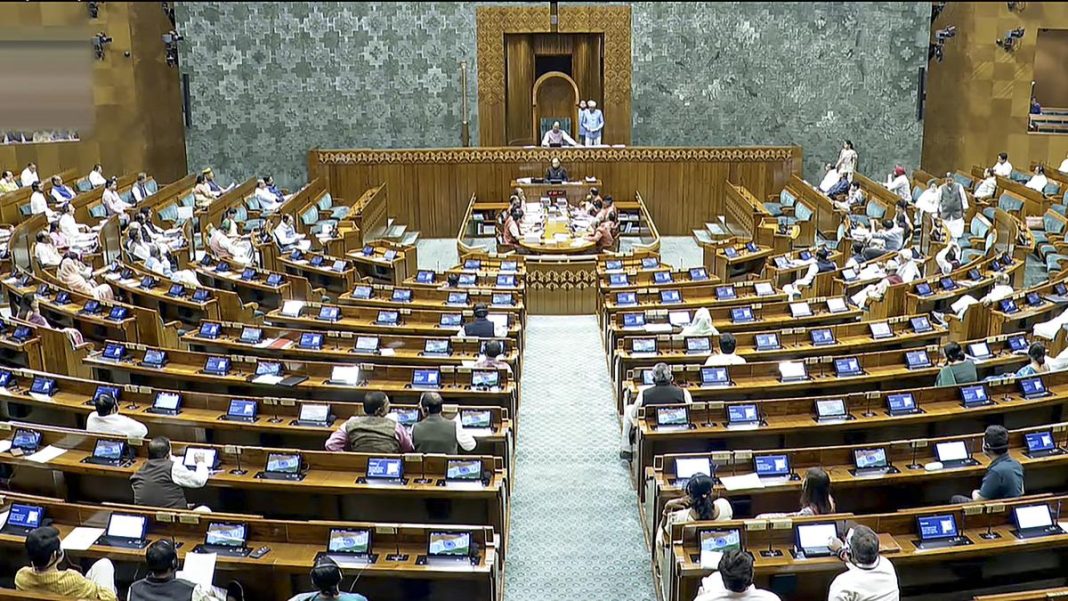
The Indian Parliament’s Budget Session, a crucial period for legislative action and political discourse, continued to witness a blend of spirited debate and significant legislative progress. As live proceedings unfolded, the nation observed contrasting events: sharp political accusations from the ruling party against the opposition, and the steady march of economic reforms with the passage of a key amendment bill. This dynamic interplay underscores the multifaceted nature of India’s parliamentary democracy, where ideological battles often run parallel to the critical task of nation-building through lawmaking.
Political Heat: Sambit Patra’s Charge on Congress and Maoism
A significant portion of the day’s political fireworks emanated from a pointed accusation by BJP spokesperson Sambit Patra. Addressing media outside Parliament, Patra claimed that the Congress party had historically “romanticised Maoism,” drawing a strong reaction across the political spectrum. This assertion comes amidst ongoing debates within the House regarding internal security, governance, and the ideological foundations of various political movements in India.
Patra’s statement appears to link Congress’s historical stance or perceived leniency towards certain leftist ideologies with the Naxalite-Maoist insurgency, which remains a critical internal security challenge for several states. While the specific context triggering this particular accusation was not immediately clear from the live reports, it is widely understood as part of the broader political narrative employed by the BJP to critique the Congress’s past policies and present positions. Such strong claims often serve to highlight perceived ideological differences and rally political support, particularly on sensitive issues like national security and governance.
“The Congress has a track record of not just appeasement politics but also, at times, of romanticising destructive ideologies like Maoism, which has inflicted immense suffering on our tribal communities and security forces,” Patra was quoted stating, emphasizing the gravity of his allegation. This statement immediately sparked a debate among political analysts and commentators, with some viewing it as a strategic move to corner the opposition on a divisive issue, while others criticized it as an attempt to divert attention from other pressing matters within the session.
The opposition, predictably, is expected to vehemently refute such claims, often labeling them as politically motivated and baseless attempts to discredit their legacy. The exchange reflects the often-heated atmosphere of parliamentary sessions, where political rhetoric plays a vital role in shaping public opinion and setting the agenda for national conversations.
Legislative Action: LS Passes Insolvency and Bankruptcy Code (Amendment) Bill, 2025
Amidst the political sparring, the Lok Sabha proceeded with its legislative agenda, marking a significant milestone with the passage of the Insolvency and Bankruptcy Code (Amendment) Bill, 2025. This move is seen as a crucial step towards further refining India’s insolvency framework, which has been lauded for transforming the ease of doing business in the country since its inception in 2016.
The Insolvency and Bankruptcy Code (IBC) has been instrumental in providing a time-bound and market-linked mechanism for the resolution of stressed assets, thereby improving credit discipline and enhancing the recovery rates for creditors. The 2025 amendment bill aims to further strengthen this framework by addressing various operational challenges and emerging issues identified since the code’s implementation. While specific details of every provision of the 2025 bill are extensive, its broad objectives include streamlining the resolution process, enhancing stakeholder protection, and ensuring greater clarity and efficiency in its application.
Key areas of focus for the amendment are understood to include provisions for expediting corporate insolvency resolution processes (CIRP), clarifying the roles and responsibilities of various insolvency professionals and committees of creditors, and potentially introducing mechanisms for pre-packaged insolvency resolutions for certain classes of entities. Such amendments are often a response to judicial pronouncements, practical difficulties encountered during implementation, and the evolving economic landscape.
The passage of this amendment bill by the Lok Sabha signifies a strong commitment from the government to continually improve India’s business environment and ensure robust legal frameworks for financial stability. It is expected to further instill confidence among investors and creditors, assuring them of an efficient and transparent mechanism for dealing with corporate defaults. The bill will now proceed to the Rajya Sabha for its consideration and passage before it can be sent for presidential assent to become law.
Conclusion: A Session of Contrasts and Progress
The day’s proceedings in the Parliament’s Budget Session offered a snapshot of India’s vibrant democratic process – characterized by both robust political debates and dedicated legislative work. While Sambit Patra’s strong allegations against the Congress underscored the persistent ideological fault lines in Indian politics, the swift passage of the IBC (Amendment) Bill, 2025, in the Lok Sabha highlighted the Parliament’s unwavering focus on economic reforms and governance. As the Budget Session continues, the nation will keenly watch how these dual narratives evolve, shaping both the political discourse and the future trajectory of India’s economic landscape.

