


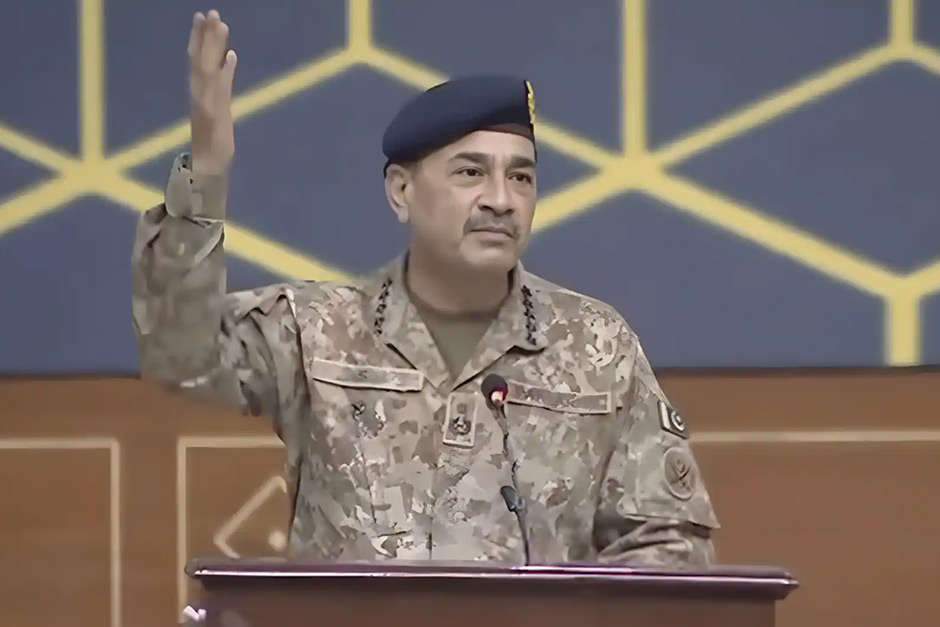
In a region frequently defined by its complex geopolitical landscape, a recent statement by Pakistan’s Chief of Army Staff, General Asim Munir, has stirred considerable discussion. Addressing a gathering, General Munir asserted that Pakistan had received ‘divine help’ during its various conflicts with India. This claim, rich in religious and nationalistic overtones, offers a compelling insight into how military narratives are shaped and perceived within the subcontinent, particularly from an Indian vantage point.
General Munir’s Assertion and Its Strategic Context
General Asim Munir’s declaration, made during a televised address, posited that Pakistan’s military successes against India were not solely attributable to human endeavour or strategic planning but were bolstered by supernatural intervention. Specifically, he stated, “Pakistan got divine help during its conflict with India.” While the precise instances he alluded to were not explicitly detailed, the statement broadly encompasses the various military confrontations between the two nuclear-armed neighbours since their independence in 1947, including the wars of 1965, 1971, and the Kargil conflict of 1999.
Such rhetoric is not entirely new in the context of South Asian nationalism, where religious identity often intertwines with military prowess and national destiny. For an army chief to articulate such a belief carries significant weight, potentially serving multiple purposes. Internally, it can be a powerful tool for boosting troop morale, fostering a sense of divine favour, and solidifying national identity. Externally, it projects an image of invincibility and righteousness, adding a layer of spiritual justification to military actions and national resolve.
Analyzing the Rhetoric from an Indian Perspective
From an Indian perspective, such a statement by a top military official of a neighbouring country is viewed through a lens of strategic analysis and geopolitical realism. India, a secular state with a diverse population, typically frames its security challenges and military engagements in terms of national interest, territorial integrity, and strategic deterrence. The concept of ‘divine help’ in military conflicts, while sometimes present in popular discourse, does not generally feature in official military or diplomatic pronouncements.
Indian strategic analysts often interpret such religiously charged claims as attempts to galvanize domestic support, especially in times of internal or external pressure, or to deflect from the more conventional military and economic factors that determine conflict outcomes. They tend to emphasize that modern warfare is governed by factors like military doctrine, technological superiority, intelligence gathering, logistical capabilities, and troop training, rather than supernatural intervention. Ignoring these tangible aspects in favour of ‘divine help’ can, ironically, be seen as a strategic miscalculation or a diversion from assessing ground realities.
“Such pronouncements, while undoubtedly powerful for domestic consumption and morale boosting, often simplify complex geopolitical realities,” observed Dr. Alok Kumar, a Delhi-based strategic affairs commentator. “For a stable regional dynamic, dialogue must be grounded in pragmatic assessments of military capabilities, diplomatic channels, and mutual interests, rather than exceptionalist claims.”
Implications for India-Pakistan Relations
General Munir’s statement, coming at a time when India-Pakistan relations remain largely strained, adds another dimension to an already complex bilateral dynamic. While direct military confrontation has been largely contained in recent years, rhetoric plays a crucial role in shaping public opinion and setting the tone for diplomatic engagements, or the lack thereof.
For India, the statement underscores a perceived divergence in how the two nations approach security and conflict. India consistently advocates for a resolution of issues through bilateral dialogue, respecting international norms and focusing on countering cross-border terrorism. Attributing military outcomes to ‘divine help’ can be seen as sidestepping the need for concrete strategic reviews or even fostering an environment less conducive to rational, de-escalatory discourse. It risks entrenching narratives that hinder pragmatic engagement and cooperation, which are essential for long-term peace and stability in South Asia.
Ultimately, General Munir’s assertion highlights the deep-seated historical and ideological currents that continue to influence military and political discourse in the subcontinent. While it resonates powerfully within certain segments of Pakistani society, its impact on the broader geopolitical calculus will be measured by how it is integrated into or challenged by the realities of strategic capabilities and the persistent demand for regional stability.

