


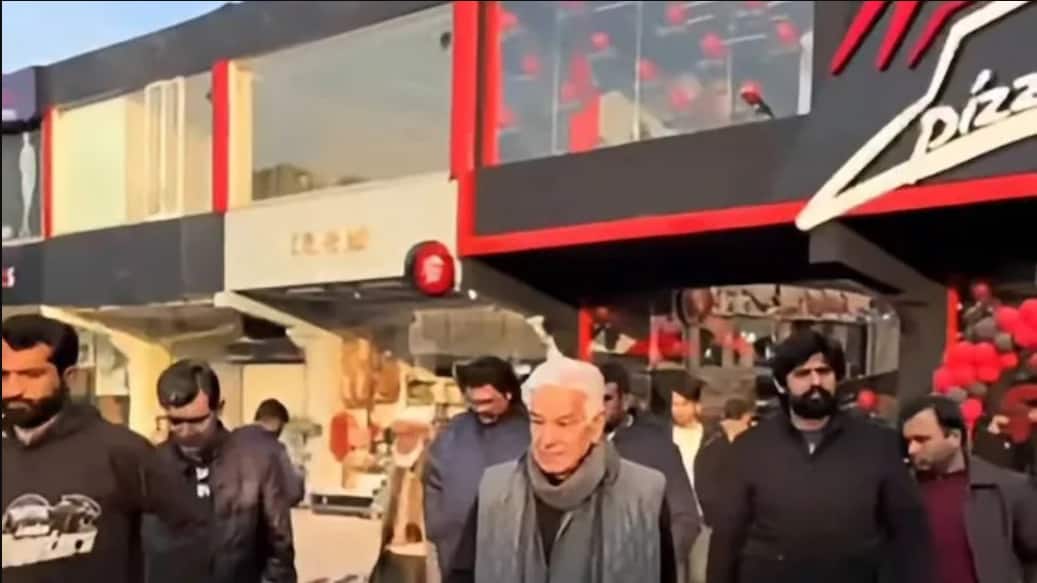
In an age where information travels at the speed of a tweet, public figures are under constant digital scrutiny. Pakistan’s Defence Minister, Khawaja Asif, recently found this out the hard way, becoming the subject of widespread ridicule and criticism after sharing an image on social media that he claimed depicted the inauguration of a new Pizza Hut outlet in his constituency, Sialkot. The only problem? The image was reportedly old, leading to a swift and sharp backlash across social media platforms, turning a seemingly innocuous post into a significant political gaffe.
The Faux Inauguration That Wasn’t
The incident unfolded when Khawaja Asif, a senior figure in the Pakistan Muslim League-Nawaz (PML-N) government, posted a picture on his official social media account. The image showed him cutting a ribbon, ostensibly inaugurating a new branch of the popular international fast-food chain, Pizza Hut, in Sialkot. His caption suggested a recent event, aiming to highlight development or investment in his area. However, the internet, with its long memory and penchant for fact-checking, quickly went to work.
Social media users were quick to point out that the photograph was not new. Investigations by various online sleuths, including journalists and common citizens, revealed that the picture likely dated back to a previous event, possibly even from years ago, and was certainly not of a recent inauguration. Some reports suggested the photo was from an inauguration in 2017 or earlier, while others simply highlighted that the specific outlet shown in the picture had been operational for a significant period. The revelation led to an immediate flood of mocking comments and sharp criticism, questioning the minister’s intent and his team’s verification processes.
A Storm of Criticism and Online Trolling
The disclosure that the “inauguration” was not new sparked a veritable storm across Pakistani social media. Twitter (now X) and other platforms were inundated with memes, satirical posts, and angry condemnations. Users called out the minister for spreading what they perceived as misinformation, particularly at a time when Pakistan faces pressing economic and political challenges. Many questioned why a senior defence minister would resort to sharing such an outdated and misleading image.
Political opponents were quick to seize upon the gaffe, using it as an opportunity to lambast the government. Critics argued that such actions highlight a disconnect between public officials and the realities faced by ordinary citizens, suggesting that ministers should focus on substantive policy matters rather than seemingly trivial and unverified claims. The incident became a symbol for some of the perceived inefficiencies and lack of accountability in governance. One prominent social media observer remarked, “This isn’t just about a pizza; it’s about the credibility of public officials. In an era rife with misinformation, ministers must be scrupulous about what they share. Such incidents erode public trust, which is already a scarce commodity.” The backlash underscored the increasing power of digital platforms in holding public figures accountable and debunking misinformation swiftly, irrespective of their position.
Beyond the Gaffe: Trust and Digital Accountability
While seemingly a minor incident involving a social media post, the backlash against Khawaja Asif highlights a critical aspect of modern political communication: the absolute necessity for accuracy and transparency. In today’s hyper-connected world, unverified information, especially from high-ranking officials, is quickly scrutinised and debunked. For an Indian audience observing regional politics, this event serves as a pertinent reminder of the universal challenges faced by politicians in managing their digital presence and the relentless public expectation for authenticity.
The episode also raises questions about the communication strategies employed by political offices. In an environment where misinformation can spread like wildfire, the responsibility to verify content before sharing it becomes paramount. The Khawaja Asif Pizza Hut incident, though humorous to some, underscores the serious implications of digital gaffes for political credibility and public trust, reinforcing the idea that no detail, however small, escapes the vigilant eye of the internet.
The swift and widespread criticism faced by Pakistan’s Defence Minister serves as a cautionary tale for public figures across the subcontinent. It vividly demonstrates that in the digital age, authenticity and transparency are not just ideals, but essential prerequisites for maintaining public confidence and navigating the complex landscape of modern politics.

