


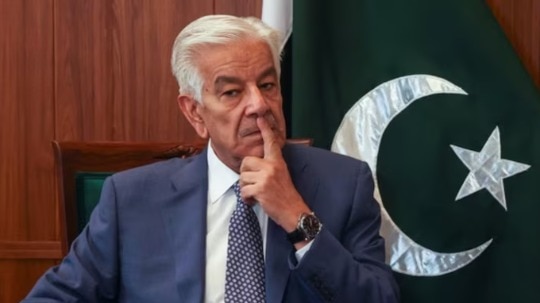
In a recent development that underscores the persistent tensions between India and Pakistan, Pakistan’s Defence Minister, Khawaja Asif, issued a stark warning regarding his country’s response to any potential attack from India. Asif’s remarks, characterized by a firm and unyielding tone, suggest that Islamabad would meet aggression with a “decisive” reply, further intensifying the diplomatic friction that often defines relations between the two nuclear-armed neighbours.
This statement, delivered amidst a backdrop of simmering disputes and occasional border skirmishes, has predictably garnered significant attention in India. While not entirely unprecedented given the historical trajectory of India-Pakistan ties, the directness of Asif’s warning adds another layer of complexity to an already delicate regional security landscape. For Indian strategic analysts and policymakers, such pronouncements are often viewed through the lens of Pakistan’s internal political dynamics as much as external posturing, yet they cannot be dismissed lightly given the potential for escalation.
The Echoes of Past Confrontations
Khawaja Asif’s latest remarks resonate with a long history of heated exchanges and military standoffs between India and Pakistan. Both nations have, at various junctures, asserted their resolve to defend their sovereignty and territorial integrity, often leading to a cycle of escalation and de-escalation. Incidents like the 2016 Uri attack and India’s subsequent surgical strikes, or the 2019 Pulwama terror attack and India’s Balakot airstrike, serve as stark reminders of how quickly rhetoric can translate into real-world military action.
From India’s perspective, the primary driver of regional instability has consistently been cross-border terrorism, which New Delhi alleges is sponsored by elements within Pakistan. India has repeatedly called for Pakistan to dismantle terror infrastructure operating from its soil and to take demonstrable action against groups responsible for attacks on Indian territory. Pakistan, while denying state involvement, often frames its statements as a deterrent against perceived Indian aggression or interference.
Asif’s warning, therefore, can be interpreted as an attempt to project strength and convey a message of readiness, possibly aimed at both a domestic audience and international observers. It also seeks to counter India’s long-standing narrative about Pakistan being the aggressor or incubator of militancy. The challenge for India lies in navigating this rhetoric while maintaining its own strategic deterrence and its firm stance against terrorism, without inadvertently contributing to an unnecessary escalation of tensions.
Implications for Regional Stability and Diplomacy
A statement of such gravity from a defence minister naturally carries significant implications for regional stability. In a volatile region like South Asia, where two nuclear powers share a heavily militarized border and unresolved territorial disputes, every word from a high-ranking official is scrutinized. The immediate concern is whether such rhetoric could limit the space for diplomatic engagement or, worse, be misconstrued in a way that leads to an unintended confrontation.
The global community, accustomed to the delicate balance of power in the subcontinent, often urges both nations to exercise restraint and engage in constructive dialogue. However, the path to dialogue remains fraught with obstacles, not least of which is the deep mistrust fostered by decades of conflict and competing narratives. India has consistently maintained that “terror and talks cannot go together,” placing the onus on Pakistan to create a conducive environment for peace by addressing its concerns regarding cross-border terrorism.
Khawaja Asif’s statement, “Pak response to attack would be decisive,” serves as a stark reminder of the underlying fragility of peace in the region. While such strong language might be intended to project resolve, it simultaneously underscores the urgent need for a framework that allows for de-escalation and confidence-building measures. For India, the emphasis remains on vigilance, strengthening its defensive capabilities, and reiterating its principled stand against terrorism, while keeping open channels for communication to prevent any miscalculation.
Ultimately, while these statements contribute to the ongoing war of words, the hope for lasting peace in the subcontinent hinges not on escalating rhetoric, but on sincere efforts to address core issues through diplomacy and a commitment from both sides to avoid actions that could imperil regional stability.

