


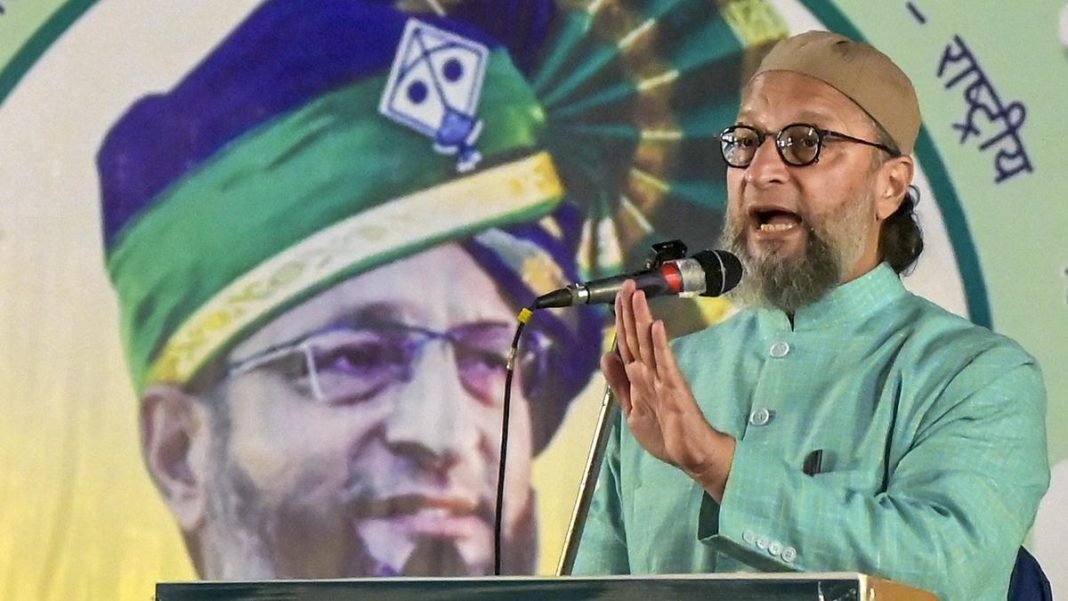
In the vibrant and often tempestuous landscape of Indian politics, sharp barbs and historical recriminations are commonplace. Recently, All India Majlis-e-Ittehadul Muslimeen (AIMIM) chief Asaduddin Owaisi launched a scathing attack on the Congress party, accusing it of hypocrisy regarding its stance on the stringent Unlawful Activities (Prevention) Act (UAPA). Owaisi’s critique specifically highlighted the continued denial of bail to activists Umar Khalid and Sharjeel Imam, underscoring a contentious debate around India’s anti-terror law and its implications for civil liberties.
Owaisi’s Scathing Critique of Congress
Asaduddin Owaisi, a prominent voice from Hyderabad, pulled no punches in his assault on the Congress, linking the party’s historical legislative actions to the current legal predicaments of Khalid and Imam. Addressing a public gathering, Owaisi reminded the audience that it was the Congress-led government that originally enacted UAPA in 1967 and subsequently strengthened it with significant amendments in 2008 and 2012. These amendments, particularly after the 26/11 Mumbai terror attacks, broadened the scope of what constitutes ‘terrorist acts’ and made bail provisions considerably more stringent.
Owaisi argued that while the Congress now often criticizes the misuse of UAPA by the current Bharatiya Janata Party (BJP) government, its own hands are far from clean. He suggested a profound irony in the Congress lamenting the plight of individuals booked under a law that it had instrumentalized and robustly expanded. His statements aim to expose a perceived double standard, challenging the Congress’s moral authority to speak on issues of civil liberties when its past actions laid the groundwork for the very legal challenges facing accused individuals today. For Owaisi, the denial of bail to figures like Khalid and Imam is a direct consequence of a legal framework meticulously crafted and reinforced over decades, with significant contributions from successive Congress regimes.
UAPA: A Contentious Legal Framework and Bail Denials
The Unlawful Activities (Prevention) Act, 1967, is India’s primary anti-terrorism law, designed to prevent unlawful activities associations and terrorist acts. Over the years, particularly with the 2008 and 2019 amendments, UAPA has become one of the most contentious pieces of legislation in India. Critics argue that its broad definitions of “unlawful activity” and “terrorist act,” coupled with its extremely stringent bail conditions, make it prone to misuse and have a chilling effect on dissent. Under UAPA, the burden of proof often shifts, and bail is notoriously difficult to obtain, particularly if the court believes there are reasonable grounds to suspect the accusation is prima facie true.
The cases of Umar Khalid and Sharjeel Imam serve as stark examples of the UAPA’s stringent application. Both were arrested in September 2020 and January 2020, respectively, in connection with the alleged “larger conspiracy” behind the February 2020 Delhi riots and charges of sedition and inciting violence during anti-CAA protests. Despite repeated efforts, their bail applications have been consistently rejected by various courts, including the Delhi High Court. The courts have often cited the stringent provisions of UAPA, particularly Section 43D(5), which restricts bail if the court is of the opinion that the charges are prima facie true. This legal hurdle has meant that Khalid and Imam, along with many others booked under UAPA, have remained incarcerated for extended periods as undertrials, without conviction.
Owaisi highlighted this specific aspect of their detention, stating, “The Congress enabled the very law that keeps Khalid and Imam behind bars today. They cannot absolve themselves of responsibility by merely criticizing the current government’s actions.” This quote encapsulates his argument that the structural issues within UAPA, which prevent bail and prolong incarceration, are a legacy inherited from previous governments, including those led by the Congress.
The Broader Implications for Indian Democracy
Owaisi’s direct confrontation with the Congress over UAPA not only serves as a political strategy but also reignites a crucial debate about the balance between national security and civil liberties in India. The discussion around UAPA frequently involves legal experts, human rights activists, and political commentators who express concerns about its potential to stifle dissent and target minorities or critics of the government. The arbitrary nature of arrests, the prolonged detention of undertrials, and the difficulty in securing bail under UAPA are issues that consistently draw criticism from various quarters.
From a political standpoint, Owaisi’s statements also aim to position AIMIM as a more principled voice on minority issues and civil rights, distinguishing itself from other opposition parties. By pointing out the Congress’s historical role, he challenges the party’s credentials as a guardian of democratic freedoms, particularly for marginalized communities. This rhetorical strategy aims to draw a clear line between parties that have historically contributed to strong, potentially overreaching state powers and those claiming to champion individual rights.
Ultimately, the ongoing legal battles involving UAPA and the political discourse surrounding it underscore a fundamental tension in India’s democratic framework. It highlights the need for a sustained discussion on judicial reforms, the role of investigative agencies, and a re-evaluation of laws that have far-reaching implications for fundamental rights and the very fabric of Indian society.
The accusations leveled by Owaisi against the Congress over UAPA and its impact on individuals like Umar Khalid and Sharjeel Imam serve as a potent reminder of the complex interplay between legislative history, current political realities, and the persistent struggle for justice and civil liberties in India. As these debates continue, they challenge all political parties to reflect on their past actions and current positions, demanding greater accountability in upholding the democratic principles they often invoke.

