


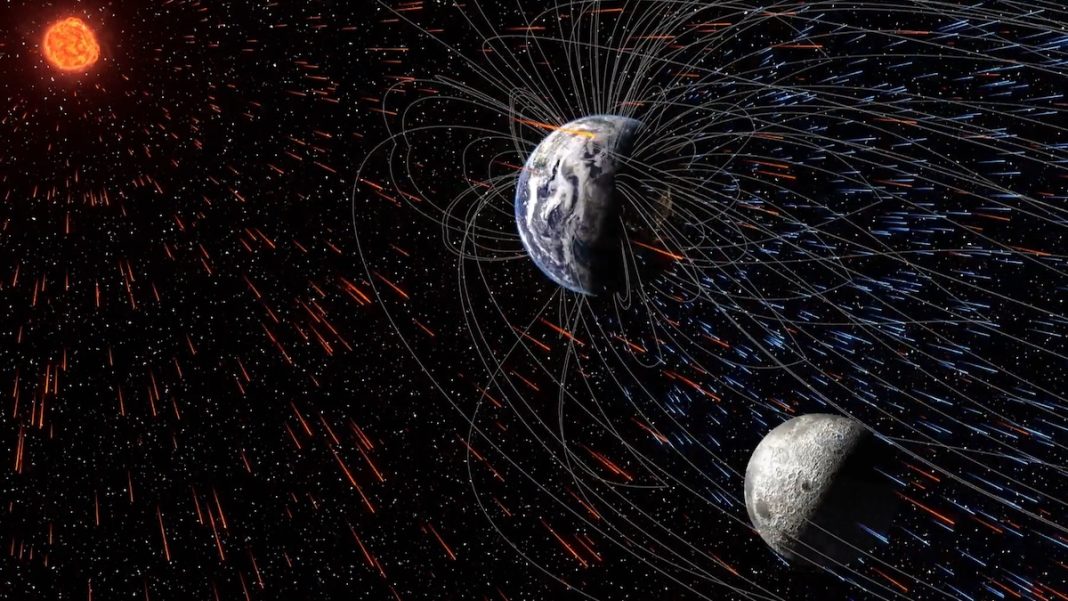
It sounds like something out of a science fiction novel, but it’s true: our planet’s atmosphere is, in a very small but measurable way, continually leaking to the Moon. Far from being a cause for alarm, this fascinating phenomenon reveals intricate processes at play between celestial bodies, offering a unique glimpse into the dynamics of our solar system. Let’s unpack how Earth’s protective blanket contributes to the lunar environment.
The Magnetosphere’s Dynamic Dance
Our planet is wrapped in an invisible shield called the magnetosphere, generated by Earth’s molten iron core. This magnetic field largely protects us from the constant stream of charged particles emanating from the Sun, known as the solar wind. However, this interaction isn’t entirely static. As the solar wind buffets the magnetosphere, it can strip away some of the outermost particles from Earth’s upper atmosphere, specifically from the ionosphere. These particles, mostly ionized oxygen, nitrogen, and hydrogen atoms, become super-energized and escape into space.
This outflow of particles forms a long, comet-like tail called the magnetotail, which stretches millions of kilometers behind Earth, always pointing away from the Sun. Think of it less as a leak and more like a gentle spray of fine mist escaping a powerful force field – a spray composed of fundamental building blocks from our own air. This continuous dynamic interaction is a natural consequence of Earth’s magnetic field encountering the Sun’s constant stellar outflow.
The Moon as an Interceptor
Here’s where the Moon enters the picture. Our celestial neighbor orbits Earth, and for about five days each month, it passes directly through this magnetotail. During this period, the Moon is effectively bathed in the stream of escaping particles from Earth. Unlike Earth, the Moon lacks a substantial atmosphere or a global magnetic field of its own. This means there’s nothing to deflect these incoming ions. When these energized particles collide with the lunar surface, some of them implant themselves into the top layer of dust and rock, while others bounce off and contribute to the Moon’s incredibly tenuous exosphere – a barely-there “atmosphere” composed of widely dispersed atoms.
Scientists have confirmed this transfer through various lunar missions. Apollo-era experiments detected the presence of terrestrial ions on the Moon, and more recently, NASA’s Lunar Atmosphere and Dust Environment Explorer (LADEE) mission provided further evidence. “It’s a subtle but persistent process,” explains planetary scientist Dr. Elena Petrova. “While not a significant loss for Earth’s vast atmosphere, it offers us a unique window into the dynamics of our magnetosphere and how planetary bodies interact in space, even without direct contact.” This ongoing exchange means the Moon carries a microscopic, ancient fingerprint of Earth’s atmosphere, slowly accumulating over billions of years.
Conclusion
The idea of our atmosphere reaching the Moon might seem counterintuitive, but it’s a testament to the intricate, interconnected nature of our solar system. What we see is not a detrimental drain on Earth’s vital gases, but rather a slow, continuous flow of fundamental particles. This phenomenon highlights how even seemingly isolated celestial bodies are part of a larger cosmic dance, exchanging matter and energy in ways that continue to surprise and inform our understanding of the universe.
*

