


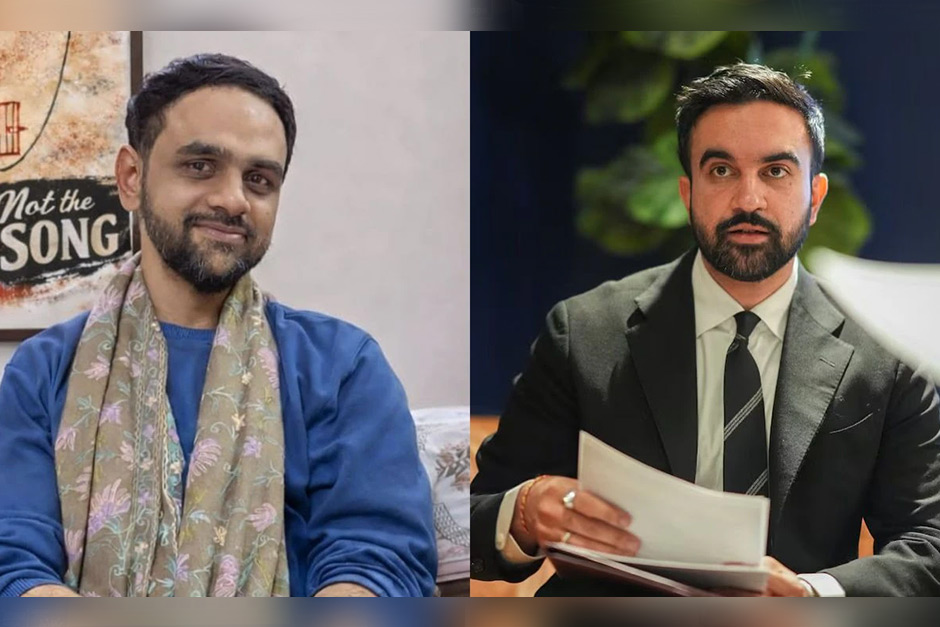
In a significant development that has drawn attention from across continents, New York State Assembly Member Zohran Mamdani recently met with the parents of jailed Indian student leader Umar Khalid in New Delhi. During the meeting, Mamdani handed over a personal note penned for Khalid, expressing solidarity with the prominent activist who has been in judicial custody since September 2020 under the Unlawful Activities (Prevention) Act (UAPA). The gesture, marked by the simple yet powerful message, “Thinking of you,” has resonated within circles advocating for human rights and civil liberties in India.
The meeting occurred amidst Mamdani’s visit to India, a trip that has seen the US legislator engaging with various civil society members and addressing issues pertaining to democratic values and human rights. His decision to meet Khalid’s parents and convey a personal message underscores the growing international interest in high-profile cases of alleged political incarceration in India.
The Gesture from Across the Ocean
Zohran Mamdani, a prominent figure in the New York State Assembly and son of acclaimed academic Mahmood Mamdani, has a distinct connection to the Indian subcontinent through his heritage. His visit to India offered an opportunity to engage directly with families impacted by ongoing legal battles. Meeting S.Q.R. Ilyas and Sabeeha Khan, the parents of Umar Khalid, Mamdani conveyed a message of support that transcended geographical boundaries.
The note itself, while brief, carried considerable weight. According to sources close to the family, it was a gesture of personal solidarity, indicating that Khalid’s situation is not forgotten by observers and advocates abroad. This act of reaching out by an elected official from a global city like New York highlights the increasing scrutiny that cases like Khalid’s are attracting on international platforms, moving beyond purely domestic discourse. Such a direct communication can often serve as a morale booster for families enduring prolonged legal struggles and for the incarcerated individuals themselves, providing a sense that their fight is acknowledged.
Umar Khalid’s Incarceration and the Delhi Riots Case
Umar Khalid, a former student leader from Jawaharlal Nehru University (JNU), rose to national prominence as a vocal critic of government policies, particularly the Citizenship Amendment Act (CAA). His activism positioned him at the forefront of nationwide protests that preceded the 2020 Delhi riots. In September 2020, Khalid was arrested by the Delhi Police on charges of being a part of a larger conspiracy behind the communal violence that engulfed parts of Delhi in February 2020.
He was booked under the stringent Unlawful Activities (Prevention) Act (UAPA), a law often criticised for its broad definitions and difficult bail provisions. Despite repeated attempts, Khalid has been denied bail by various courts, with judges often citing the prima facie evidence presented by the prosecution regarding his alleged involvement in the conspiracy. His legal team has consistently maintained that the charges are fabricated, politically motivated, and that Khalid is being targeted for his dissent.
His parents, S.Q.R. Ilyas and Sabeeha Khan, have been steadfast in their efforts to secure his release, navigating a complex legal landscape while publicly appealing for justice. Speaking about the solidarity received, S.Q.R. Ilyas stated, “Every message of support, whether from within India or abroad, gives us strength. It reminds us that Umar’s struggle for justice is being seen and heard, and that we are not alone in this fight.”
Implications and Broader Context
The gesture by Zohran Mamdani is not an isolated incident but rather a part of a larger trend where international human rights organisations, academic institutions, and foreign legislators express concern over the state of civil liberties and the use of anti-terror laws against dissenters in India. Such engagements often spark debates within India regarding external interference versus universal human rights principles.
While some view these interventions as unwelcome meddling in India’s internal affairs, others interpret them as crucial expressions of global democratic solidarity. The case of Umar Khalid, along with several other activists, journalists, and students arrested under similar circumstances, has become a litmus test for India’s commitment to democratic freedoms and due process. The prolonged incarceration without trial, coupled with the nature of the charges, has drawn considerable scrutiny.
Zohran Mamdani’s personal note to Umar Khalid, delivered through his parents, is a powerful symbol of this evolving global awareness. It underscores that the individual battles for justice in India are increasingly being watched and acknowledged on the world stage, adding another layer to the complex narrative surrounding human rights and democratic space in the country.

