


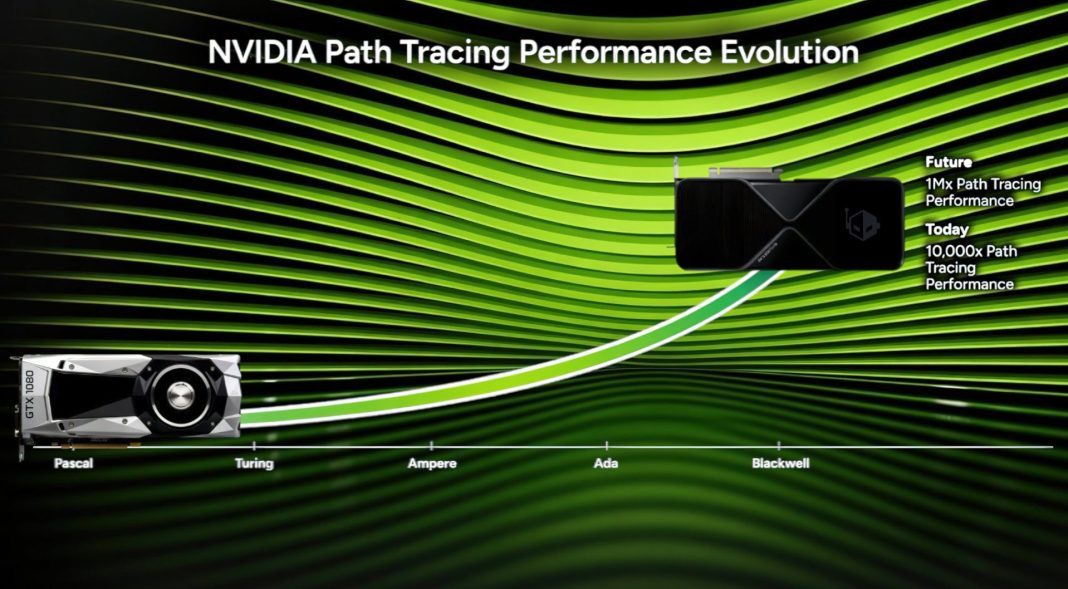
Imagine a game where every flicker of light, every subtle reflection, every intricate shadow behaves exactly as it would in the real world. A world so visually authentic, it blurs the line between digital fantasy and reality. NVIDIA is promising just that, claiming its future gaming GPUs, armed with RTX and AI, will make path tracing an astonishing million times faster. This isn’t merely an upgrade; it’s a seismic shift poised to redefine what “realistic” means in gaming.
The Quest for Perfect Light: Understanding Path Tracing
For decades, game developers have employed clever tricks and approximations to simulate light. Shadows were often baked in, reflections were screen-space projections, and global illumination – the way light bounces around a scene – was an art of smoke and mirrors. While impressive, these methods always had limitations, revealing their artificiality under scrutiny.
Enter path tracing. This is the holy grail of lighting, a physically accurate rendering technique that simulates individual light rays bouncing around a scene, interacting with surfaces, and ultimately reaching the virtual camera. It models light precisely, from how it scatters and reflects to how it refracts through glass or casts soft, diffuse shadows. The result? Unparalleled realism, where every visual element is bathed in light that feels organically present.
The catch? Path tracing is incredibly computationally intensive. Even the most powerful GPUs today struggle to render fully path-traced scenes at playable frame rates without significant compromises or advanced denoising techniques. This is where NVIDIA’s bold promise enters the picture, addressing the very bottleneck that has held true photorealism at bay.
The AI & RTX Symphony: Unlocking Unprecedented Speed
The “million times faster” claim isn’t just about brute force; it’s about an intelligent synergy between specialized hardware and advanced artificial intelligence. NVIDIA’s RTX architecture, with its dedicated RT Cores, has already laid the groundwork for real-time ray tracing. These cores accelerate the core calculations involved in tracing light paths, making complex reflections and global illumination possible in real-time. But the next leap involves AI, specifically the evolution of technologies like DLSS (Deep Learning Super Sampling).
Imagine AI algorithms learning to perfectly reconstruct a high-resolution, path-traced image from far less raw data. This isn’t just upscaling; it’s an intelligent inference, where the AI fills in the gaps, predicts light behavior, and denoises complex scenes with incredible efficiency. This partnership between accelerated hardware and predictive AI is the secret sauce. The RT Cores handle the initial ray-surface intersections, while the Tensor Cores (NVIDIA’s AI processors) and sophisticated deep learning models refine and accelerate the final image generation, effectively performing the work of millions of traditional calculations in a fraction of the time. “It’s not just about making games look better; it’s about making them feel real, stripping away the artificiality we’ve worked around for decades,” observed a veteran game developer, encapsulating the potential shift.
The Future is Bright: What This Means for Gaming
A million-fold increase in path tracing speed isn’t just an incremental improvement; it’s a paradigm shift. For gamers, this means an immersive experience that current technology can only hint at. Environments will come alive with dynamic light that truly bounces, illuminates, and casts shadows with absolute accuracy. Water will reflect its surroundings flawlessly, metallic surfaces will gleam with precise reflections, and even the subtle interplay of light and shadow in a character’s expression will achieve cinematic fidelity.
For game developers, this opens up a universe of creative possibilities. No longer will they be constrained by the need to fake lighting or resort to complex workarounds. They can focus purely on artistic vision, confident that the underlying technology will render their worlds with absolute fidelity. This could lead to entirely new gameplay mechanics centered around light, environmental storytelling elevated to new heights, and experiences that blur the line between interactive entertainment and hyper-realistic film.
NVIDIA’s vision of future gaming GPUs suggests a future where graphical fidelity isn’t just about polygons and textures, but about the true-to-life behavior of light itself. The promise of a million times faster path tracing is a beacon, signaling the dawn of a new era in gaming realism, powered by the incredible synergy of RTX and AI.

