


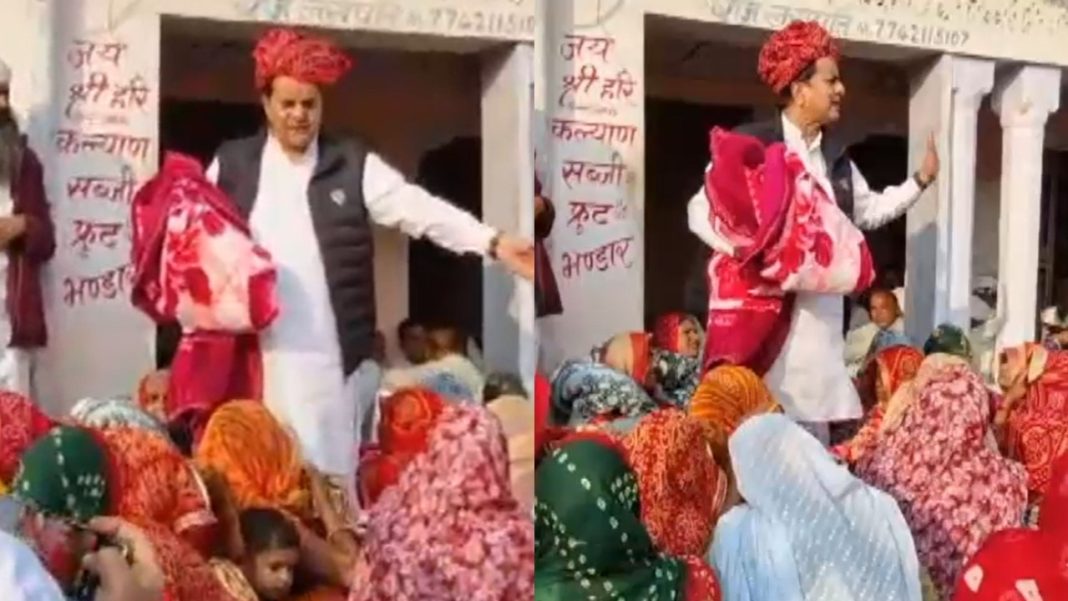
In a nation where acts of charity often transcend social and political divides, a recent incident involving a former Member of Parliament from the Bharatiya Janata Party (BJP) has ignited a fierce debate. The controversy surrounds a blanket distribution drive in Uttar Pradesh, a humanitarian effort aimed at providing succour to those battling the biting winter cold. However, what began as an act of compassion quickly spiralled into a national discussion on discrimination, political rhetoric, and the fundamental principles of aid distribution.
The incident, widely reported across Indian media, saw former BJP MP Harish Dwivedi allegedly refusing blankets to members of the Muslim community, explicitly stating that the aid was “not for those who abuse PM Modi.” This remark, captured and circulated online, has sparked outrage among various sections of society, raising pertinent questions about the politicisation of humanitarian assistance and the erosion of inclusive values.
The Winter Blanket Row: An Incident Unfolds
The scene was set amidst the harsh chill of northern India, where local volunteers, including the former MP, were engaged in distributing blankets to the needy. According to multiple reports and viral video clips, when approached by individuals from the Muslim community, Dwivedi reportedly interjected, singling them out. His precise words, “Yeh kambal un logon ke liye nahi hai jo Pradhanmantri Modi ko gaali dete hain,”
translating to “These blankets are not for those who abuse Prime Minister Modi,” sent shockwaves, transforming a simple act of charity into a political flashpoint.
The statement effectively introduced a political loyalty test as a precondition for receiving humanitarian aid, a concept that has been widely criticised for being antithetical to the very spirit of charity. Observers highlighted that such conditions could potentially alienate and disadvantage vulnerable sections of the population based on their perceived political affiliations or dissent, rather than their actual need. The timing and context of the remark — during a period of widespread need due to dropping temperatures — further amplified the public’s concern.
Waves of Criticism and Political Discourse
The former MP’s remarks were met with swift and severe condemnation from opposition parties, civil society activists, and a significant section of the public. Critics argued that such statements not only violate the principles of secularism enshrined in the Indian Constitution but also undermine the non-discriminatory nature expected of public figures, especially during humanitarian endeavours.
Political leaders from parties like the Samajwadi Party and Congress voiced strong disapproval, accusing Dwivedi of communalising humanitarian aid and fanning divisive sentiments. They stressed that aid, by its very definition, should be universal and devoid of any political or religious conditionalities. Social media platforms became a battleground, with many users expressing dismay over the apparent politicisation of basic human needs, while others defended Dwivedi, suggesting he was merely responding to perceived disrespect towards the Prime Minister.
However, the overwhelming sentiment leaned towards concern over the precedent being set. The incident prompted discussions on whether public service, even in its charitable forms, should ever be contingent upon political allegiance or agreement with the ruling establishment. Human rights advocates pointed out that denying aid based on such criteria could be seen as discriminatory, violating the dignity of individuals and creating a tiered system of citizenship.
Humanitarian Aid or Political Tool? The Broader Debate
This incident transcends the immediate act of blanket distribution and delves into deeper questions about the evolving landscape of Indian politics and society. It forces a critical examination of whether humanitarian efforts, traditionally seen as apolitical and inclusive, are increasingly becoming instruments of political messaging or even retribution.
India, a diverse democracy, prides itself on its constitutional commitment to equality and non-discrimination. When public figures, especially those with political affiliations, impose conditions on aid based on perceived dissent, it invariably raises alarms about the erosion of these foundational principles. The act of charity is fundamentally about alleviating suffering, regardless of the recipient’s background, beliefs, or political views. To attach conditions to it, particularly those related to political allegiance, transforms it from a selfless act into a politically charged one, potentially fostering resentment and further widening societal divides.
The episode serves as a stark reminder of the ethical considerations that must guide public service and charity. It underscores the responsibility of leaders to uphold principles of inclusivity and compassion, ensuring that basic human needs are addressed without prejudice. As India navigates its complex socio-political terrain, incidents like these prompt important introspection into the values that truly define the nation’s character and its commitment to all its citizens.

