


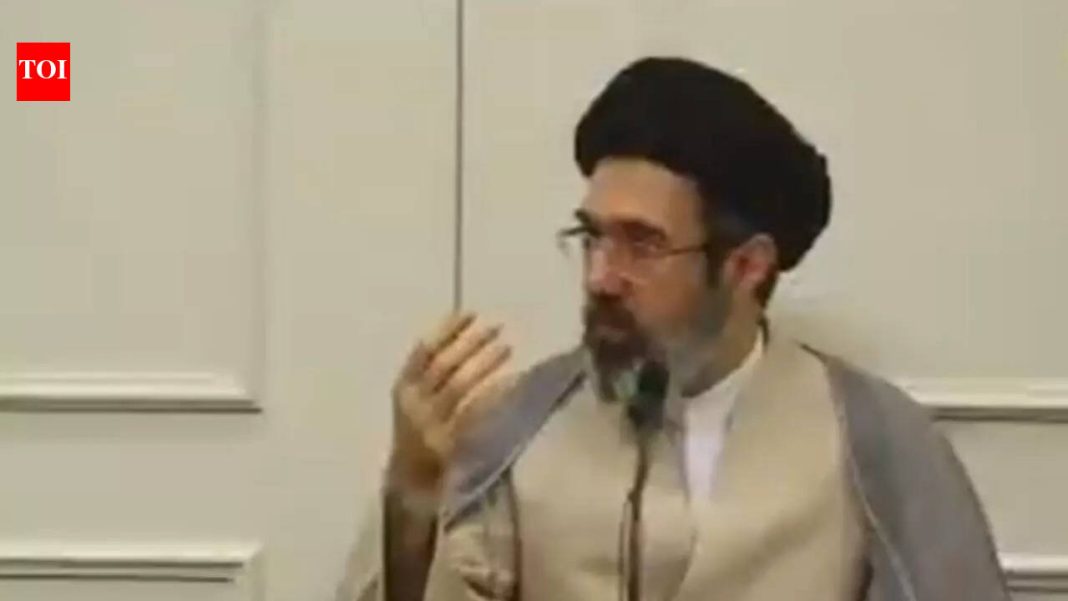
In the intricate and often opaque world of Iranian politics, where whispers can carry more weight than public pronouncements, the figure of Mojtaba Khamenei has long been a subject of intense speculation. As the son of Iran’s Supreme Leader Ayatollah Ali Khamenei, his name invariably surfaces in discussions about succession. Recently, however, his usual absence from the public eye was momentarily punctuated by a rare video appearance, sparking renewed debate and raising a critical question across the globe: Where is Mojtaba Khamenei, and what does his sudden, albeit brief, visibility signify for Iran’s future?
The Heir Apparent, or Just a Powerful Son?
Mojtaba Khamenei is not a public official in the traditional sense, yet his influence within the Iranian establishment is widely acknowledged. Born in 1969, he is the second son of the Supreme Leader. Unlike some of his siblings, Mojtaba has maintained a remarkably low public profile, rarely giving interviews or appearing at official functions. Despite this, he is believed to hold significant sway, particularly in areas concerning his father’s office, security apparatus, and the Basij paramilitary force. He is also understood to have deep connections within the Revolutionary Guard Corps (IRGC), a critical pillar of the Islamic Republic’s power.
His religious credentials, honed through studies at Qom’s seminaries, are formidable. He has reportedly attained the rank of Hojjat al-Islam, a significant achievement, though not yet Ayatollah. The succession to the Supreme Leader is decided by the Assembly of Experts, a body of 88 clerics. While there’s no official rule for hereditary succession, Mojtaba’s proximity to power, his deep religious learning, and his presumed understanding of the intricate workings of the Islamic Republic make him a perpetual candidate in the minds of many observers, both within Iran and internationally. The advanced age and health concerns surrounding Ayatollah Ali Khamenei, who is 85, only intensify the scrutiny on potential successors.
A Glimpse into the Shadows: The Video and its Fallout
The recent video, which circulated across social media and some semi-official Iranian channels, showed Mojtaba Khamenei in a more public setting than usual, though still not in a formal political capacity. Details surrounding the video—its origin, purpose, and exact context—remain hazy, as is often the case with such sensitive political moves in Iran. However, its very existence, after years of his meticulous avoidance of the limelight, immediately fueled theories. Was it a deliberate move to subtly introduce him to a wider public? A calculated ‘soft launch’ by elements within the establishment keen on his eventual ascension?
The timing of this subtle emergence is particularly salient in the wake of the tragic death of President Ebrahim Raisi in a helicopter crash earlier this year. Raisi was widely considered another strong contender for the Supreme Leadership, an individual who had carefully cultivated a public image and had the backing of certain powerful factions. His sudden demise has undoubtedly altered the succession chessboard, potentially clearing a path for other candidates, including Mojtaba. For many analysts, the video was not an accidental leak but a purposeful signal, perhaps a “test balloon” to gauge public and institutional reaction, or a quiet assertion of his presence in the evolving political landscape.
Geopolitical Tremors: What it Means for India and Beyond
The question of Iran’s next Supreme Leader is not merely an internal matter; it has profound geopolitical implications that reverberate globally, including for a key strategic partner like India. Iran sits at a crucial geopolitical crossroads, impacting energy markets, regional stability, and international power dynamics. A smooth, stable transition of power is vital for continued predictability in its foreign policy, its nuclear programme, and its approach to regional conflicts.
For New Delhi, stability in Iran is paramount. India has significant strategic interests, particularly with the Chabahar Port project, which offers a vital gateway to Central Asia, bypassing Pakistan. India also relies on Iran for a portion of its energy needs and has cultivated a relationship based on mutual strategic autonomy. Any perceived instability or radical shift in Iran’s leadership could introduce uncertainty into these crucial partnerships, potentially impacting trade routes, energy security, and regional balance. “The Iranian succession is a high-stakes game played largely behind closed doors,” observes Dr. Sameer Khan, a Delhi-based geopolitical analyst. “Every small signal, like a public appearance by a figure like Mojtaba, is scrutinised for hints about the future direction of a nation critical to global energy and regional stability.” The world, therefore, watches with bated breath, seeking to decipher the cryptic signals emanating from Tehran.
As the curtains of secrecy continue to shroud the ultimate decision, Mojtaba Khamenei’s fleeting appearance has only intensified the questions surrounding his role and destiny. Whether this video was a precursor to a more prominent public life or merely a momentary crack in his carefully constructed private persona, it underscores the intense focus on Iran’s leadership succession and its far-reaching implications, from the corridors of Tehran to the strategic calculations in New Delhi.

