


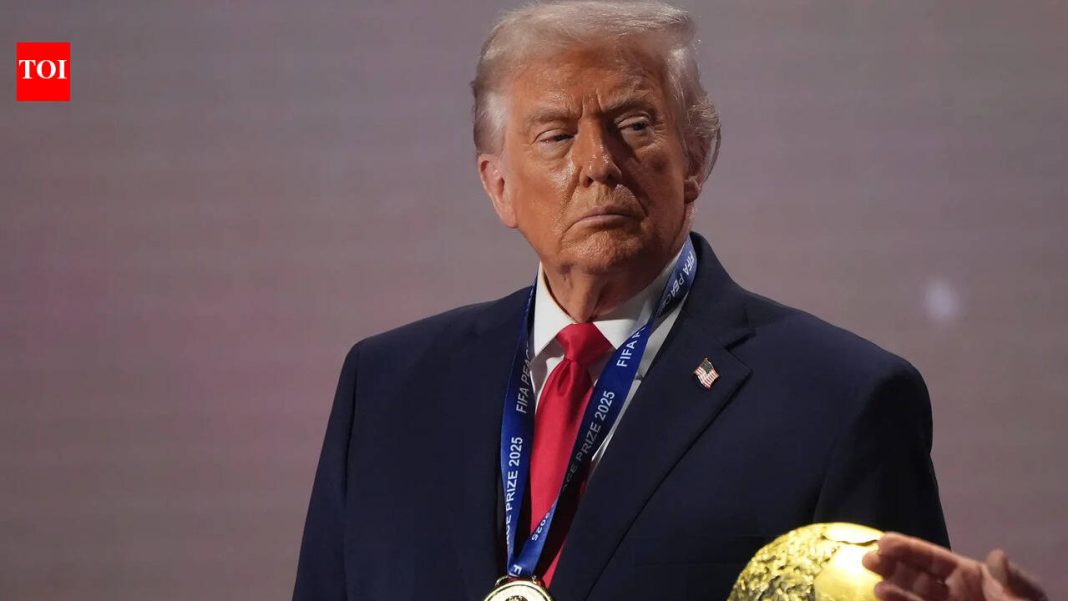
The world of sports, often hailed as a unifying force, frequently finds itself entangled in the intricate web of global politics. A recent exchange between former US President Donald Trump and Iran’s Foreign Ministry has once again highlighted this persistent friction, drawing significant attention as the FIFA World Cup in Qatar draws near. Trump’s suggestion to exclude Iran from the upcoming global football spectacle has elicited a strong, unequivocal rebuttal from Tehran, underscoring the complexities of separating athletic competition from international statecraft.
Trump’s Controversial Call and Tehran’s Resolute Response
The controversy ignited when former President Donald Trump, speaking at a rally, openly suggested that Iran should be prevented from participating in the FIFA World Cup. His rationale reportedly stemmed from long-standing US allegations against Iran regarding its nuclear programme, human rights record, and alleged support for regional militant groups. While not currently in office, Trump’s remarks carry weight given his past presidency and continued influence in US political discourse, particularly concerning foreign policy.
The reaction from Tehran was swift and firm. Iran’s Foreign Ministry spokesman, Nasser Kanaani, emphatically rejected Trump’s suggestion, asserting Iran’s sovereign right to partake in international events. Addressing the media, Kanaani declared, “No one can exclude us from international sports arenas or from the World Cup.” He stressed that sports should remain apolitical and free from undue influence, a principle often championed by international sporting bodies like FIFA. Kanaani further criticised Trump’s remarks as an attempt to politicise sports, calling them “meddlesome” and driven by “political objectives.” For Iran, participation in the World Cup is not merely about football; it is a matter of national pride and a demonstration of its presence on the global stage, despite geopolitical pressures.
The Iranian government views any attempt to bar its athletes as a violation of international sporting norms and an affront to its sovereignty. This stance resonates with many nations, including India, which often advocates for the non-politicisation of sports and culture, believing they serve as crucial bridges for understanding and cooperation between countries, irrespective of their political differences. The episode highlights the delicate balance international organisations like FIFA must maintain when faced with calls for exclusion based on political criteria.
Geopolitics on the Pitch: The Interplay of Sports and Statecraft
The friction between the US and Iran is a deeply entrenched narrative in international relations, characterised by decades of sanctions, diplomatic standoffs, and regional rivalries. In this context, the World Cup becomes more than just a football tournament; it transforms into another arena where these geopolitical tensions play out. While FIFA’s charter explicitly aims to keep politics out of sports, the reality is far more nuanced. National teams represent their respective countries, and their performance, presence, or absence often carries symbolic weight that extends far beyond the pitch.
For nations like India, which maintains a complex diplomatic relationship with both the United States and Iran, such political manoeuvring around sporting events is watched with keen interest. India has historically navigated a non-aligned path, advocating for dialogue and multilateralism. From an Indian perspective, the principle of a sovereign nation’s right to participate in international platforms, including sports, is paramount. Excluding a nation based on political disagreements risks setting a precedent that could undermine the universal spirit of sports and lead to greater fragmentation in international relations.
The call to exclude Iran is not an isolated incident. Throughout history, various nations have faced similar pressures or have themselves used boycotts as a political tool. However, the global nature of the FIFA World Cup, with its massive viewership and cultural significance, amplifies the stakes. For the host nation, Qatar, and for FIFA, the primary objective remains delivering a smooth tournament focused on the sport. Political distractions, especially those stemming from powerful global actors, inevitably complicate this objective and test the resolve of sporting bodies to uphold their non-political mandates.
As the World Cup draws closer, the incident serves as a stark reminder that even the “beautiful game” cannot always escape the shadows of geopolitical realities. Iran’s defiant response underscores a broader international sentiment that sporting participation is a right, not a privilege to be granted or revoked based on political whims. The challenge for the global community remains in finding ways to foster unity through sports, even amidst the clamour of political discord.

