


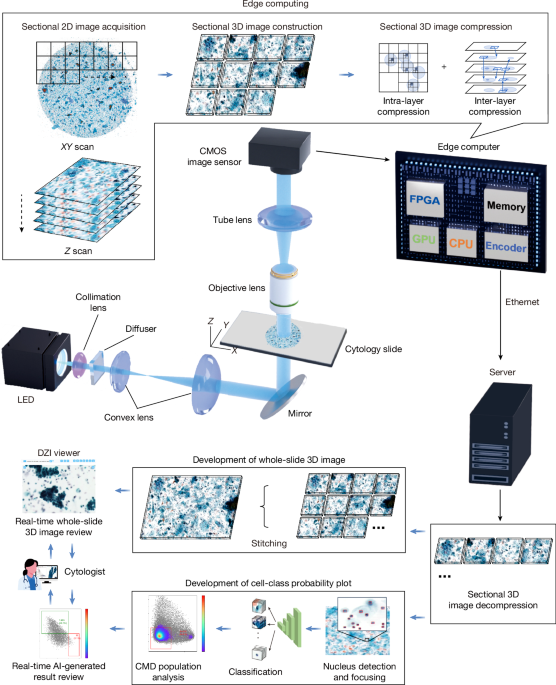
The field of medical diagnostics is witnessing a significant evolution, driven by advancements in artificial intelligence. A recent breakthrough promises to redefine how cell diseases are identified and characterized. This innovation centers on AI’s ability to provide clinical-grade diagnoses of complex cellular conditions, leveraging advanced full-slide imaging techniques that offer an unprecedented view into the microscopic world of human tissue.
Beyond the Magnifying Glass: The Rise of Digital Pathology
For decades, the cornerstone of diagnosing diseases like cancer, infections, and inflammatory conditions has been the microscopic examination of tissue samples by highly trained pathologists. This involves meticulously reviewing glass slides, a process that is both art and science, requiring immense skill, experience, and time. While invaluable, traditional pathology faces inherent limitations: it can be labor-intensive, subject to individual interpretation, and sometimes challenged by the sheer volume and complexity of the cellular changes present across an entire tissue section.
The advent of digital pathology began to transform this by digitizing entire microscope slides into high-resolution images. These whole-slide images (WSIs) allowed for easier sharing, remote consultation, and digital archiving. However, the true potential of these digital slides is now being unlocked by AI, moving beyond mere visualization to sophisticated, automated analysis.
AI’s Analytical Edge: Full-Slide Scans for Precision Diagnosis
The latest breakthrough lies in AI systems trained to not just identify anomalies, but to perform a clinical-grade diagnosis directly from these full-slide scans. This means the AI can achieve diagnostic accuracy comparable to, and in some cases even exceeding, that of human experts for specific tasks. These advanced algorithms are fed massive datasets of digitized tissue slides, annotated by expert pathologists, allowing them to learn incredibly subtle patterns, cellular morphologies, and spatial relationships that are indicative of various diseases.
What makes this particularly powerful is the AI’s capacity to analyze the entire slide, systematically and exhaustively. Unlike a human pathologist who can only examine a limited number of fields of view at high magnification, an AI can process every pixel of a gigapixel-sized image. This comprehensive analysis helps in identifying diffuse patterns, quantifying disease severity, and detecting minute changes that might be overlooked in a manual review due to human fatigue or the sheer scale of the information.
“The sheer scale and precision with which these AI systems can analyze entire tissue samples is truly transformative,” notes Dr. Anya Sharma, a lead researcher in computational pathology. “It allows us to catch subtle indicators that might otherwise be missed, paving the way for more targeted treatments and earlier intervention.“
Transforming Patient Care and Pathologist Workflow
The implications of clinical-grade AI diagnosis from full-slide scans are profound. For patients, it could mean faster and more accurate diagnoses, reducing anxious waiting times and enabling quicker commencement of treatment. For example, in oncology, precise and timely diagnosis of cancer type and stage is crucial for effective therapy planning. AI’s ability to rapidly sift through vast amounts of cellular data can accelerate this process significantly.
For pathologists, this technology isn’t about replacement but about
Looking Ahead: A New Era in Diagnostics
This breakthrough marks a significant step towards integrating AI more deeply into healthcare, particularly in areas requiring intricate visual analysis. As these systems continue to evolve and gain regulatory approvals, they are poised to become indispensable tools in the diagnostic laboratory. The fusion of advanced imaging, powerful AI, and human expertise promises a future where cell diseases are diagnosed with unprecedented precision, leading to more effective treatments and ultimately, improved patient outcomes.
The journey is ongoing, but the foundation for a new era of precision diagnostics, powered by intelligent machines working alongside skilled professionals, is firmly in place.

