


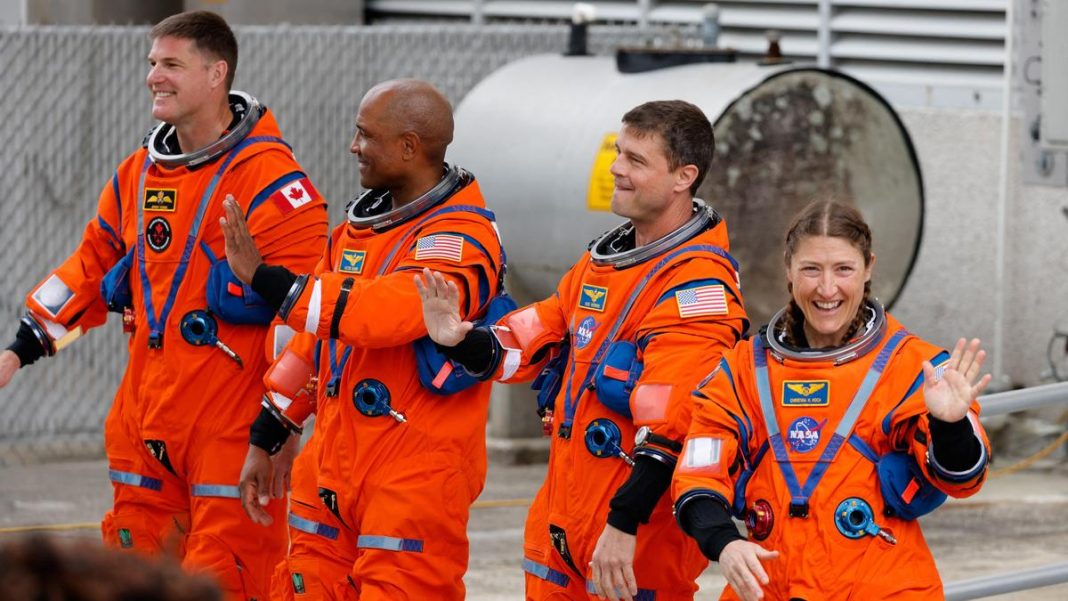
The global spotlight in space exploration is firmly fixed on Cape Canaveral, Florida, as NASA prepares for the historic launch of its uncrewed Moon flyby mission. This monumental endeavour, part of the ambitious Artemis programme, marks a critical first step towards humanity’s return to the lunar surface and eventual journeys to Mars. For India, a nation with its own burgeoning space prowess, NASA’s mission resonates deeply, symbolising a shared global quest for knowledge and discovery that pushes the boundaries of human ingenuity.
Gateway to Deep Space: The Artemis I Mission
At the heart of this mission is Artemis I, an uncrewed flight test designed to push the limits of NASA’s new deep space exploration systems. Poised atop the most powerful rocket ever built, the Space Launch System (SLS), is the Orion spacecraft, a marvel of engineering built to carry astronauts further than ever before. Artemis I isn’t just a mission; it’s a dress rehearsal for future crewed flights, validating the complex interplay of hardware, software, and operational procedures that will ultimately ferry humans to the Moon.
The mission profile is an intricate dance in space. After launch, the SLS will propel Orion into orbit before its upper stage sends the capsule on a trajectory towards the Moon. Orion will then embark on a journey that will take it thousands of kilometres beyond the Moon, performing a flyby, and collecting vital data before returning to Earth. The duration of this mission, approximately 4-6 weeks, will test Orion’s systems, from its advanced navigation and communication capabilities to its robust life support systems, under the extreme conditions of deep space.
A Test of Endurance and Innovation
A primary objective of Artemis I is to rigorously test Orion’s heat shield during its fiery re-entry into Earth’s atmosphere. This critical component must withstand temperatures approaching 2,760 degrees Celsius (5,000 degrees Fahrenheit), generated by friction as the spacecraft slams into the atmosphere at speeds exceeding 39,400 kilometres per hour (24,500 miles per hour). Success here is paramount, as a failure would jeopardise the safety of future astronaut crews. The mission will also assess Orion’s overall performance, attitude control, power generation, and the integrity of its structural components after prolonged exposure to the harsh vacuum and radiation of deep space.
Engineers and scientists globally will be keenly observing every phase, from launch to splashdown. Every piece of data collected will be invaluable, informing the design and operation of subsequent Artemis missions, including Artemis II, which will carry astronauts on a lunar flyby, and Artemis III, which aims to land the first woman and person of colour on the Moon.
As Bill Nelson, NASA Administrator, succinctly put it, “Artemis I will demonstrate our commitment and capability to extend human existence to the Moon and beyond. It’s a foundational mission that will enable future human exploration of Mars.”
India’s Space Aspirations and Global Collaboration
For India, NASA’s ambitious undertaking resonates with the nation’s own impressive strides in space exploration. ISRO’s Chandrayaan missions have already demonstrated India’s capability to reach the Moon, with Chandrayaan-1 discovering water molecules and Chandrayaan-2 providing valuable insights into the lunar south pole. The upcoming Chandrayaan-3 mission further solidifies India’s commitment to lunar science and exploration.
The spirit of global collaboration in space is becoming increasingly vital. India’s decision to sign the Artemis Accords, a set of principles guiding peaceful and sustainable space exploration, highlights its commitment to responsible space activities and potential future partnerships. NASA’s lunar flyby mission serves not just as an American endeavour, but as an inspiration for all spacefaring nations, including India, to pursue their own lunar and interplanetary dreams, contributing to a collective human legacy of discovery. It underscores the idea that while nations may have individual missions, the ultimate quest for understanding the cosmos is a shared human enterprise.
As the countdown progresses for this landmark mission, the world watches with bated breath. NASA’s Moon flyby is more than just a test flight; it’s a beacon of humanity’s enduring desire to explore, understand, and ultimately, extend its presence beyond Earth. Its success will undoubtedly usher in a new era of lunar exploration, paving the way for boots on the Moon once again, and charting a course for even grander voyages to the Red Planet.

