


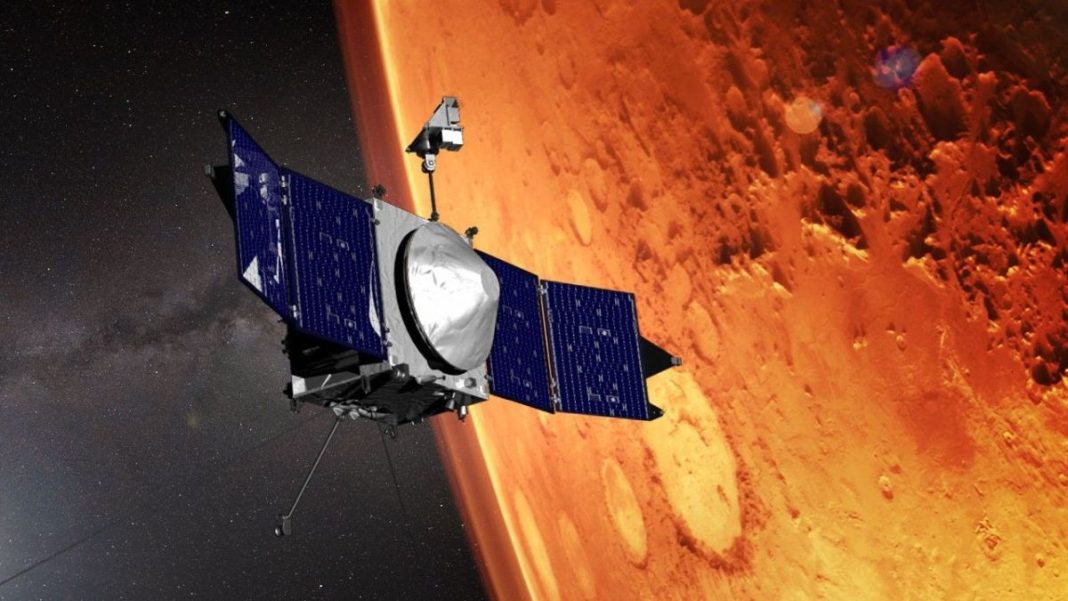
The vast, silent expanse of space often reminds us of both humanity’s incredible reach and its inherent limitations. NASA has recently confirmed a stark illustration of the latter: it has lost communication with the Mars Atmosphere and Volatile Evolution (MAVEN) orbiter, a veteran spacecraft that has been meticulously studying the Red Planet’s atmosphere for years.
This news sends ripples through the planetary science community, as MAVEN isn’t just another probe; it’s a key player in our understanding of how Mars transformed from a potentially habitable, wetter world into the arid desert we see today. The mission control teams are now working tirelessly to re-establish contact, highlighting the persistent challenges of operating spacecraft millions of miles away.
MAVEN’s Indispensable Mission at Mars
Launched with the primary goal of unraveling the mysteries of Mars’ atmospheric loss, MAVEN has been an invaluable scientific asset. Its instruments are designed to measure how solar wind and radiation strip gases from the Martian upper atmosphere, directly impacting the planet’s ability to retain liquid water on its surface. By studying these processes, scientists gain crucial insights into the planet’s climatic history and its potential for past life.
Beyond its groundbreaking atmospheric research, MAVEN also serves a critical secondary role: acting as a communications relay for NASA’s surface missions, including the Perseverance rover and InSight lander. This dual functionality underscores its importance to the ongoing exploration efforts on and around Mars. Its data has been pivotal in painting a clearer picture of Martian evolution, revealing the complex interplay between the planet, its atmosphere, and the sun.
The Silent Treatment: Understanding the Communication Loss
According to NASA, communication with MAVEN ceased recently, prompting immediate investigation. While the exact cause remains under active examination, the challenges of deep-space communication are myriad. Potential culprits often include issues with the spacecraft’s transponder, an unexpected change in its orientation that prevents its antenna from pointing correctly towards Earth, or even power-related anomalies. Each of these scenarios presents a complex diagnostic puzzle for engineers.
NASA’s Deep Space Network, a global array of massive radio antennas, is actively listening for any signal from MAVEN, while teams on Earth are sending commands in an attempt to prompt a response. This process is akin to trying to contact a friend across a crowded stadium, hoping they’re listening and looking in your direction. The immense distances involved mean even light-speed communication takes minutes, making real-time troubleshooting impossible.
A veteran of several deep-space missions recently remarked, “These spacecraft are marvels of engineering, but they’re also operating in an incredibly harsh, unforgiving environment. Losing contact, while always disheartening, is a stark reminder of the immense distances and the subtle complexities involved.” This sentiment captures the delicate balance between technological prowess and the unforgiving nature of the cosmos.
The Path Forward
As the teams at NASA continue their dedicated efforts to regain contact with MAVEN, the situation serves as a poignant reminder of the inherent risks and rewards of space exploration. Every deep-space mission pushes the boundaries of engineering and human ingenuity, but also operates at the mercy of immense distances, radiation, and the inevitable wear and tear over time.
While the immediate focus is on re-establishing communication, the legacy of MAVEN’s scientific contributions is already firmly cemented. Its data has significantly advanced our understanding of Mars, shaping future missions and inspiring new generations of scientists. The space community holds cautious hope for its recovery, but regardless of the outcome, MAVEN’s role in decoding the Red Planet’s past will continue to influence our journey to Mars for years to come.

