


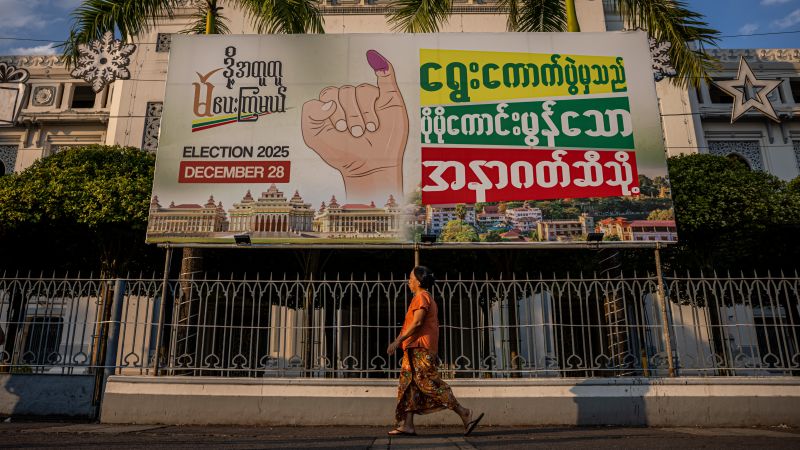
Myanmar, a nation scarred by decades of military rule and now engulfed in a fierce civil war, stands at a perplexing juncture. The State Administration Council (SAC), the military junta that seized power in a 2021 coup, has proceeded with holding elections. This move has unfolded amidst widespread armed resistance and deepening humanitarian crises, painting a stark picture of a country where the ballot box is presented as a solution while the battlefield rages on.
For India, a contiguous neighbour with significant strategic and economic interests, the unfolding situation in Myanmar presents a complex geopolitical dilemma. As New Delhi navigates its “Act East” policy and secures its porous border, the junta’s electoral exercise, deemed illegitimate by many, adds another layer of instability to an already volatile region.
A Contested Mandate Amidst Turmoil
The military junta’s rationale for holding elections is ostensibly to restore a semblance of constitutional order and legitimacy following its ouster of the democratically elected government led by Aung San Suu Kyi. However, the conditions under which these elections are being conducted have drawn widespread condemnation. Major opposition parties, including the National League for Democracy (NLD), have been dissolved or barred from participating, their leaders imprisoned or in hiding. Significant portions of the country remain under martial law or are active conflict zones, making genuine voter participation and oversight virtually impossible.
Critics argue that these elections are nothing more than a carefully orchestrated facade designed to consolidate military power and legitimize its rule. The National Unity Government (NUG), formed by deposed lawmakers and anti-junta activists, along with numerous ethnic armed organizations (EAOs), has unequivocally rejected the polls, labelling them a sham. Reports from human rights groups and international observers suggest a climate of fear and suppression, where dissent is met with severe repression, further undermining any claim of a free and fair electoral process.
The SAC’s decision to press ahead despite the ongoing conflict underscores its determination to create a political framework amenable to its continued dominance, rather than seeking a genuine reconciliation with the diverse political aspirations of the Myanmarese people.
India’s Delicate Balancing Act and Regional Implications
Myanmar’s internal strife casts a long shadow over its neighbours, particularly India. The 1,600-kilometre border shared between the two nations has become a conduit for refugees fleeing the violence, particularly into India’s northeastern states like Mizoram and Manipur. This influx places considerable strain on local resources and raises security concerns regarding potential insurgent activity and drug trafficking.
From a strategic perspective, India cannot afford to ignore Myanmar. It is a critical component of India’s “Act East” policy, providing a land bridge to Southeast Asia. Projects like the Kaladan Multi-Modal Transit Transport Project are vital for connecting India’s landlocked northeastern states to the Bay of Bengal. However, engaging with a junta that has overthrown a democratic government presents a moral and diplomatic quandary for New Delhi.
While Western nations have largely imposed sanctions and isolated the junta, India, like other regional players, has adopted a more cautious approach, emphasising engagement and dialogue. New Delhi’s stance is shaped by a complex interplay of factors: countering China’s growing influence in Myanmar, managing border security, and preserving strategic connectivity. Balancing these pragmatic geopolitical imperatives with democratic values is a tightrope walk.
As an Indian foreign policy analyst recently observed, “India’s policy towards Myanmar is a classic example of realpolitik intersecting with democratic ideals. While we advocate for a return to democracy, our strategic compulsions demand a practical engagement to ensure stability at our borders and protect our interests. It’s a pragmatic necessity, albeit a difficult one, in a turbulent neighbourhood.”
The Association of Southeast Asian Nations (ASEAN) has also struggled to formulate a unified and effective response, with its “Five-Point Consensus” for peace largely unimplemented, highlighting the internal divisions and external limitations in addressing the crisis.
The Elusive Path to Stability
The elections, held in the shadow of a raging civil war, are unlikely to bring stability or legitimacy to Myanmar. Instead, they risk further entrenching the military’s grip on power and deepening the chasm between the junta and the resistance forces. The humanitarian situation continues to deteriorate, with millions displaced, a collapsing economy, and widespread human rights abuses reported daily.
True stability in Myanmar can only emerge from an inclusive political dialogue that respects the democratic aspirations of its people and involves all stakeholders, including the NUG, ethnic armed groups, and civil society. A unilateral electoral exercise, devoid of genuine participation and transparency, will only prolong the conflict and exacerbate the suffering.
The international community, including India, faces the ongoing challenge of encouraging a return to democracy and peace while navigating the harsh realities of geopolitical interests. The path ahead for Myanmar remains fraught with peril, with its people caught between the ambition of a military regime and the yearning for genuine freedom and stability.
In conclusion, Myanmar’s military junta’s decision to hold elections amidst a raging civil war is a move that has further complicated the already volatile situation. While intended to legitimize the regime, these polls are widely seen as a mockery of democracy, deepening divisions and prolonging the suffering of the Myanmarese people. For India, the crisis continues to pose significant strategic, humanitarian, and diplomatic challenges, demanding a nuanced approach that prioritizes long-term stability and democratic values in its immediate neighbourhood.

