


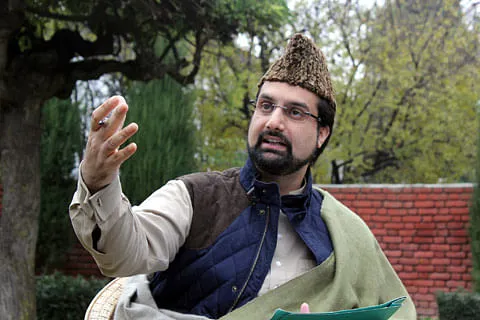
In a notable development reflecting the evolving political landscape of Jammu and Kashmir, Mirwaiz Umar Farooq, the prominent Kashmiri cleric and moderate separatist leader, has removed the designation of ‘Hurriyat chairman’ from his X (formerly Twitter) profile. The subtle yet significant change, which now simply identifies him as “Mirwaiz Umar Farooq” with a focus on his religious and spiritual role, has sparked considerable discussion and speculation across political circles and among observers of the region.
For decades, the title ‘Hurriyat chairman’ has been synonymous with a particular brand of politics in Kashmir – one advocating for self-determination and often at odds with the Indian state. Mirwaiz, as the head of the All Parties Hurriyat Conference (APHC) (M) faction, has been a key voice in this discourse. His decision to drop the designation from a widely followed social media platform is being interpreted by many as a strategic recalibration, possibly signaling a shift in focus or an acknowledgment of the altered ground realities in the Union Territory.
The Legacy of Hurriyat and Mirwaiz’s Role
The All Parties Hurriyat Conference was formed in 1993 as a conglomerate of various separatist political, social, and religious organizations in Jammu and Kashmir. Its primary objective was to facilitate dialogue and represent the aspirations of the Kashmiri people for self-determination. Over the years, the Hurriyat split into factions, with the Mirwaiz leading the relatively moderate wing, often advocating for a peaceful resolution through dialogue with both India and Pakistan.
Mirwaiz Umar Farooq himself inherited the mantle of Mirwaiz-e-Kashmir, the traditional spiritual leader of Kashmiri Muslims, at a young age after the assassination of his father, Mirwaiz Mohammad Farooq, in 1990. His dual role as a spiritual authority and a political leader made him a unique figure in Kashmir’s complex socio-political fabric. While he often championed the cause of Kashmiri separatism, he was also known for his emphasis on dialogue and non-violent means. His consistent calls for peace and resolution earned him a reputation as a moderate voice within the separatist camp, distinct from more hardline elements.
However, the political space for separatist outfits in J&K has significantly shrunk, particularly following the abrogation of Article 370 in August 2019. The central government has adopted a firm stance against separatist narratives, leading to a visible decline in their public activities and influence. Mirwaiz himself spent nearly four years under house arrest post-2019, only to be released in September 2023, primarily resuming his religious duties, including delivering sermons at Srinagar’s historic Jamia Masjid.
Interpreting the Designation Removal
The removal of ‘Hurriyat chairman’ from Mirwaiz’s X profile is a symbolic gesture that invites multiple interpretations. On one hand, it could be seen as a pragmatic response to the changed political climate. With the Hurriyat Conference largely dormant and its leaders facing increased scrutiny, maintaining such a designation might be viewed as an unnecessary provocation or simply outdated. The move could signify an attempt to de-emphasize his political affiliation in favor of his primary religious and spiritual identity, especially as he has been allowed to resume his traditional religious duties.
On the other hand, some analysts suggest it might indicate a broader shift in strategy. It could be an acknowledgment of the diminished efficacy of traditional separatist politics and a subtle signal towards exploring new avenues for engagement, or even a focus on internal community building rather than direct confrontation with the state. The Indian government’s consistent push for mainstreaming politics in J&K could also be a factor, with leaders being encouraged to shed overtly separatist identities to participate in the political process.
“This move by Mirwaiz Umar Farooq, while subtle, holds significant symbolic weight in the current Kashmiri context,” notes a Srinagar-based political analyst. “It reflects a pragmatic adaptation to a profoundly altered political reality where traditional separatist labels carry different implications than they did even a few years ago. It’s a moment of introspection for the entire separatist discourse.”
A Glimpse into J&K’s Future
The alteration of Mirwaiz Umar Farooq’s social media profile arrives at a crucial juncture for Jammu and Kashmir. As the region gradually moves towards normalcy and the prospect of assembly elections looms, every political gesture, no matter how small, is scrutinized for its underlying message. The fading prominence of separatist politics and the increasing focus on development and governance by the central government suggest a new era for J&K.
Mirwaiz’s decision might be a precursor to a more nuanced engagement with the region’s future, one where the focus shifts from a contested past to a more integrated future. While the full implications remain to be seen, this small but telling change on a digital platform underscores the ongoing transformation within Kashmir’s political and social landscape, pointing towards a possible re-evaluation of roles and strategies by its traditional leaders.
The move serves as a subtle indicator of the evolving political narrative in Jammu and Kashmir, where traditional symbols of separatism are either being shed or reinterpreted in the face of new realities.

