


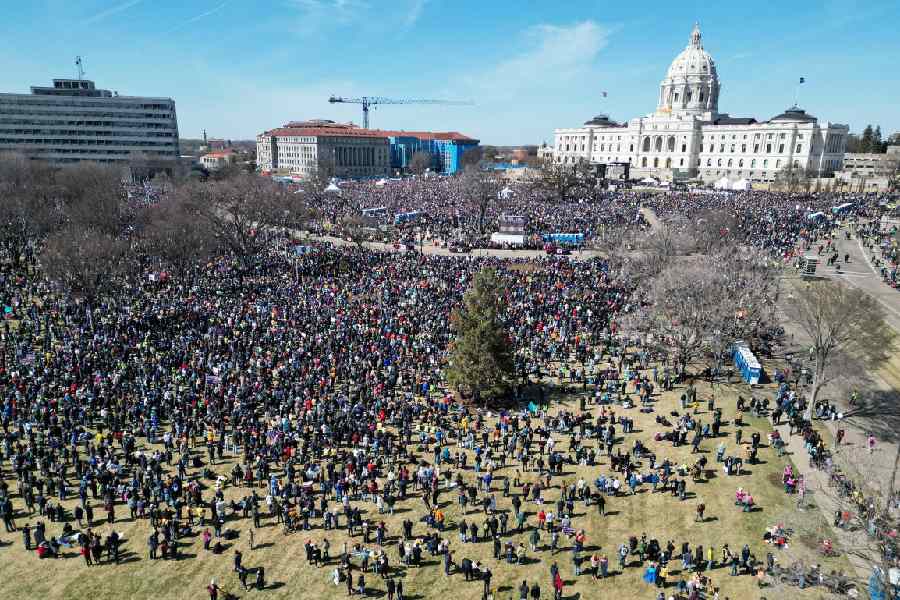
Across major cities in the United States and Europe, millions of citizens recently took to the streets in a powerful display of dissent, coalescing under the evocative banner of ‘No Kings’. These widespread demonstrations, marked by their sheer scale and fervent energy, were primarily a repudiation of specific policies enacted by the Trump administration and a stark warning against the perceived escalation towards a potential conflict with Iran. For India, a nation deeply invested in global stability and navigating complex geopolitical shifts, these transatlantic rallies carry significant implications, underscoring the interconnectedness of international politics and the enduring power of citizen voice.
The Roar of ‘No Kings’: A Transatlantic Uprising
From the bustling squares of Washington D.C. and New York to the historic avenues of London, Paris, and Berlin, protestors congregated in unprecedented numbers, transforming urban landscapes into vibrant arenas of political expression. The ‘No Kings’ slogan, prominently displayed on banners and chanted by crowds, served as a potent symbol of defiance against what many perceive as an increasingly autocratic style of governance and a rejection of unilateral decision-making. The grievances were multifaceted, reflecting a deep disillusionment with various facets of the Trump presidency.
Key among the protested policies were the administration’s stances on immigration, including the controversial family separations at the border and travel bans impacting Muslim-majority countries. Environmental policies, particularly the withdrawal from the Paris Climate Accord and the rollback of various protections, also fueled significant anger. Furthermore, perceived attacks on democratic institutions, healthcare reforms, and trade protectionism were frequently cited as motivations for attendance. However, a unifying and particularly urgent concern driving many to the streets was the palpable fear of a military confrontation with Iran. Rising tensions in the Persian Gulf, coupled with increasingly hawkish rhetoric, ignited widespread apprehension that diplomatic solutions were being sidelined in favour of a path to war.
The protests showcased a diverse coalition of activists, from seasoned political organizers to first-time protestors, united by a common desire for a more inclusive, just, and peaceful world order. The sheer visibility and sustained energy of these movements signal a significant awakening of civic engagement, reminding political leaders that public opinion remains a powerful force that cannot be ignored.
Geopolitical Ripple Effects: India’s Stake in Western Stability
For India, a nation with burgeoning economic ties and strategic partnerships across the globe, the stability of the Western world is not merely an external affair but a direct determinant of its own trajectory. The ‘No Kings’ protests, while focused on American and European domestic and foreign policy, resonate deeply within the Indian context on several fronts.
Firstly, the looming threat of an Iran war poses a substantial challenge to India’s energy security and regional stability. India relies heavily on oil imports from the Middle East, and any conflict in the Persian Gulf would inevitably disrupt supply chains, escalate oil prices, and potentially destabilize a region where millions of Indian expatriates reside and contribute significantly to remittances. India’s strategic investment in Iran’s Chabahar Port, vital for trade access to Afghanistan and Central Asia, would also face severe jeopardy. The calls for de-escalation and diplomatic engagement voiced by protestors align with India’s long-standing foreign policy of advocating for peaceful resolutions to international disputes.
Secondly, the economic ramifications of sustained political instability in major global economies directly impact India’s growth prospects. Uncertainty in the US and European markets can lead to reduced foreign investment, volatile financial markets, and challenges for India’s export-driven sectors, particularly IT and manufacturing. India, as the world’s largest democracy, also observes these democratic expressions with keen interest, acknowledging the universal commitment to free speech and the right to peaceful assembly, principles deeply enshrined within its own constitutional framework.
A Call for Accountability and Multilateralism
Beyond the immediate grievances, the ‘No Kings’ protests represent a broader global yearning for accountability from leaders and a reaffirmation of multilateralism in an increasingly complex world. They are a powerful rejection of perceived authoritarian tendencies and a demand for governance that respects international norms and human rights. As one demonstrator in London was quoted saying, “This isn’t just about one man; it’s about the erosion of democratic norms and the threat of reckless conflict. We are here to say that the people have a voice, and we will not be silenced by those who act like kings.” This sentiment encapsulates the core message: that leadership must be responsive to its citizens and adhere to a global framework of cooperation rather than unilateralism.
For India, navigating its role as a rising power, these protests serve as a crucial reminder of the importance of robust democratic institutions, the vitality of civil society, and the imperative of fostering a stable, rules-based international order. The clamour for peace and responsible leadership from citizens in the US and Europe is not just their local narrative but a global one, echoing the aspirations of billions worldwide, including in India, for a future defined by collaboration over conflict.
The ‘No Kings’ protests underscore a fundamental truth: in an interconnected world, the actions of powerful nations, and the reactions of their citizens, have a profound and far-reaching impact. As India continues its journey towards economic prosperity and geopolitical influence, understanding and engaging with these global currents of public opinion will be paramount.

