


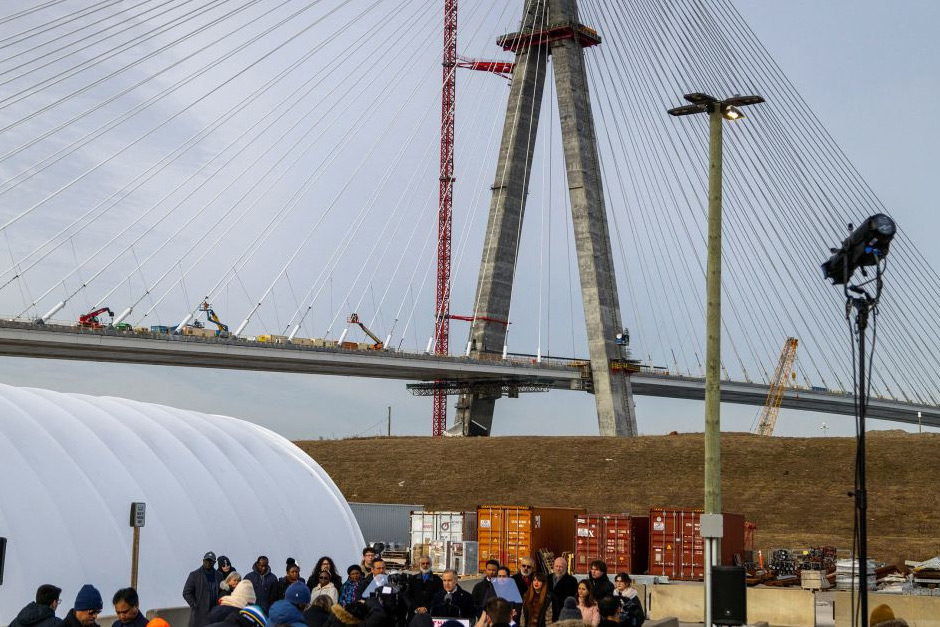
In a political landscape often defined by surprising turns, a recent development regarding the Gordie Howe International Bridge has left many scratching their heads. Amidst a critical infrastructure project nearing completion, former President Donald Trump reignited his demand that Canada “pay up” for the bridge, threatening significant tariffs on Canadian-made cars if his demand isn’t met. What’s perhaps even more startling is the prompt and unwavering stand taken by Michigan’s GOP leaders, who have thrown their support behind Trump’s controversial threats. This alliance signals a peculiar political calculus, one that seemingly prioritizes partisan loyalty over direct economic realities for the state that birthed the automotive industry.
The Bridge That’s Already Built (Almost)
The Gordie Howe International Bridge is more than just a crossing; it’s a vital artery connecting Detroit, Michigan, with Windsor, Ontario, promising to enhance trade, tourism, and economic cooperation between the two nations. This ambitious project, spearheaded primarily by Canada, is already well underway and on track for completion. The vast majority of its funding has been secured and committed by Canada, underscoring its immense importance to cross-border logistics and trade. Estimates suggest it will be one of the busiest land border crossings in North America, crucial for the flow of goods – especially automotive parts and finished vehicles – between the U.S. and Canada.
Given these facts, Trump’s renewed demands for Canada to “reimburse” the U.S. for a bridge Canada is largely funding, coupled with threats of steep tariffs on Canadian-made cars, strikes many as a bewildering proposition. The logic behind demanding payment for a project that’s already financed and nearing completion by the other party is difficult to reconcile with conventional understanding of international agreements and infrastructure development. Such a move risks disrupting established trade relationships and imposing economic penalties without clear justification, raising questions about the stability and predictability of U.S. trade policy.
Michigan GOP’s Unwavering Stance Amidst Economic Storm Clouds
Perhaps the most perplexing aspect of this entire saga is the endorsement of Trump’s threats by Michigan’s top Republican officials. Michigan is, at its heart, an automotive state. Its economy is deeply intertwined with the auto industry, which relies heavily on a seamless and tariff-free supply chain that stretches across the U.S.-Canada border. Components often cross the border multiple times before a vehicle is fully assembled, making any disruption, particularly in the form of tariffs, a direct hit to the state’s economic vitality and the livelihoods of its citizens.
Supporting tariffs on Canadian-made cars, therefore, presents a significant paradox for a state that prides itself on its automotive heritage. It’s a position that has baffled economists and political observers alike, given Michigan’s deep ties to the industry and its reliance on cross-border trade. Many view this as a clear example of political alignment taking precedence over practical economic considerations, potentially exposing Michigan businesses and consumers to unnecessary financial strain. The implications could ripple through the industry, leading to higher production costs, increased consumer prices, and even job losses within the state.
As one economic analyst, Dr. Evelyn Reed, recently observed, “Threatening tariffs on Canadian vehicles directly undermines the very industry Michigan is built upon. It’s a classic case of cutting off your nose to spite your face, especially when the issue at hand – bridge funding – is already resolved. The political calculus here seems entirely divorced from economic reality.” Her comment highlights the disconnect between the political rhetoric and the tangible risks to Michigan’s economy.
The Political Road Ahead
The decision by Michigan GOP leaders to stand by Trump’s Gordie Howe Bridge threats, despite the clear and present danger to their state’s primary industry, underscores the complex interplay of national politics, trade policy, and local economic interests. It signals a continued adherence to a political strategy that prioritizes loyalty and a particular brand of economic nationalism, even when it appears to contradict the immediate best interests of the constituents it purports to serve. As the Gordie Howe Bridge inches closer to its grand opening, the political standoff surrounding its funding and the threats of trade war loom large, casting a shadow over what should be a celebration of international cooperation and shared prosperity. The road ahead for U.S.-Canada relations, particularly concerning trade, remains uncertain, with Michigan caught squarely in the crosscurrents of this peculiar political storm.
—

